



Sudoku X-Wing pattern usually arrives at the exact moment a grid starts to feel rude. The easy singles are gone. The obvious rows have stopped giving answers. Your notes are spreading across the page like weeds, and every empty cell seems to be whispering "maybe."
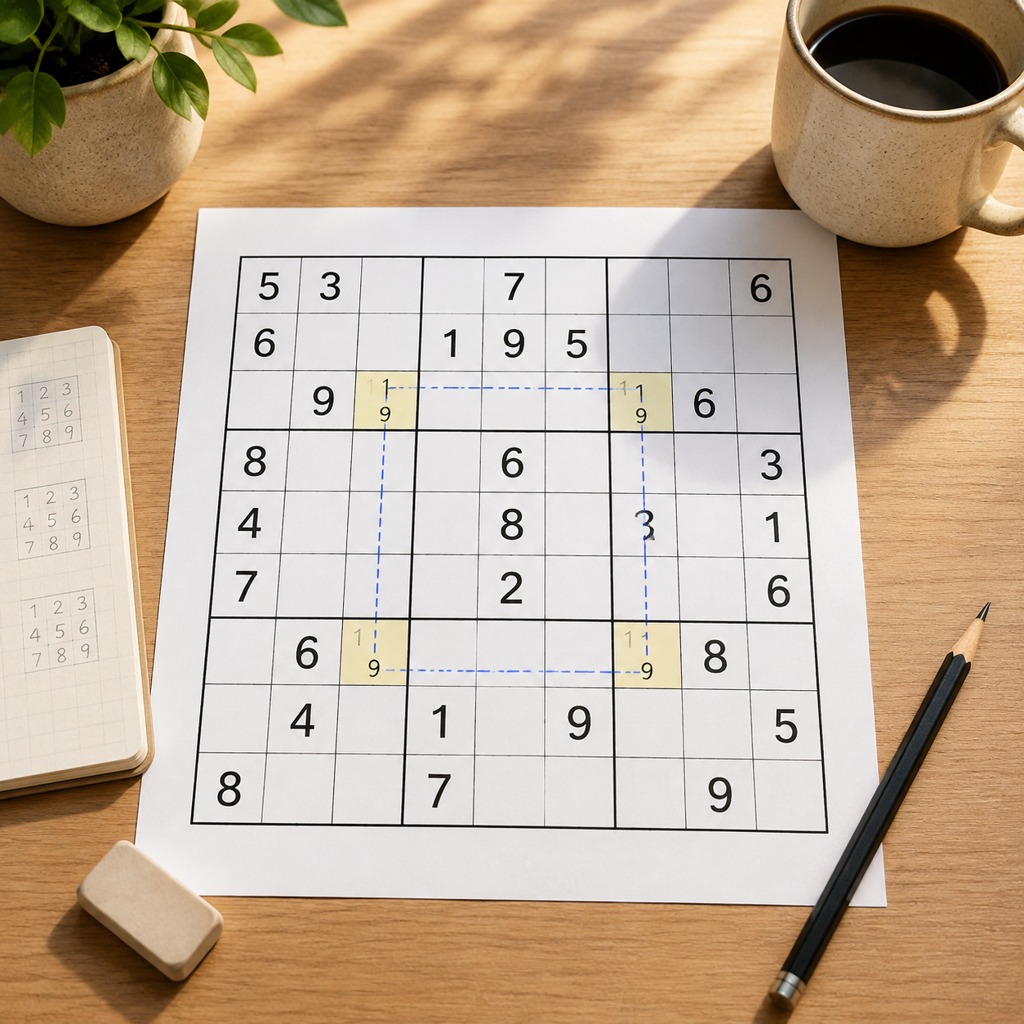
Then four little candidates line up in a rectangle.
That is the part most players miss at first. The Sudoku X-Wing pattern is not a magic placement. It is a cleanup move. It tells you where one digit cannot go, which is often enough to make the next real answer appear.
If you like number puzzles on Easy Daily Puzzle, this is a good technique to learn slowly because it sits right between comfortable Sudoku and the more serious logic patterns. You can also browse more number-grid ideas through Easy Daily Puzzle Sudoku articles when you want another small technique for your next break.
Sudoku X-Wing pattern starts with one digit
The base Sudoku rule stays beautifully plain. Nikoli's Sudoku page describes the classic job: place 1 through 9 so every row, column, and 3x3 block contains each digit once. No arithmetic. No guessing. Just placement by proof.
The Sudoku X-Wing pattern begins after those basic checks have slowed down. Pick one digit, not the whole grid. Maybe you are hunting 7s. Maybe 4s. The number itself does not matter. What matters is whether that digit has only two possible cells in each of two separate rows, and whether those two rows share the same two columns.
That sounds abstract until you draw it. Four candidate cells become the corners of a rectangle. The digit must appear once in each of the two rows. Because the possible columns match, the digit will occupy one diagonal pair or the other. Either way, no other copy of that digit can survive in those two columns.
SudokuWiki's X-Wing strategy page explains the same idea through rows and columns: when two rows each have only two possible spots for a value, and those spots sit in the same columns, other candidates for that value can be removed from the columns.
That is the whole trick. The rectangle does not solve all four corners. It cleans the lines running through them.
Sudoku X-Wing pattern is a removal tool
This is where many players get frustrated. They spot the four corners and expect one of them to become the answer immediately. Usually it does not.
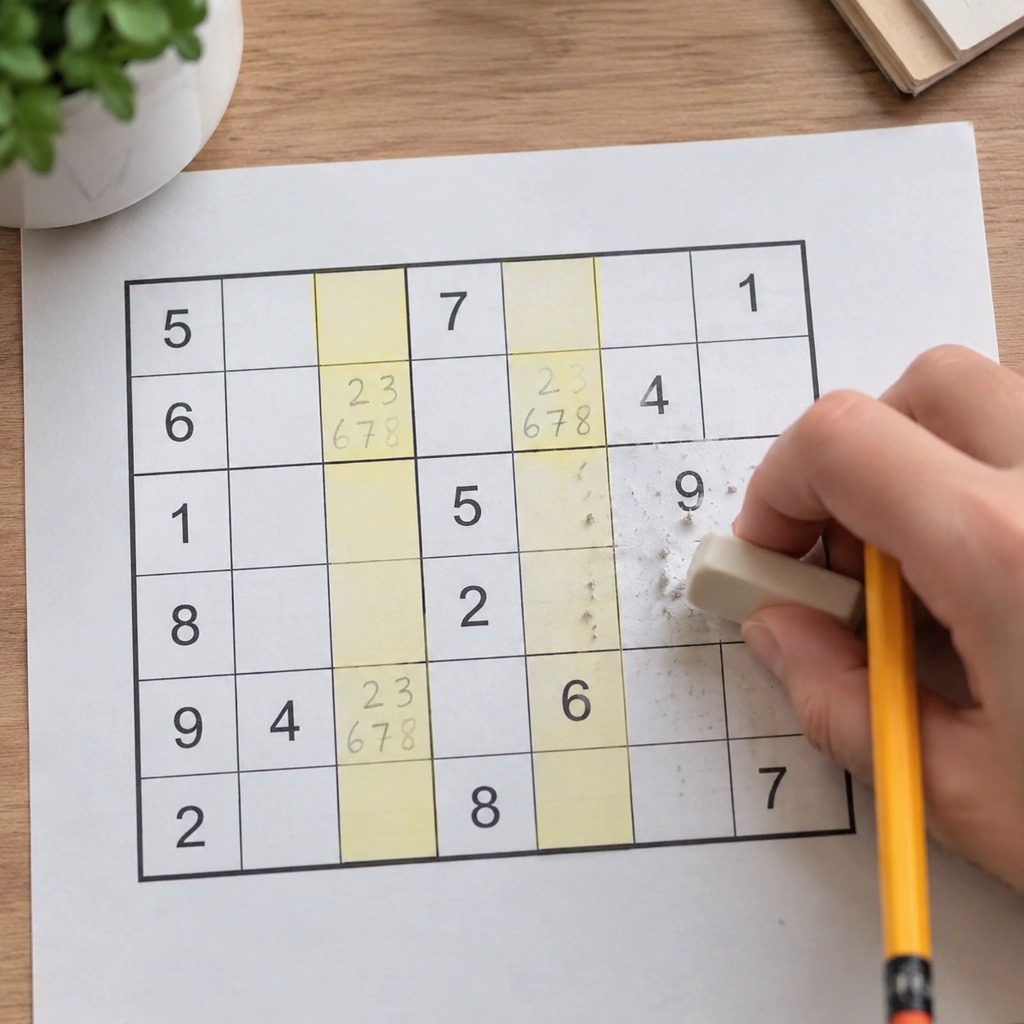
The Sudoku X-Wing pattern is more like finding a bad note and crossing it out. If your four corners involve candidate 7, the pattern may let you remove other 7s from the same two columns. One of those removed 7s might leave a cell with only one candidate. Or it might clean a box enough for a hidden single. Or it may simply make the grid less cluttered.
That can feel underwhelming if you wanted fireworks. But Sudoku is often won by boring little removals. A good grid does not always hand you a dramatic number. Sometimes it gives you permission to erase the one note that has been blocking the next step.
Think of the pattern this way: you are not choosing between the four corners yet. You are proving that the digit is trapped inside those corners, so it has no business appearing elsewhere on the matching lines.
How to search for a Sudoku X-Wing pattern without staring
The worst way to find an X-Wing is to stare at the whole grid and hope a rectangle appears. That turns Sudoku into wallpaper.
Use a narrower scan.
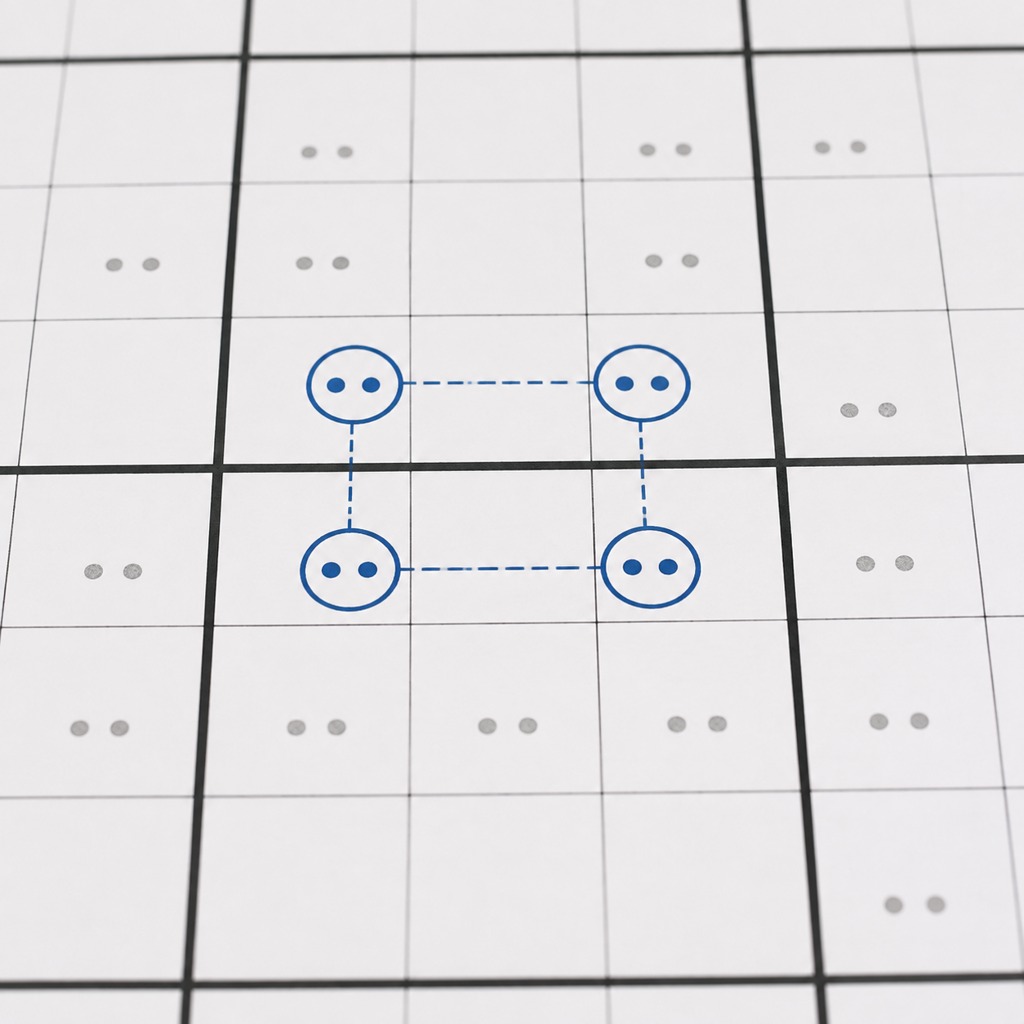
Start with one digit that already has several placements or candidates. Look across the rows. Does any row have exactly two possible spots for that digit? If yes, mark that pair with your eyes. Then ask whether another row has the same two columns for that same digit.
If the answer is no, move on. Do not force it.
If the answer is yes, check the columns running through those four cells. Any other candidate of the same digit in those columns can be removed, unless it is one of the four corners. The same logic works in the other direction: two columns can form the pattern and remove candidates from rows.
A clean routine:
1. Pick one digit.
2. Scan rows for exactly two candidate positions.
3. Compare those row pairs by column.
4. If two rows match, check the matching columns.
5. Remove only that same digit from outside the four corners.
That last line is important. Do not remove every candidate from those cells. Do not place the digit just because the rectangle looks neat. The Sudoku X-Wing pattern has a precise job.
Why this pattern feels harder than it is
The hard part is not the logic. The hard part is seeing it through messy notes.
Beginners often write too many candidates too early. By the time the grid reaches a medium-hard stage, every cell is crowded. The X-Wing is there, but it is buried inside tiny numbers. The player's eyes bounce around until all rectangles look possible.
The fix is not to become faster. The fix is to scan with a smaller question.
Ask: "Where can 5 go in this row?" Not "what is the next answer?" That question is calmer. It lets you read the grid as a set of constraints instead of a pile of maybes.
There is also a little emotional trap here. A Sudoku X-Wing pattern often appears when you feel stuck, so the first rectangle you notice can feel precious. Be skeptical. The two rows must each have exactly two candidate positions for the same digit, and the columns must match. Close enough is not enough.
If one row has a third possible spot, the pattern breaks. If the columns do not line up, the pattern breaks. If you are looking at two different digits, the pattern breaks.
Annoying? A bit. Useful? Very.
The newspaper habit behind the modern grid
Sudoku became popular partly because it asks for proof in a compact space. Nikoli notes that the puzzle came to Japan from an American magazine under the name "Number Place" and was later shortened to "Sudoku." That little naming history matters because it explains the game's staying power. The grid travels well. A row is a row in any language.
The X-Wing fits that same spirit. It looks like an advanced trick, but it is still built from the ordinary rule that each row and column can hold a digit only once.
That is why the technique belongs in a casual puzzle routine. You do not need to memorize a wall of advanced strategy names. You need one calm way to handle the moment when singles are gone and the grid still has a lot to say.
If the pattern does not appear today, fine. Most grids do not need it. But learning to search for it teaches a better habit anyway: isolate one digit, read its possible homes, and let the rows and columns argue before you guess.
A better next grid with Sudoku X-Wing pattern
Try this on your next medium or hard Sudoku. Do your normal scan first. Fill the numbers that are actually forced. Clean obvious notes. Then, before guessing, pick one digit and look for rows with exactly two positions.
You may find nothing. That is still practice.
You may find two matching rows. If so, pause before celebrating. Check the columns. Remove only the outside candidates that the pattern truly eliminates. Then look again at the affected cells, boxes, and rows.
The small pleasure of the Sudoku X-Wing pattern is that it feels quiet after you understand it. Four corners. One digit. A few false notes gone.
The grid does not have to become easy. It just has to become readable again.