



Jigsaw puzzle depth layers are useful when color stops being useful. A patch of green may belong to a leaf in the foreground, a hill halfway across the picture, or a soft background behind both. If those pieces sit in one large green pile, every comparison becomes vague.
Distance gives the pile a second label.
Foreground pieces usually have sharper edges, stronger contrast, and more obvious objects. Background pieces often have softer texture, wider color changes, and fewer hard lines. The middle ground sits between them. It may contain a roofline, a tree row, a road, or a shadow that connects the clear object to the distant scene.
Jigsaw puzzle depth layers begin with overlap
The quickest depth clue is often overlap. If a branch crosses a pale sky, the branch is closer. If a person stands in front of a wall, the person has the sharper boundary. If a road narrows toward the horizon, its near pieces and distant pieces may share a color while carrying very different line direction.
The history of jigsaw puzzles began with images that already had strong boundaries. The [Strong National Museum of Play's jigsaw puzzle history](https://www.toyhalloffame.org/toys/jigsaw-puzzle/) describes John Spilsbury's eighteenth-century dissected map, where geographic borders helped turn a flat image into a set of pieces. Modern photographs are less obedient, but the basic idea remains useful: a visible boundary can tell you more than a color name.
Before sorting by exact shade, ask three questions. Does the piece contain a crisp object edge? Does the texture look close or distant? Does a line get larger, smaller, softer, or more broken as it moves across the image?
Those questions separate pieces that a color-only sort would mix together.
Build the foreground island first
Choose the clearest object in the picture. It might be a window, boat, face, flower, sign, roof, or tree trunk. Pull out pieces that share its sharp color changes and strong lines. Do not worry about building the whole object immediately. A three-piece island can be more informative than a perfect tray of similar background colors.
Once the island starts, read its outer edges. One side may meet the background with a clean boundary. Another may fade into a middle-ground shadow. That difference tells you what kind of piece to search for next.
Foreground pieces often have more contrast than the pieces behind them. They also tend to contain recognizable shapes. If a piece shows a small dark line that belongs to the object, keep it near the island even if its main color looks ordinary.
This is the point where shape becomes a confirmation rather than a first guess. A tab may fit, but the foreground line should continue. If it does not, set the piece aside.
Let the middle ground connect the picture
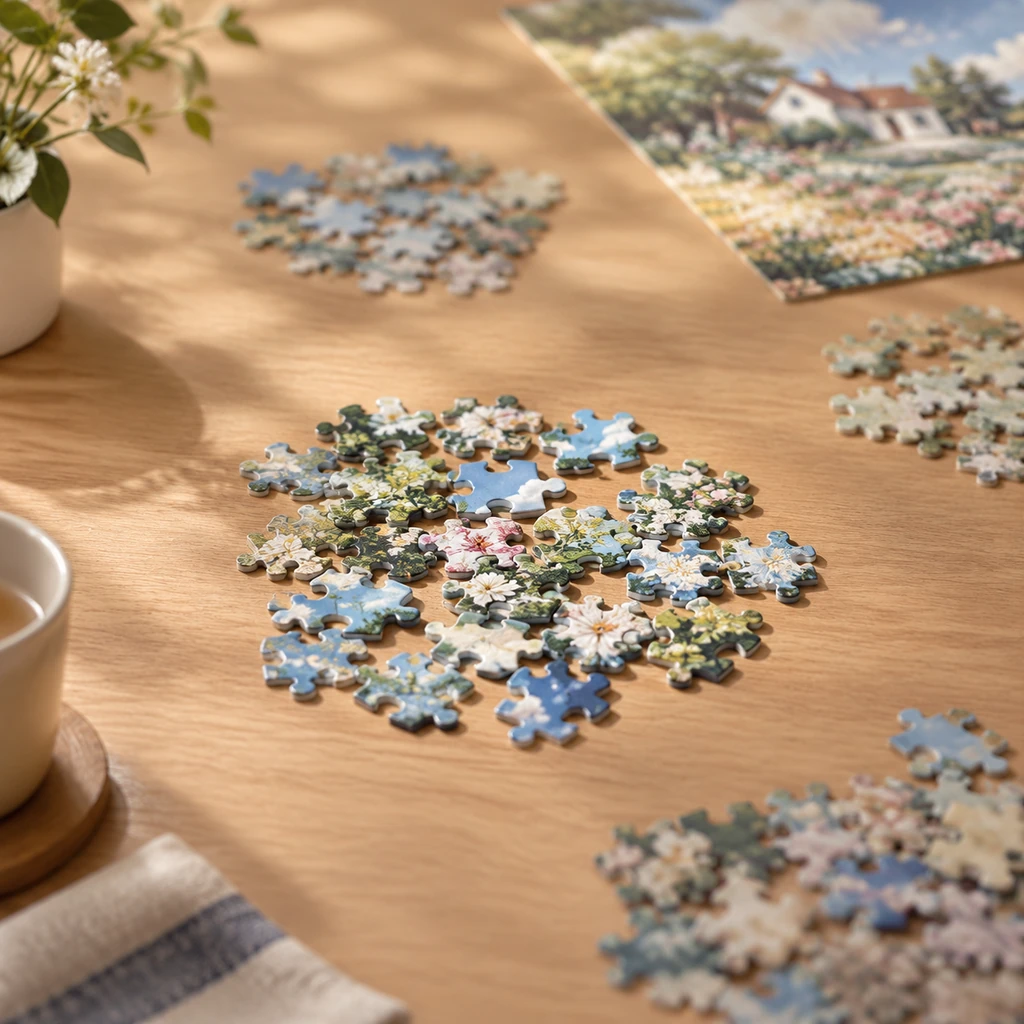
The middle ground is often the most useful layer because it links a clear object to a difficult background. It may be a strip of grass, a table edge, a row of windows, or a change from bright light to shadow.
Look for pieces with a line that changes direction gradually. A distant fence may appear as a thin, repeated mark. A street may widen toward the bottom of the image. A mountain ridge may soften as it moves away. These clues are more reliable than “this piece is roughly the right green.”
Keep middle-ground pieces in a separate group while the foreground island grows. If you combine them too soon, the image loses its depth map. You are not trying to solve three puzzles forever. You are delaying the mix until the picture gives you better evidence.
False fits often happen here. Two pieces may share the same shade and even connect by shape, but one creates a line that suddenly jumps in scale. The problem is not the tab. It is the distance.
Background pieces need texture and softness
Background pieces can feel like a punishment because they carry less obvious information. Instead of asking what they depict, ask how the surface behaves.
Is the color flat or gently graded? Does the texture repeat evenly? Are there tiny marks that become smaller toward the distance? Does the edge of a cloud, wall, or waterline soften as it moves away?
Sorting by these qualities creates smaller groups without pretending that every background piece can be identified immediately. A pale sky with no texture should not be mixed with a pale wall that contains a faint horizontal grain. They may share a color, but they make different kinds of neighbors.
Use depth layers in an online jigsaw
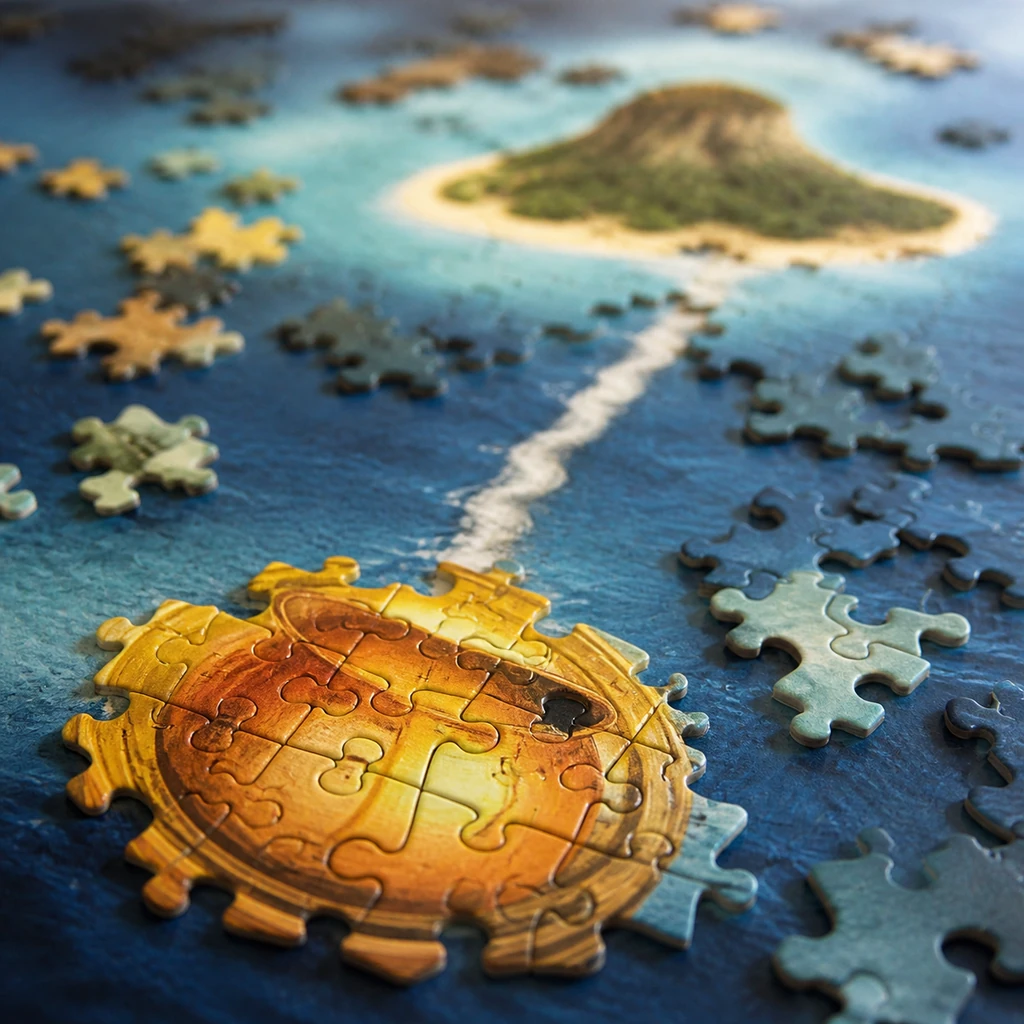
Digital play gives you more control over space, but it can also make every loose piece feel equally available. Keep the active work area small. Place the foreground island near the middle, keep the middle-ground group close enough to test, and move low-information background pieces to a quiet edge.
Zoom in to inspect texture, then zoom out to check whether the larger scene still makes sense. At high zoom, a piece may look like a perfect match because you cannot see the image around it. At low zoom, the same piece may reveal that its line belongs to a different distance.
The [Easy Daily Puzzle jigsaw collection](https://easydailypuzzle.com/?s=jigsaw) is a good place to practice this on different images. The [full Easy Daily Puzzle library](https://easydailypuzzle.com/) also lets you change to a number or word puzzle when your eyes need a different kind of work.
A five-step depth-layer routine
Use this order when repeated colors are slowing the solve:
1. Find the clearest foreground object or sharp edge.
2. Pull aside pieces with strong contrast and recognizable lines.
3. Separate middle-ground pieces by overlap, scale, and direction.
4. Group background pieces by softness and repeated texture, not color alone.
5. Recombine groups only after a reliable island or boundary tells you how they connect.
The method is not a ban on color sorting. Color still matters. It simply gives color a location. Green near a sharp leaf edge is different from green inside a distant hill, and blue below a crisp roofline is different from blue in a flat sky.
Let distance do some of the sorting
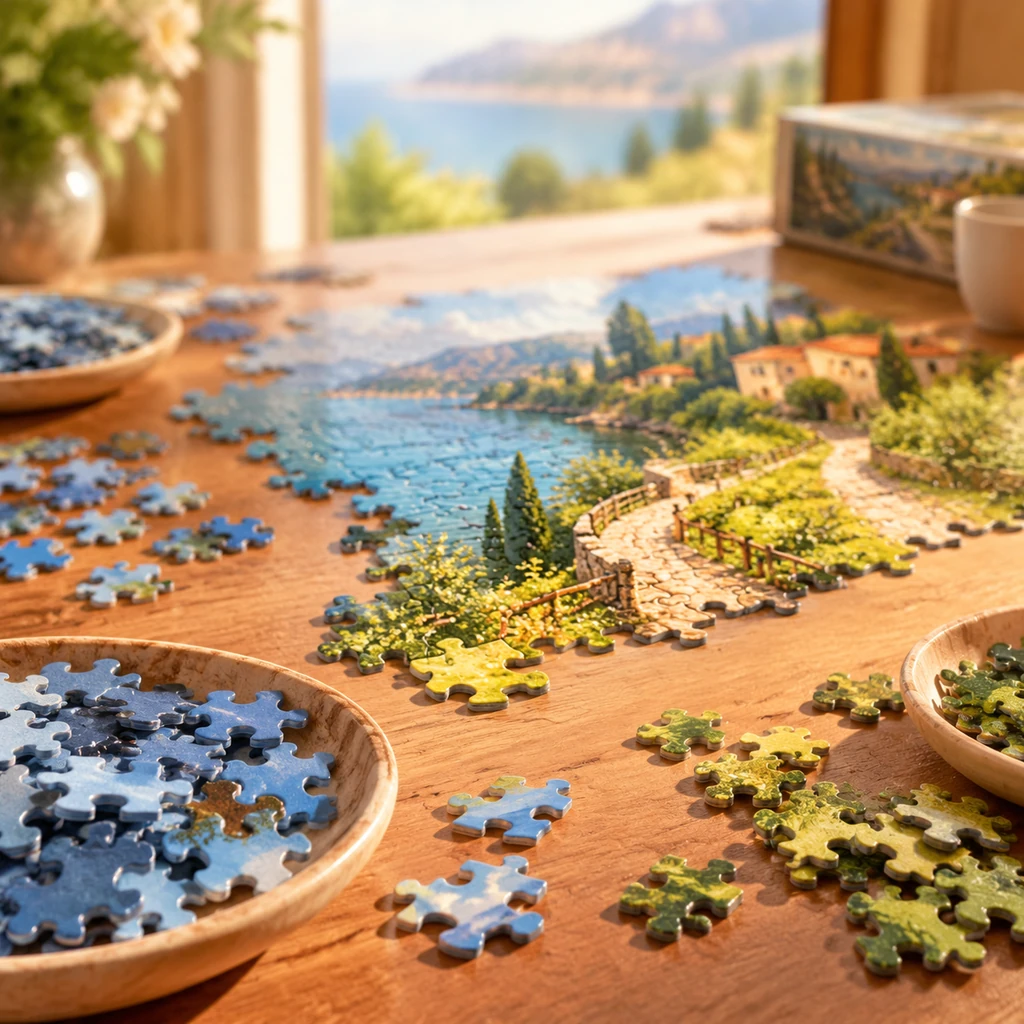
Jigsaw puzzle depth layers make a repeated image less anonymous. Foreground pieces offer objects and edges. Middle-ground pieces carry transitions. Background pieces ask for patience with softness and scale.
When a large color pile refuses to cooperate, do not keep dividing it into lighter and darker piles forever. Ask how far each piece seems to be from the viewer. The answer may give the picture enough structure for the next small island to appear.