



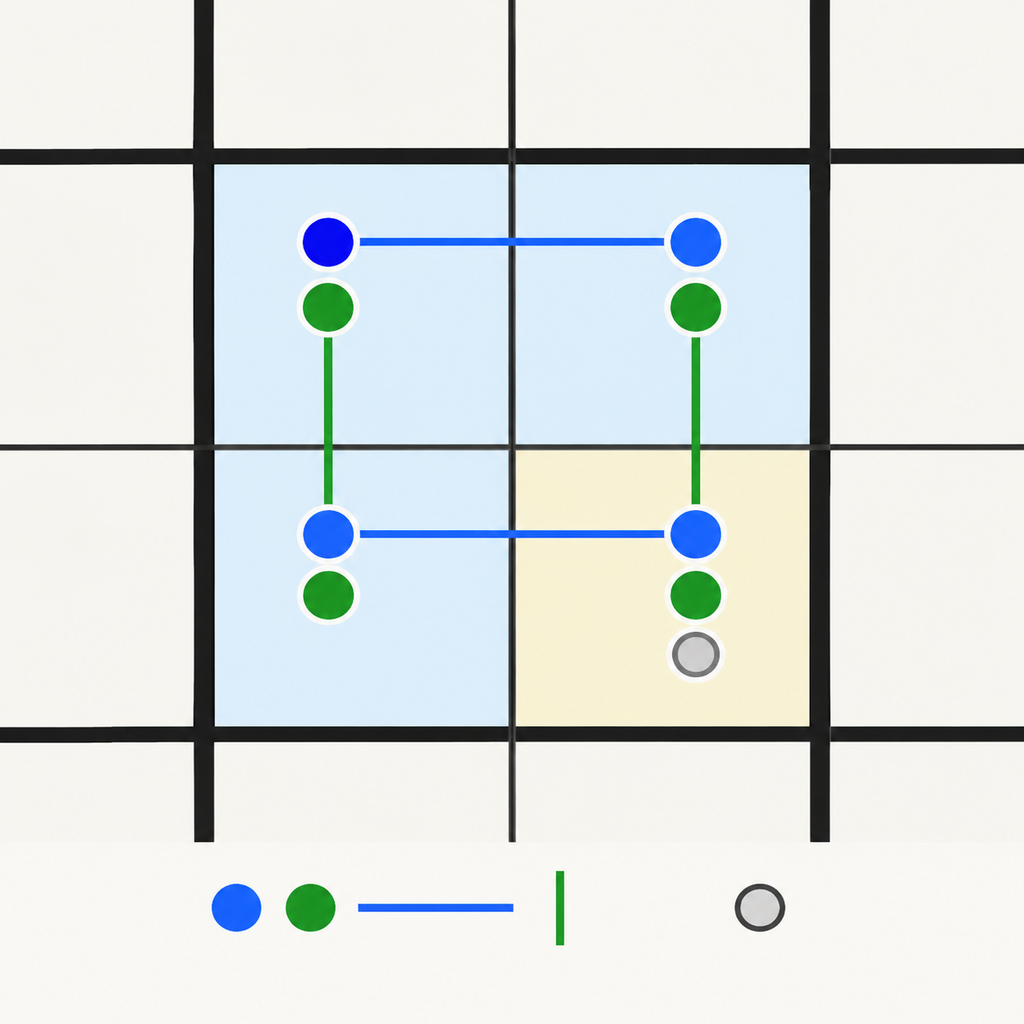
Sudoku unique rectangle sounds more intimidating than it feels. The pattern is simply four cells arranged at the corners of a rectangle, usually inside two rows and two boxes, where the same two candidates keep appearing. The warning is not that the puzzle has become impossible. It is that one careless choice could leave two values interchangeable and make the grid depend on a guess.
That makes the pattern useful for a very specific reason. It helps you protect the solve from ambiguity. You are not trying to make a dramatic deduction. You are checking whether the candidates already on the page are creating a branch that the puzzle should not need.
Sudoku unique rectangle starts with the normal rules
Before looking for an advanced pattern, return to the ordinary Sudoku rules. Every row, column, and 3 by 3 box must contain the digits 1 through 9 without repetition. [Nikoli's Sudoku explanation](https://www.nikoli.co.jp/en/puzzles/sudoku/) gives the familiar rule set and the history of how the grid became a worldwide format.
The unique rectangle idea adds a question: what would happen if the same two digits could be swapped between four cells without breaking any visible row, column, or box rule?
Imagine four cells at the intersections of two rows and two boxes. In each cell, the candidate pair is 2 and 8. If those were the only candidates in all four corners, the grid could allow one arrangement with 2 on one diagonal and another arrangement with 8 on that diagonal. The two solutions would look different, but every local rule would still be satisfied.
A standard Sudoku puzzle is intended to lead to one solution. The repeated pair is therefore a warning sign. It tells you to look for an extra candidate in one corner or an outside restriction that breaks the symmetry.
What the four corners need to have in common
Do not call every rectangle a Sudoku unique rectangle. The geometry is only the beginning.
First, the four cells should occupy two rows and two boxes in a way that gives the rectangle a clean structure. In a typical pattern, the corners are spread across two 3 by 3 boxes. The columns may be different, but the row and box relationships must be checked.
Second, the same pair of candidates should appear in three corners. The fourth corner often contains that pair plus one extra candidate. That extra value is the reason the pattern can produce a safe elimination.
Third, the two repeated candidates must be the values that could swap. If one of the corners has another restriction that you have not written down, the pattern may be incomplete. A rectangle that only looks symmetrical from a distance is not enough.
A small example without turning it into a guess
Suppose the four corners are A, B, C, and D. Cells A, B, and C contain candidates 2 and 8. Cell D contains 2, 8, and 5.
If 5 were removed from D, all four cells would be limited to 2 and 8. That would leave the two diagonal arrangements possible. Since the puzzle should have a unique completion, 5 is the candidate that breaks the dangerous pattern. In this simple form, you can remove 2 or 8 from D only when the exact arrangement and surrounding units support that deduction. The point is not to delete a value because a rectangle looks pretty. The point is to identify the extra candidate that prevents the two-value swap.
This is where many players get into trouble. They see three matching pairs and immediately erase a candidate from the fourth corner. That is too fast. The fourth cell must be checked against its row, column, and box, and the rectangle must be complete enough for the uniqueness logic to apply.
Three mistakes that make the pattern unsafe
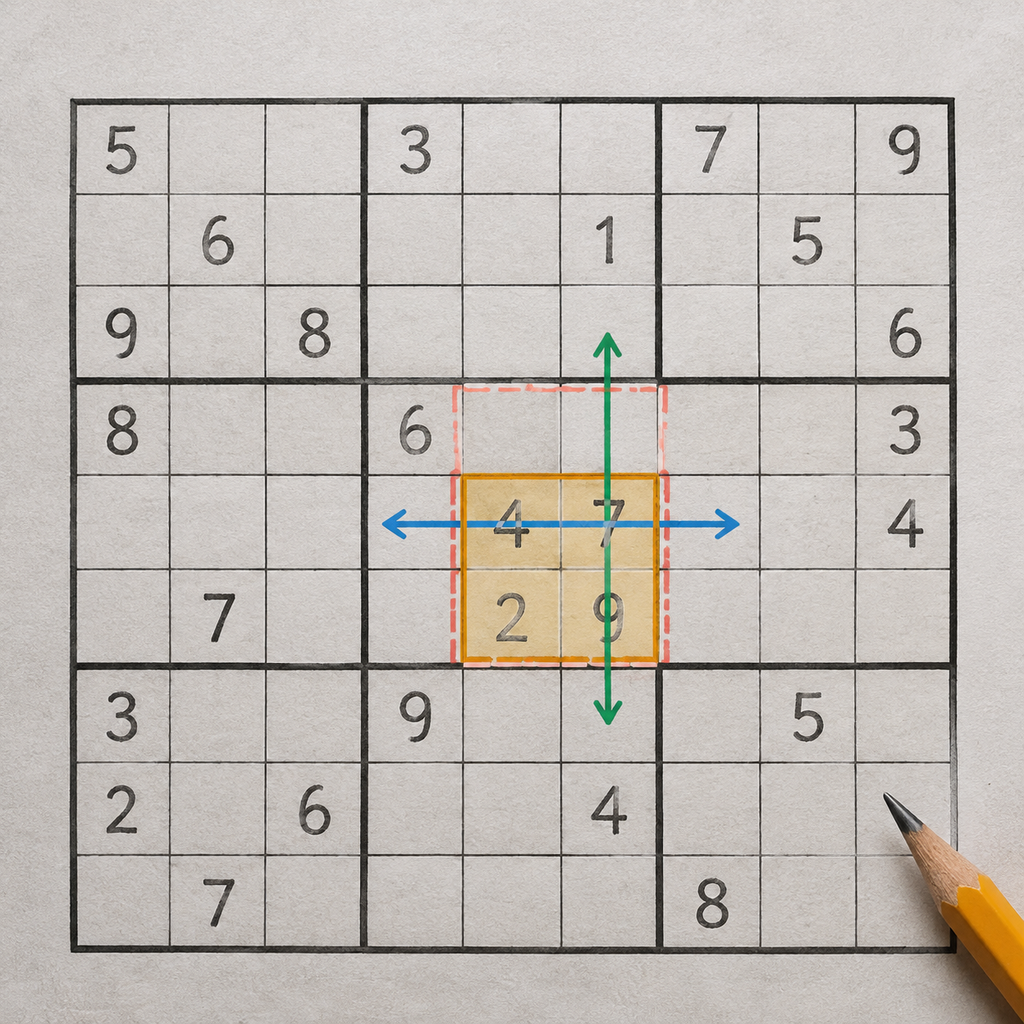
**Skipping the box check.** Two rows and two columns can form a rectangle, but the 3 by 3 boxes decide whether the arrangement has the structure you think it has. Mark the boxes before you name the pattern.
**Assuming every puzzle is unique.** Most standard Sudoku puzzles are designed with one solution, but a player should still treat uniqueness as a puzzle property, not a license to make any convenient elimination. If you are solving a custom grid, a variant, or a puzzle with unclear construction, leave the candidate in place until another rule confirms it.
**Using an incomplete rectangle.** If one corner has three or four unknown candidates, the repeated pair may be accidental. A near-pattern is a reason to inspect the area, not a reason to force the deduction.
The [SudokuWiki unique rectangles guide](https://www.sudokuwiki.org/Unique_Rectangles) is useful for comparing the basic pattern with more advanced types. You do not need to memorize every variation. Start with the simplest complete shape and ask what candidate actually breaks the ambiguity.
A calm scan routine for a hard daily grid
Use the pattern after ordinary singles, pairs, and line restrictions have slowed down.
**1. Look for repeated pairs.** Find a pair of candidates that appears in several cells. Do not search the whole board at once. Start in two neighboring boxes.
**2. Mark the geometry.** Ask whether three of those cells can be matched with a fourth corner in two rows and two boxes.
**3. Recheck the units.** Confirm that each corner belongs to the expected row, column, and box structure.
**4. Find the extra candidate.** If one corner has a third candidate, test whether it is the value that prevents the two-pair swap.
**5. Place only a verified result.** If the pattern is incomplete, leave it alone and move to another scan. An advanced technique is still a technique, not a shortcut around proof.
You can practice the routine in the [Easy Daily Puzzle Sudoku collection](https://easydailypuzzle.com/?s=sudoku). When the grid starts feeling too technical, the [full Easy Daily Puzzle library](https://easydailypuzzle.com/) makes it easy to switch to a crossword, jigsaw, or card game without turning one stuck pattern into a long session.
The pattern is a warning, not a performance
The best use of a Sudoku unique rectangle is often quiet. It tells you that four cells are carrying more symmetry than the rest of the grid can safely allow. Once you see that, slow down, verify the units, and remove only the candidate that the complete pattern justifies.
Advanced Sudoku becomes more enjoyable when each named pattern answers a real question. Here the question is simple: could these two digits trade places and leave the puzzle with two solutions? If the answer is yes, the rectangle has done its job. It has stopped a guess before the guess was written.