



A sudoku scanning technique should happen before the grid turns into a cloud of tiny notes. That is the part many casual players skip. They open a puzzle, see a few empty squares, and start writing candidates because writing something feels safer than waiting.
Waiting is not wasted time here.
The first 90 seconds of a sudoku puzzle are often where the easiest progress is hiding. No advanced trick. No clever chain. Just a slow look across rows, columns, and boxes before the pencil marks arrive. If you play daily sudoku on Easy Daily Puzzle , this one habit can make a normal grid feel cleaner almost immediately.
Nikoli explains the basic sudoku rule plainly: each row, column, and 3x3 block needs the numbers 1 through 9. That rule sounds simple because it is. The difficulty comes from noticing where the rule is already doing work for you.
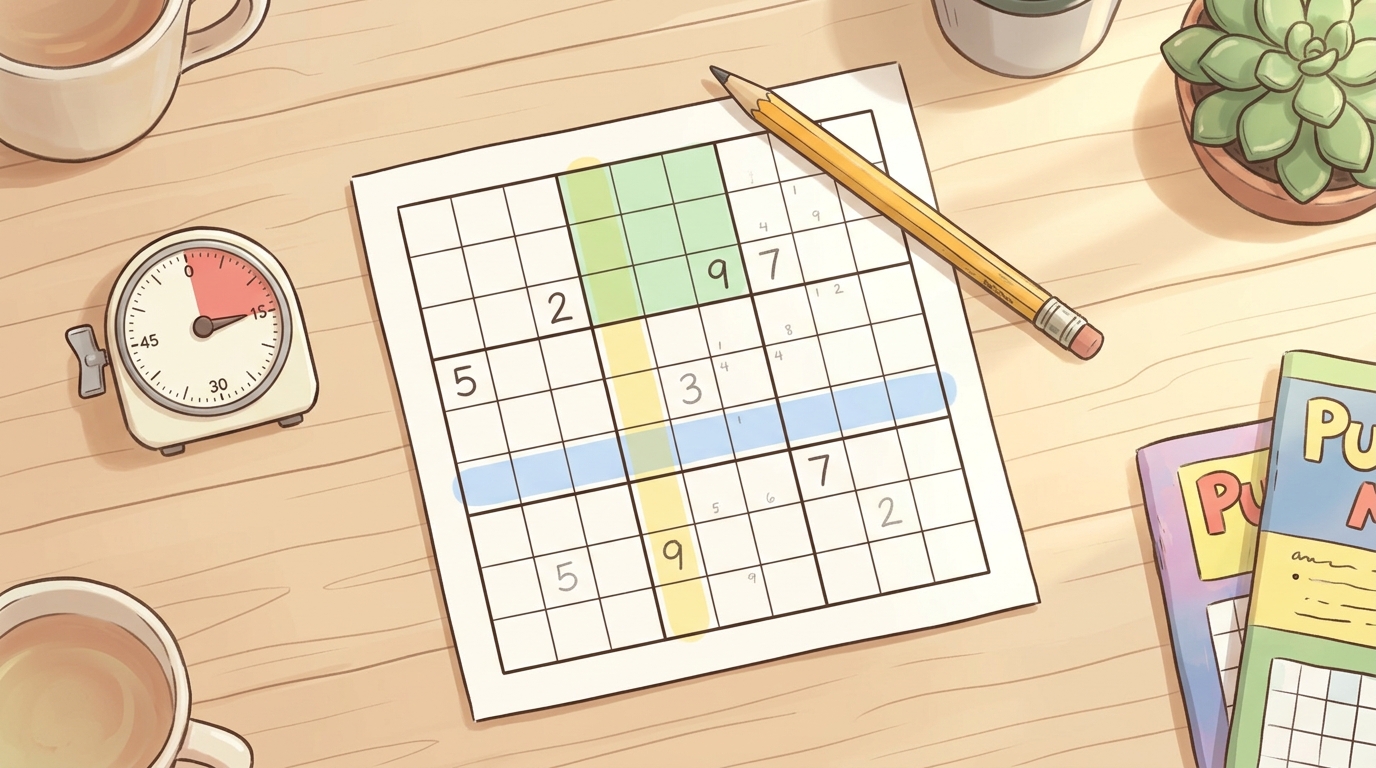
Why the sudoku scanning technique comes before notes
Notes are useful, but they are not the first move. They are a second move.
A clean scan asks, "What does the grid already know?" Notes ask, "What might be possible?" Those are different questions. If you jump to the second question too early, the board fills with possibilities before you have used the facts.
The best opening scan has three passes.
First, look for crowded rows. A row with six or seven numbers already placed is usually more helpful than an empty corner. You are not solving the whole row yet. You are asking which missing numbers have obvious restrictions from nearby columns and boxes.
Second, look for crowded columns. This is where players often find a number that could not be seen from the row alone. A digit may look possible in two squares until one column quietly rules it out.
Third, look at the 3x3 boxes. Boxes are the friendly part of sudoku because they keep the search area small. If a box already has five or six numbers, it deserves attention.
That is the whole first habit. Rows. Columns. Boxes. Then notes.
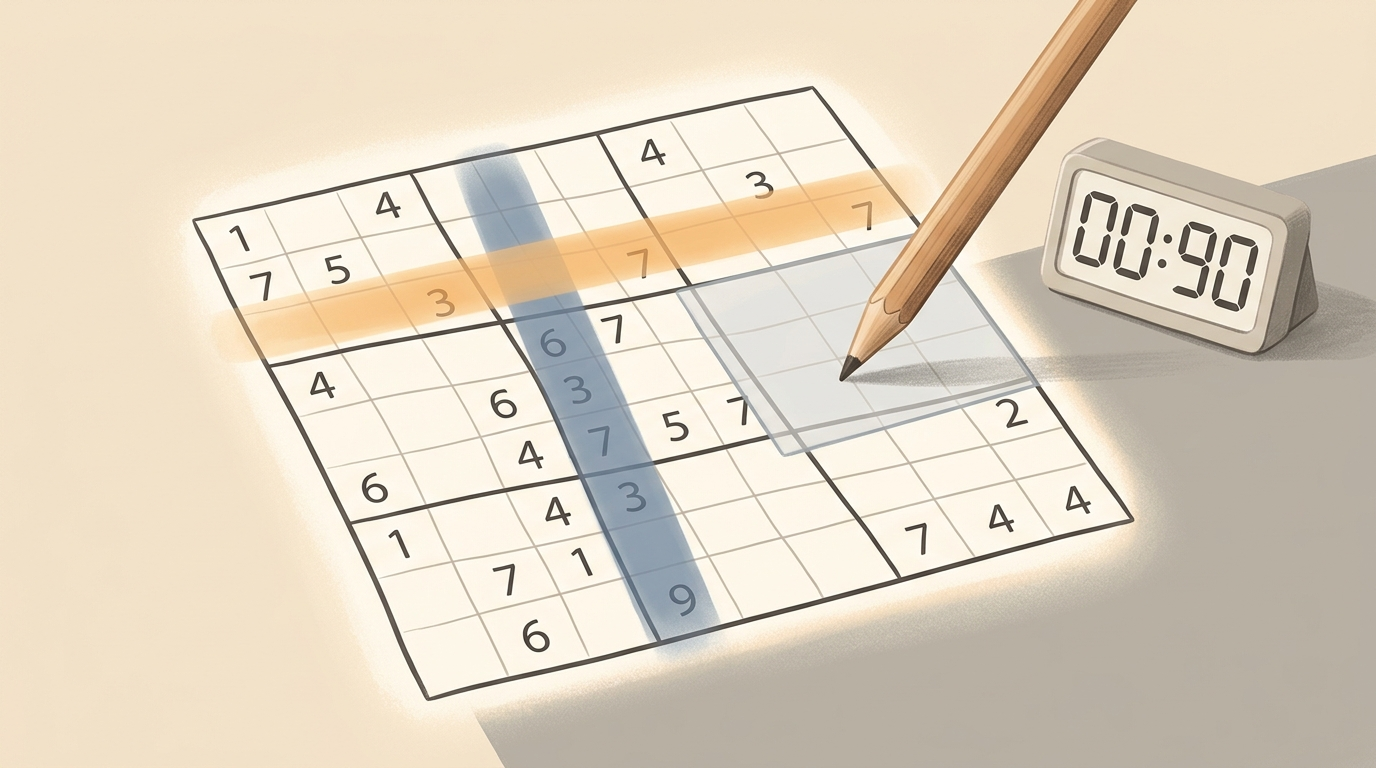
The 90-second scan
Set a soft timer in your head, not a real one unless you like timers. For the first 90 seconds, do not write any candidates.
Use this order:
- Find the row with the most numbers.
- Name the missing digits in that row.
- Check the columns crossing the open squares.
- Move to the fullest column and repeat the same idea.
- Pick the fullest 3x3 box and check whether any missing digit has only one home.
This does not guarantee a placement. That is fine. The goal is not to force a number. The goal is to stop the grid from feeling like 50 empty cells at once.
Most players will find at least one clean number with this pass. Even when they do not, they usually learn where the puzzle is soft and where it is not ready yet.
That matters.
When you finally start making notes, those notes will be less noisy. You will be adding candidates to a board you have already read, not a board you are trying to understand through clutter.
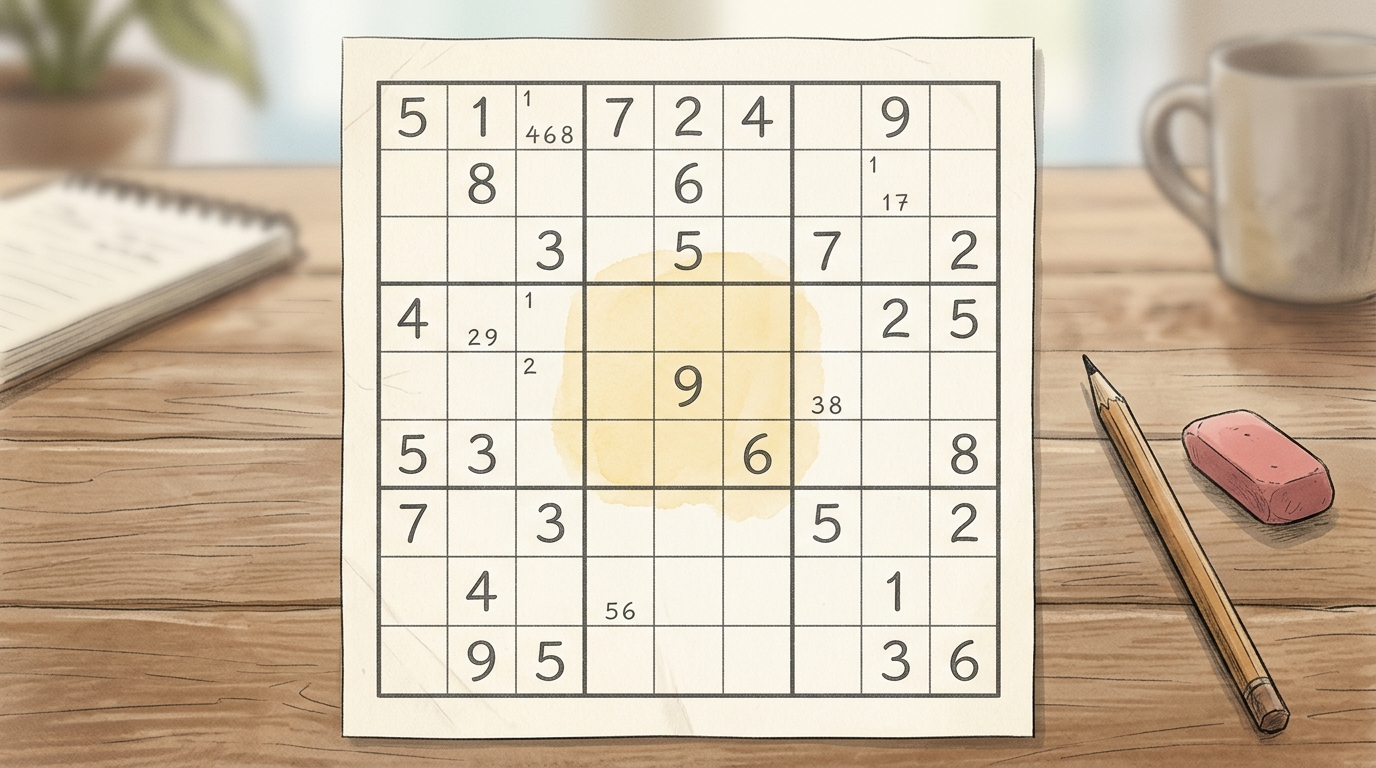
A small example of better scanning
Imagine a top-left box with six numbers filled. The missing digits are 2, 5, and 8.
One empty square sits in a column that already has a 5. That square cannot be 5. Another empty square sits in a row that already has an 8. That square cannot be 8. Suddenly the box is not a mystery anymore. You may not have solved all three cells, but the choices have narrowed.
This is where beginners sometimes rush. They see "maybe 2, maybe 5, maybe 8" and write all three candidates everywhere. A better player takes one more breath and checks the crossing lines.
That breath is the sudoku scanning technique.
It feels small because it is small. It works because small checks compound. One ruled-out number makes one square clearer. One clearer square makes a nearby row easier. A nearby row gives the next box a clue.
Sudoku is rarely one dramatic discovery. Most good solves are a stack of quiet ones.
When to start writing candidates
Start notes after the first scan stops giving you clean information.
Kristanix describes sudoku notes as temporary small numbers used to track possible placements. That is a good way to think about them. Notes are a memory aid, not a decoration. They should hold useful uncertainty, not every number you have not ruled out yet.
A practical rule: write notes only in cells where the row, column, or box is already fairly constrained. If a square could be six different numbers, it may be too early. Leave it alone. If a square is down to two or three real options, that note might help.
Another rule: do not note every cell just because the interface makes it easy. Online sudoku can turn note-taking into a reflex. The grid starts looking busy, and the player starts reading their own marks instead of the puzzle.
Use notes like a flashlight. Point them where the room is dark. Do not shine them in your own eyes.
The mistake this fixes
The mistake is not using notes. Notes are fine.
The mistake is using notes to avoid looking.
When a puzzle feels hard, filling cells with candidates gives a quick sense of control. But if the notes are lazy, they create a second puzzle on top of the first one. Now you are no longer reading the grid. You are cleaning up the mess you made in the margins.
The sudoku scanning technique prevents that by making the first job simple: read what is already visible.
Try one puzzle where you delay notes for 90 seconds. If that feels too long, try 60. If it feels easy, stretch it to two minutes. You are training your eye to spot pressure before your hand starts writing.
The result is a calmer grid.
Not always a faster solve. Faster comes later. Cleaner comes first.
How to practice it on Easy Daily Puzzle
Open a sudoku puzzle from Easy Daily Puzzle and play the first minute differently.
Do not hunt for a clever move. Hunt for the fullest areas.
Say the missing digits quietly. Check the crossing lines. Move away when a section gives you nothing. Come back after another part of the grid has changed.
If you want a second puzzle afterward, browse more daily sudoku games on Easy Daily Puzzle and repeat the same opening scan. The point is not to memorize a trick. The point is to make the first look more useful.
You will know the habit is working when the grid feels less crowded before you have written a single candidate.
That is the win.