



Sudoku naked pairs usually appear when a grid has stopped giving away easy singles. The board is not empty, but the next number is no longer sitting in plain sight. Two cells in one row, column, or box each show the same two candidates. Nothing looks solved yet. Still, the puzzle has quietly narrowed its options.
That is the useful part of the pattern. A naked pair does not place a number by itself. It removes numbers that have no right to remain elsewhere in the same unit. That small cleanup can expose a single a few moves later.
The ordinary Sudoku rule is still doing all the work: every row, column, and 3x3 box must contain the digits 1 through 9 once. NRICH's explanation of the naked pair uses that basic rule to show why two matching candidate cells can restrict the rest of their unit. You can practise the habit on Easy Daily Puzzle and then compare the opening scan with more Sudoku puzzles and articles.
Sudoku naked pairs are a promise, not a guess
Imagine a row with these candidate lists:
- R4C2: 2 or 7
- R4C6: 2 or 7
- R4C1: 1, 2, 4, or 8
- R4C4: 3, 5, 7, or 9
The two cells at R4C2 and R4C6 form a naked pair. They must contain 2 and 7 in some order. You do not know which cell gets which digit yet, and you should not pretend that you do.
What you do know is stronger than a guess: no other cell in row 4 can contain 2 or 7. Remove 2 and 7 from the other candidate lists in that row. If R4C1 loses 2 and R4C4 loses 7, the row becomes easier to read without placing a single unproved digit.
The word “naked” describes how the pair appears. The two digits are visible as the only candidates in those two cells, not hidden inside larger lists. If one cell says 2, 7, 9, it is not part of this exact pair, even if another cell says 2, 7. That distinction prevents the common mistake of erasing candidates from the rest of a row when one supposed pair cell still has a third option.
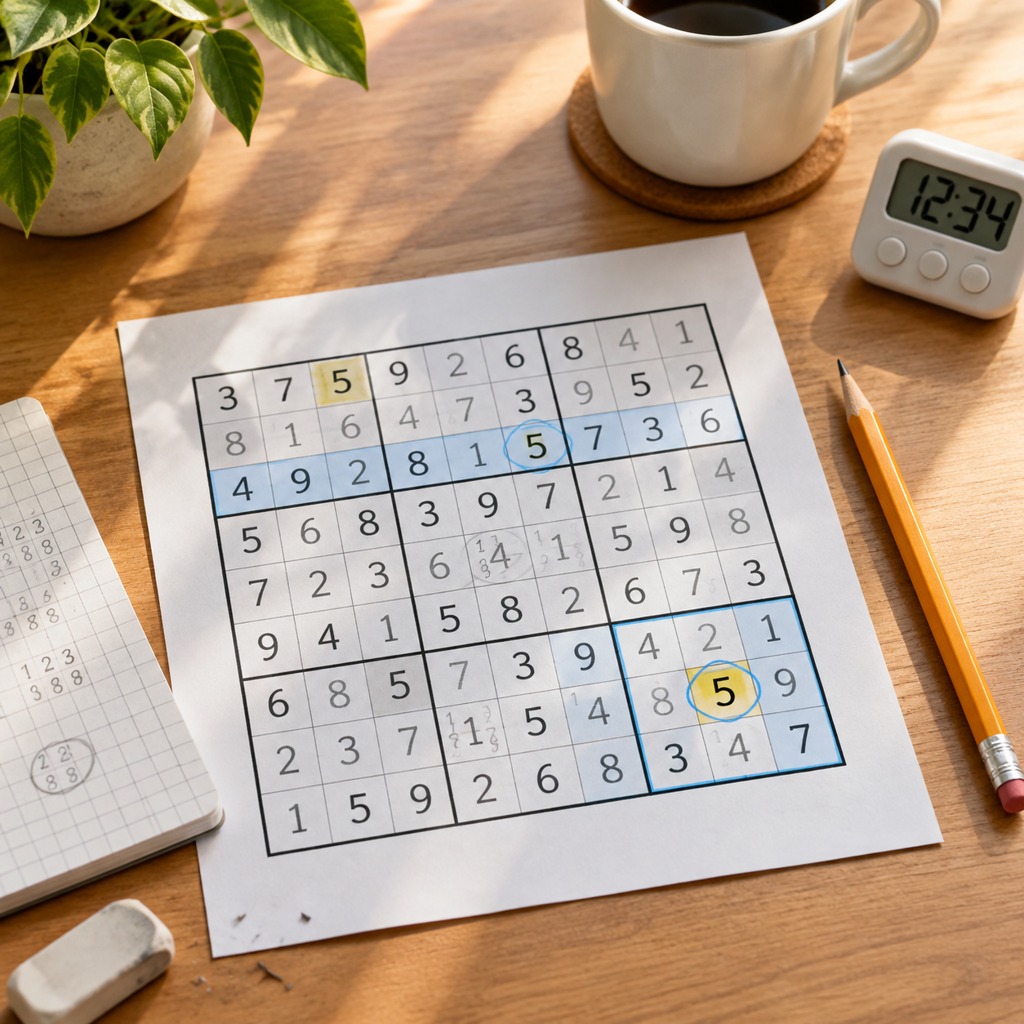
How to find Sudoku naked pairs without flooding the grid with notes
Candidate notes help, but they can also turn a clean puzzle into static. A lighter scan is often faster than listing every possibility first.
Start with one unit. Choose a row, column, or 3x3 box that has several empty cells and a few known digits. Look for cells with two candidates. If two cells show the exact same two digits, check that they belong to the same unit.
Then ask three questions:
1. Are these the only two candidates in both cells?
2. Do the cells share a row, column, or box?
3. Are the two digits present anywhere else in that same unit?
The third question may look strange. The digits can appear elsewhere as candidates before the pair is used. That is exactly why the pair matters. If the first two answers are yes, the other appearances are the ones you can erase.
Do not scan the whole grid at random. Pick the most crowded unit, find the shortest candidate lists, and inspect the repeated pairs first. This keeps the technique from becoming a hunt through hundreds of tiny numbers.
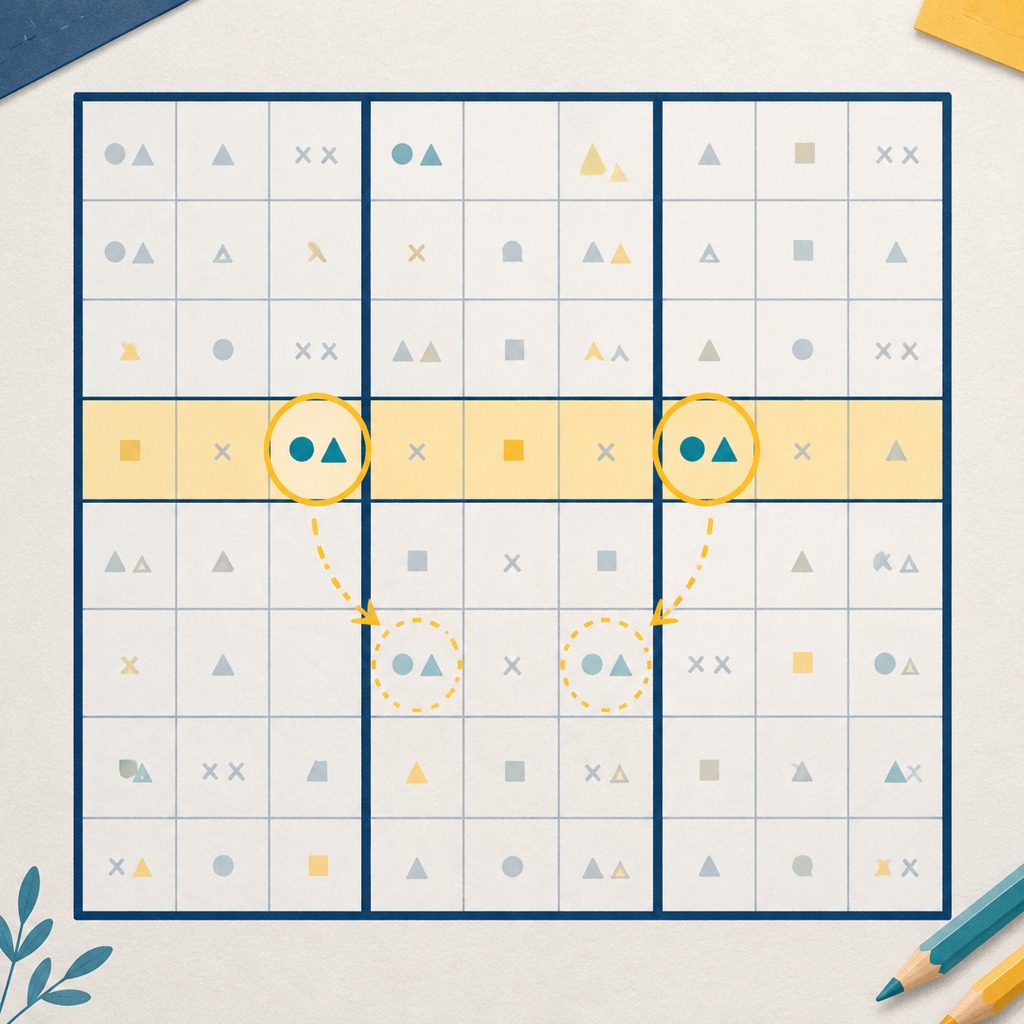
The box, row, and column versions feel different
A pair in a row is often the easiest to see because the cells sit in one horizontal line. A pair in a column can be just as useful, but vertical candidates are easier to miss when the grid is viewed quickly.
A pair inside a 3x3 box can have the biggest visual payoff. After removing the pair's digits from the other cells in the box, one of those cells may become a single. The box may also affect a crossing row or column on the next scan.
The logic does not change between the three locations. The unit is the boundary. If two cells share a row, eliminate only inside that row. If they share a box but not a row or column together, eliminate only inside that box.
This boundary is worth saying out loud when learning: a pair does not give permission to erase candidates across the entire puzzle. Sudoku naked pairs are local evidence, and the rest of the grid feels the result only when the cleaned-up unit creates a new restriction.
What a useful pair looks like in a real solve
The best pairs are not always sitting in two neat cells with only two notes from the start. Often they appear after a single elsewhere is placed. A solved 6 may remove 6 from several candidates, turning two messy cells into matching pairs.
That is why candidate cleanup matters. After every reliable placement, rescan the affected row, column, and box. You are not looking for a dramatic pattern. You are checking whether the board has become simpler in one small area.
Suppose a box contains two cells with {3, 8}, while the other open cells contain {1, 3, 5}, {2, 4, 8}, and {1, 4, 5, 8}. The pair claims 3 and 8 for the first two cells. You can remove 3 from the first remaining list and 8 from the second and fourth lists. One of those cells might become a single, or the reduced lists might create another pair in a crossing line.
The first result is often not a placed digit. That is normal. Elimination is progress even when the board does not immediately flash a new answer.
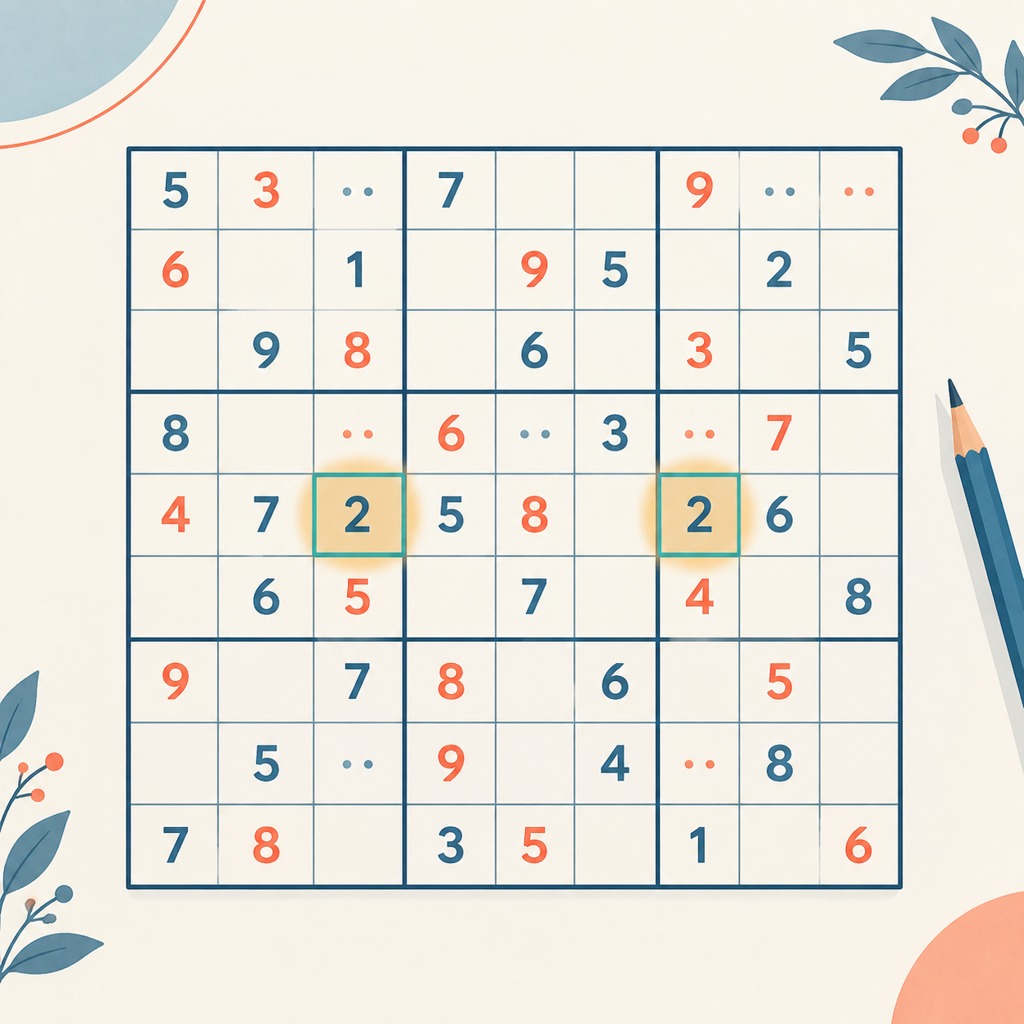
Common false pairs to reject
A naked pair is easy to overcall. Reject it when the cells do not share a unit. Two cells with {4, 9} in different rows and boxes have no relationship just because the notes look alike.
Reject it when one cell has an extra candidate. Lists {4, 9} and {4, 9, 6} do not lock 4 and 9. The second cell could still take 6, so the pair has not claimed both digits.
Reject it when you erase outside the unit. A pair in the top-left box says nothing directly about cells in the middle box, even if they line up visually.
Finally, reject the urge to choose which cell gets which digit. The pattern is valuable because it proves a removal, not because it predicts the final placement.
SudokuWiki's [naked candidates reference](https://www.sudokuwiki.org/Print_Naked_Candidates) places naked pairs alongside larger subsets such as triples and quads. You do not need to learn the entire family at once. A correctly used pair is already a strong habit for medium puzzles.
A two-minute naked-pair drill
On your next grid, do one normal scan first. Fill only numbers you can prove.
When the easy moves stop, choose one row, one column, and one box with several empty cells. Read only the two-candidate cells. Circle or mentally mark any exact repeated pair. Verify that the two cells share the selected unit, then remove the pair's digits from the other cells in that unit.
After the cleanup, scan the three affected houses again. If a single appears, place it. If nothing appears, move on. Do not keep forcing the technique after the evidence has run out.
That is the whole rhythm: find two, protect two, remove elsewhere, then look again.
The pattern is small enough for a daily puzzle and useful enough to change how a stuck grid feels. Instead of filling more notes because the board looks difficult, you give two cells a precise job. The pair holds its two digits. The rest of the unit gets quieter.
Supporting image idea: an annotated 9x9 Sudoku row with two cells marked {2,7}, the same candidates crossed out in the remaining cells, and no decorative text inside the grid.