



Sudoku competition first scan begins before the first number goes into the grid. In a timed round, that opening pause can feel expensive. The room is quiet, the clock is moving, and another solver may already be writing. The useful question is not “How fast can I fill a cell?” It is “Which information is safe enough to use first?”
That question is just as useful in a five-minute daily game. A calm opening scan prevents the first attractive guess from turning into a long repair job.
Sudoku competition first scan starts before the first number
A timed Sudoku round rewards attention that is selective, not frantic. Before placing anything, look across the grid for regions that already carry pressure.
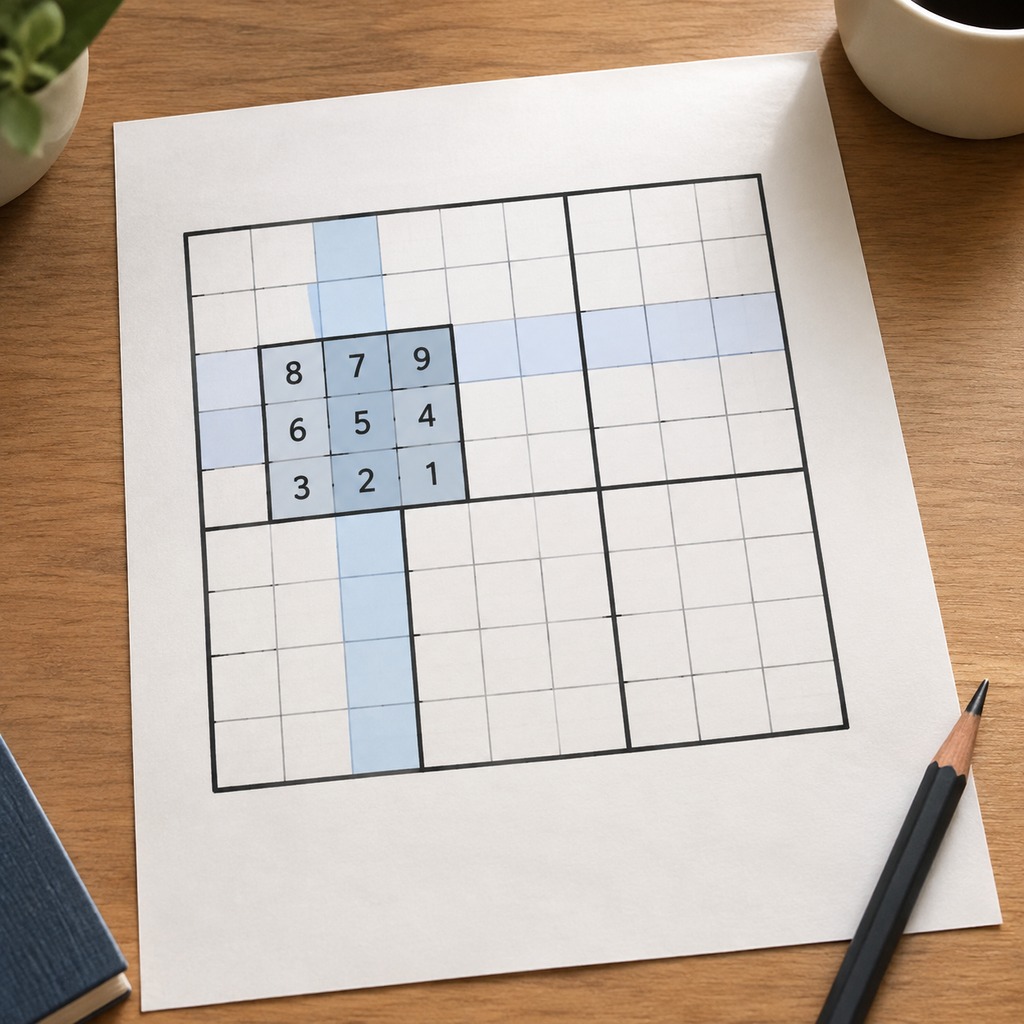
Start with the 3 by 3 boxes. Which box has the most given numbers? Which missing digit appears in several nearby rows or columns? Then look at the lines that enter and leave that box. You are not trying to solve the entire puzzle in your head. You are looking for a short path from a visible restriction to a safe placement.
Official event instructions are useful here because they show how seriously timing and start conditions are treated. The [World Sudoku and Puzzle Championship event page](https://wspc2026.logicmastersindia.com/?g=WSC) publishes round information and standings, while a [World Sudoku Championship instruction booklet](https://wspc2023.com/downloads/16thWorldSudokuChampionship-InstructionBooklet-v1.pdf) spells out competition rules such as when competitors may open their booklets. The exact format can change from one event to another, so the practical lesson is simple: wait for the start, then spend the first moments reading the board rather than reacting to the clock.
Three signals worth finding in the first 90 seconds
The opening scan becomes easier when you divide what you see into three kinds of information.
**A forced placement.** A cell has one legal digit, or a digit has one legal home in a row, column, or box. This is the best opening signal because it does not require a chain of assumptions.
**A short chain.** One placement is likely to expose another nearby restriction. A dense box can lead to a row, which can lead back to a second box. The chain should be short and visible. If you need to hold six hypothetical moves in your head, it is not an opening chain. It is a risk.
**A tempting skip.** Some cells look attractive because they have only two candidates. That does not make them the right first move. If neither candidate is forced and the surrounding lines are still open, leave the cell alone. A disciplined skip is a speed skill because it protects the next minute.
This distinction keeps the first scan from becoming a hunt for the smallest candidate list. Small is not always safe. Information that crosses two rule structures is usually more valuable than a cell that merely looks restricted.
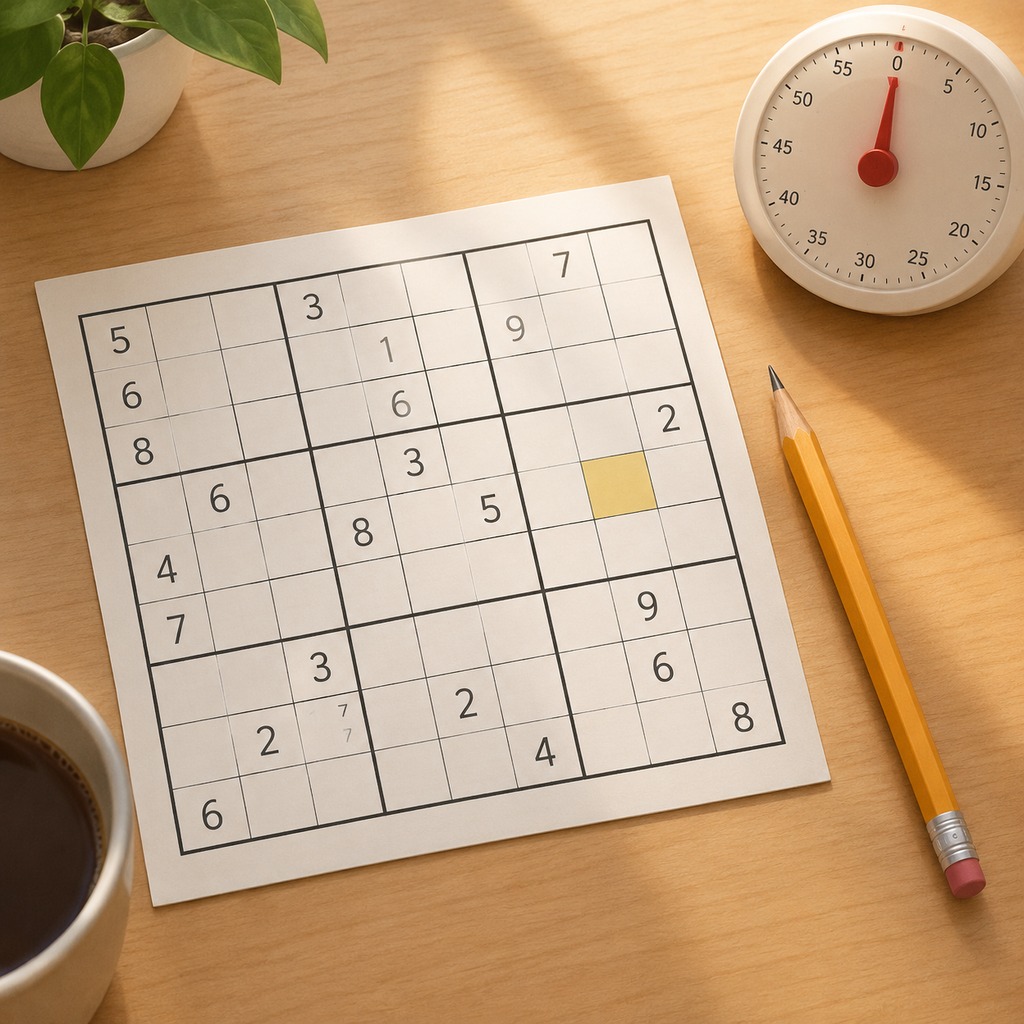
How to run a Sudoku competition first scan
Use this sequence on an unfamiliar grid.
**First 20 seconds: read the shape.** Glance over all boxes and notice where the clues are concentrated. Do not write yet. You are building a map of likely starting regions.
**Next 20 seconds: choose one digit or one box.** Pick the area with the strongest footprint. A digit that is already placed in many regions can be easier to trace than a digit that appears only a few times.
**Next 20 seconds: test the lines.** For the chosen digit, project its existing rows and columns into the boxes where it is missing. If one box leaves a single legal home, place it. If not, keep the restriction visible and move on.
**Next 20 seconds: confirm the consequence.** After a safe placement, recheck its row, column, and box. Look for the new single created by the move rather than immediately starting a new unrelated scan.
**Final 10 seconds of the opening: decide whether to continue or switch.** If the chain is producing information, follow it. If it has gone quiet, choose the next dense box or begin light notes. Do not keep pushing a dead idea because the clock makes stopping feel like failure.
The timing is a guide, not a law. Some grids offer a clear single in ten seconds. Others need a longer read. The value of the routine is that it gives the first minute a shape.
Speed comes from clean recovery, not constant motion
Strong solvers do not avoid every mistake. They avoid letting one uncertain move spread across the board.
When a candidate feels attractive but is not forced, keep it soft. If you use pencil marks, make them small and consistent. If the next two placements do not support the idea, return to the last confirmed state instead of defending the guess.
This is especially important in a competition because the clock can create a false emergency. A solver sees an empty cell and feels obligated to fill it. A better response is to ask whether the cell contains information or merely demands attention.
The [Nikoli explanation of Sudoku](https://www.nikoli.co.jp/en/puzzles/sudoku/) keeps the basic rule visible: each row, column, and block must contain the digits 1 through 9 without repetition. A first scan is simply a way to read those three rule spaces in a useful order. It is not a separate trick that replaces the rules.
Bring the competition scan to a daily puzzle
You probably do not need a stopwatch for a casual game. Borrow the sequence instead.
For the first minute, do not fill random easy-looking cells. Read the boxes, choose one visible digit, and check whether its row or column restrictions create a single. After the first confirmed move, scan its immediate consequences. If nothing opens, add notes and continue normally.
The [Easy Daily Puzzle Sudoku collection](https://easydailypuzzle.com/?s=sudoku) is a good place to practice this opening habit across different grids. When you finish, the [full Easy Daily Puzzle library](https://easydailypuzzle.com/) gives you a way to switch to a different type of puzzle instead of forcing one tired solving mode.
The routine also helps with attention. A short scan creates a clean start, while the decision to skip a weak cell keeps the session from becoming a race against every empty square.