



Sudoku candidate order is not a secret solving technique. It is a small habit that keeps useful information from turning into visual clutter.
When notes are written differently in every cell, the grid becomes tiring to read. One cell has tiny marks packed in the top corner. Another has a single candidate in the middle. A third still carries a number that was eliminated three moves ago. The puzzle may not be harder, but the page is harder to trust.
The fix is simple. Use the same order every time you write candidates. Then use the same cleanup habit every time you place a digit. The order does not make a number more likely. It makes your evidence easier to compare.
Sudoku candidate order starts with the ordinary rules
Before adding notes, use the basic Sudoku rules. Each row, column, and 3 by 3 box must contain the digits 1 through 9 without repetition. [Nikoli's Sudoku explanation](https://www.nikoli.co.jp/en/puzzles/sudoku/) is a useful reminder of that foundation.
For a blank cell, the first candidate list comes from removing the digits already present in its row, column, and box. That is the whole starting point. Candidate order comes after this check, not instead of it.
A practical order is ascending numerical order. If a cell can hold 2, 5, or 8, write the marks from low to high. If a cell can hold 1, 4, 6, and 9, use the same left-to-right and top-to-bottom positions each time. The exact visual layout matters less than consistency.
Why bother? Because a repeated pattern becomes easier to spot. If every cell uses the same layout, two cells with the same pair look alike immediately. A candidate that disappears leaves a clear gap. A cell that has not been reviewed looks different from a cell that has been checked.
A fixed order makes comparisons faster
Imagine two cells in the same box. Both contain the candidates 3 and 7. In a messy grid, you may need to reread each note. In an orderly grid, the matching marks stand out.
This matters when you are looking for a naked pair. The pair is not strong because it is written neatly. It is strong because those two digits are restricted to those two cells in the same unit. Neat notes simply make the restriction easier to see.
The same is true for a hidden single. Suppose the digit 6 appears as a candidate in only one cell of a row. If the notes have been written in a stable order, your eye can scan the same position across the row instead of interpreting a new handwriting shape in every square.
Keep the rule modest. Candidate order improves the review process. It does not create a deduction by itself.
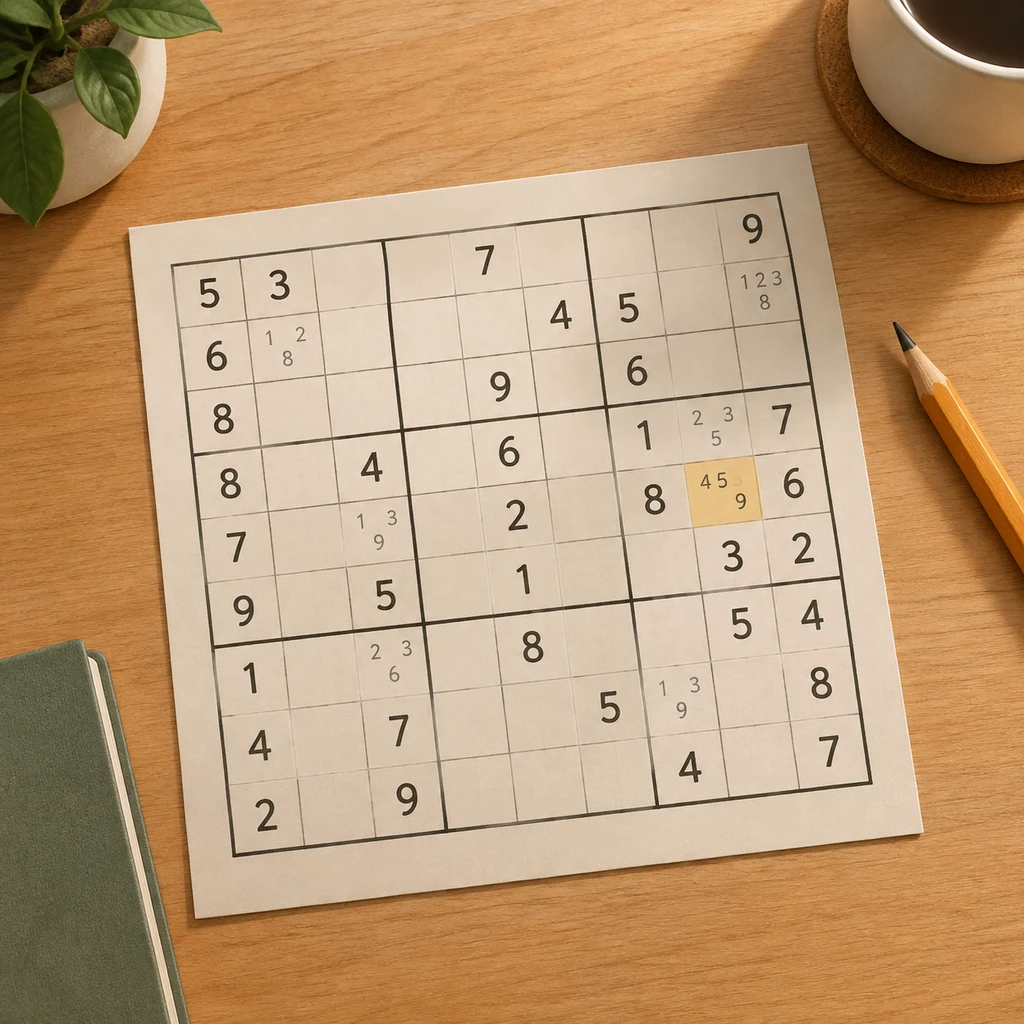
Sudoku candidate order for singles, pairs, and lines
Use three passes rather than trying to notice everything at once.
**Pass one: forced cells.** Look for a cell with one remaining candidate or a unit where one digit has only one legal home. Place the digit only after checking its row, column, and box.
**Pass two: matching cells.** Compare cells inside one unit. A repeated pair may be useful. So may a triple, but do not name a pattern just because three cells share a few marks. Count where each digit can actually go.
**Pass three: line restrictions.** If a candidate appears only in one row inside a box, or only in one column inside a box, the relationship may remove that candidate from the rest of the line. [SudokuWiki's technique index](https://www.sudokuwiki.org/) is helpful when you want to compare these patterns without treating every new name as a reason to guess.
After each confirmed placement, update the affected row, column, and box. Do not wait until the end of the page. Old marks are more dangerous than missing marks because they look like current evidence.
The notes that cause the most trouble
**Copying a candidate list without checking it.** A nearby cell may look similar, but one row or box digit can make its list different. Recalculate before copying.
**Mixing full notes and selective notes.** Selective notes can be useful late in a solve, but they should be intentional. If one cell has only the candidates you remembered and another has every candidate, comparison becomes unreliable.
**Treating position as probability.** A candidate written in the upper-left corner is not more likely than one written in the lower-right. The layout is a filing system, not a prediction.
**Leaving a solved digit behind.** The moment a digit is placed, remove it from peer cells. A five-second cleanup can prevent a long chain of false reasoning.
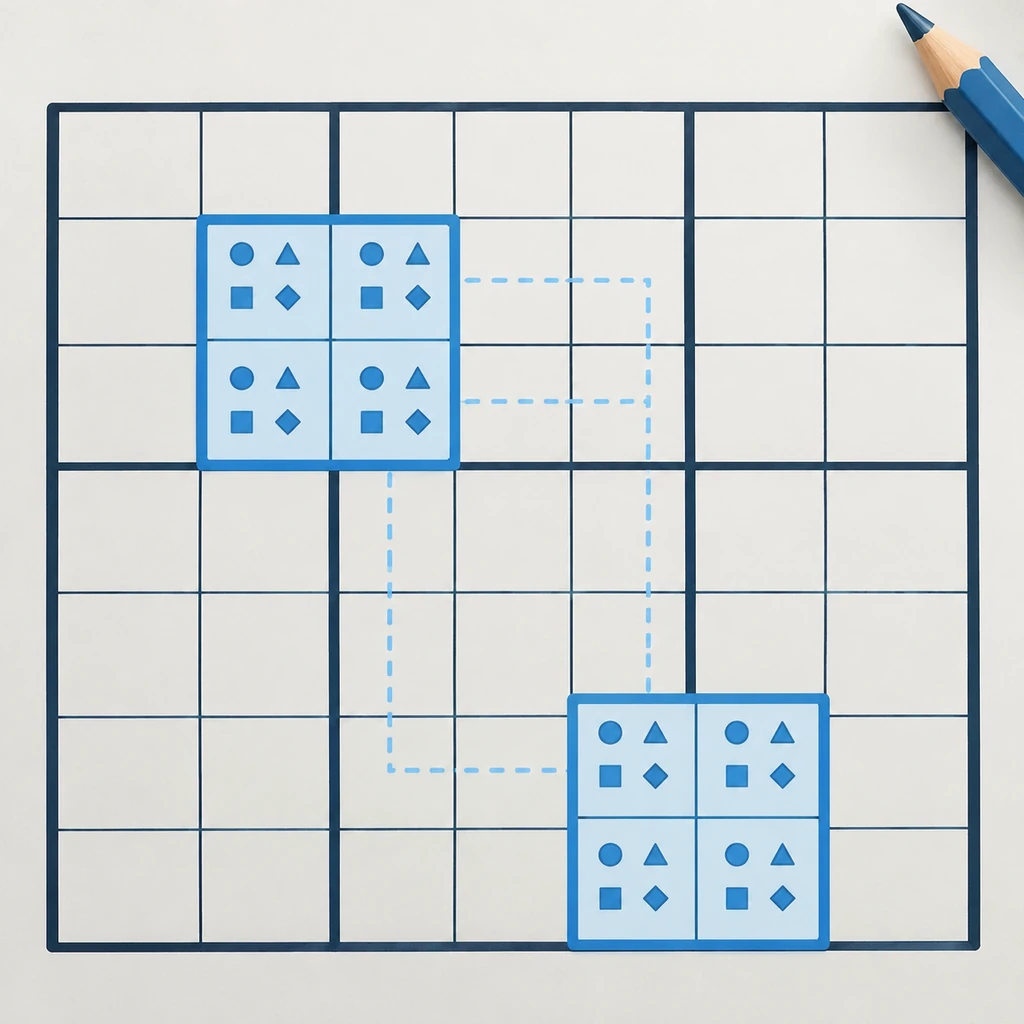
A five-minute Sudoku candidate order routine
Try this on a daily grid from the [Easy Daily Puzzle Sudoku collection](https://easydailypuzzle.com/?s=sudoku).
1. Scan for obvious singles before writing a large set of notes.
2. Choose one quiet box or row and write candidates in the same order.
3. Compare matching pairs only inside the unit you just reviewed.
4. Place one confirmed digit, then clean its row, column, and box immediately.
5. If the notes become crowded, erase one unit and rebuild it instead of adding more marks on top of old ones.
The [Easy Daily Puzzle library](https://easydailypuzzle.com/) is useful when you want to change pace after a difficult grid. A short puzzle is often a better place to practice note discipline than a very hard puzzle where every candidate list grows at once.
Let the next decision stay visible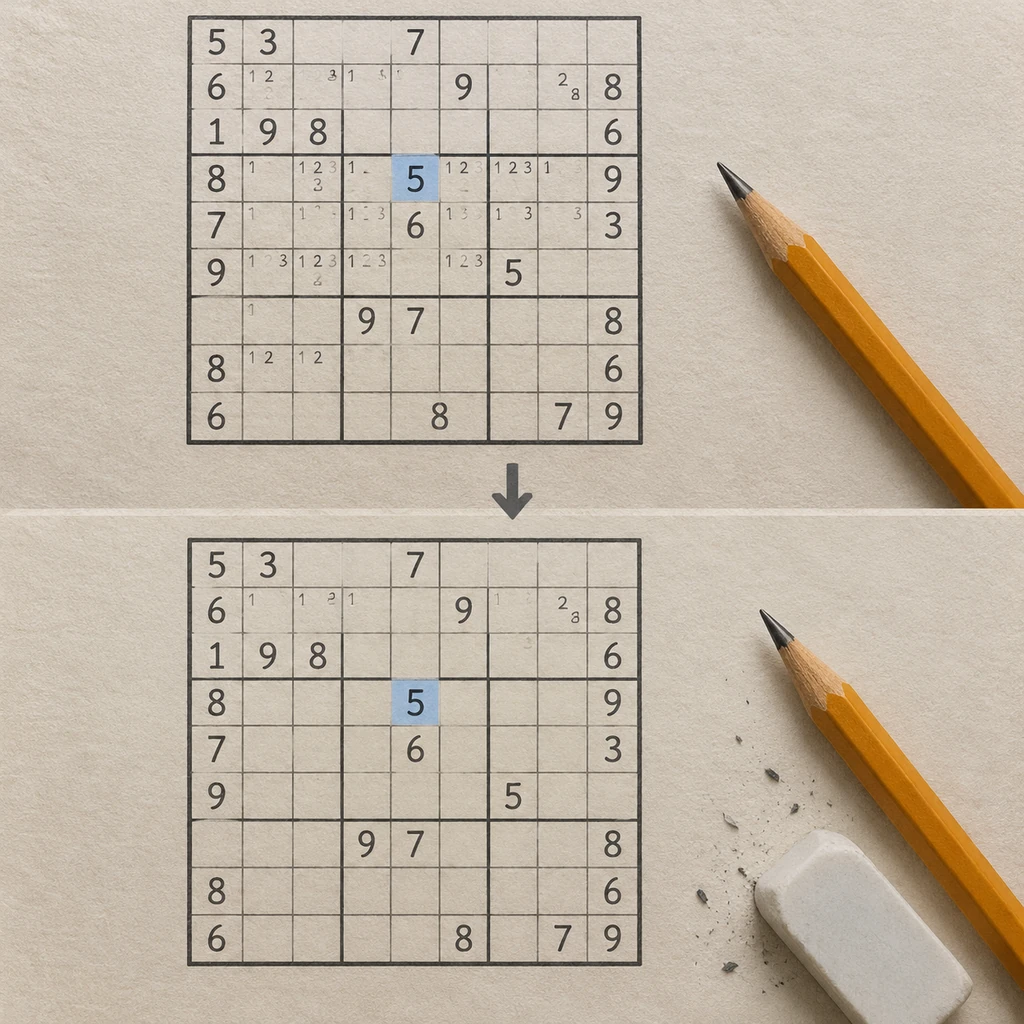
Good Sudoku notes do not need to fill every blank cell. They need to make the next useful comparison easy.
That is the value of Sudoku candidate order. It gives each mark a predictable place, makes pairs easier to compare, and makes stale information easier to remove. The order is not a strategy by itself. It is the quiet structure that lets real strategies show up.
When a grid feels noisy, do not immediately add more notes. Pick one unit, restore a consistent order, and look again. Very often, the puzzle has not hidden the next move. The page has simply made it hard to see.