



Sudoku candidate chain sounds more advanced than it needs to be. It does not require a dramatic pattern or a lucky guess. It is simply a short sequence of ordinary deductions: one candidate is removed for a clear reason, that cell or house becomes tighter, and the new restriction makes another removal visible.
The useful part is the order. If you make several unrelated changes at once, it becomes hard to tell which idea helped. If you follow one local consequence at a time, the puzzle starts to explain itself. You can stop when the chain stops, return to the updated grid, and begin another scan without carrying a vague hunch forward.
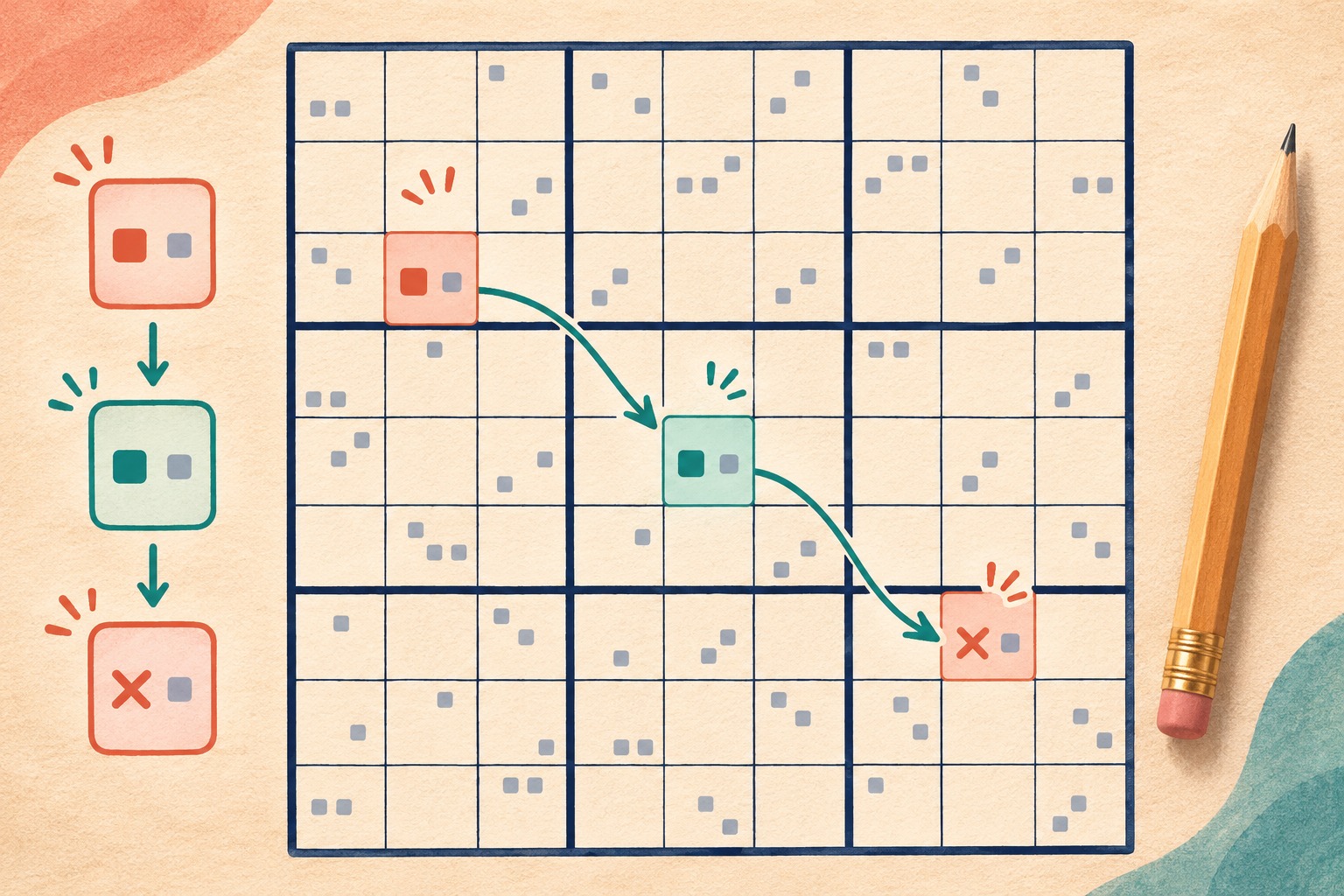
Sudoku candidate chain begins with one reason
A candidate is a digit that has not been ruled out for an empty cell. The basic exclusions come from the cell's row, column, and 3x3 box. The [Sudoku Coach lesson on eliminating candidates](https://sudoku.coach/en/learn/eliminate-candidates) presents the starting point clearly: a digit cannot remain possible when the rules already place that digit in a peer house.
Begin with a fact you can name. A 4 appears in the same column. A 7 is already in the box. A newly placed 2 affects the row. Remove that digit from the relevant notes, and do not call the result a chain yet. The chain begins when the change creates a second piece of evidence.
For example, a cell may begin with notes 3, 6, and 8. A 6 in its column removes 6, leaving 3 and 8. That pair is not a solved cell, but it may change the options in its box. If every other cell in the box can take 3 while only this cell can take 8, the house scan has produced a new question. The next deduction must still be checked, but it did not appear from nowhere. It came from the first removal.
Make the next consequence visible
After a candidate is removed, inspect the smallest area first. Check the cell. Then check its row, column, and box. This keeps the chain local and prevents you from searching the whole grid for a pattern that may not exist.
There are three common consequences.
**A cell becomes a single:** If only one candidate remains, verify it in all three houses before placing it.
**A digit gets one position in a house:** If a row, column, or box has only one cell where a digit can go, that is a hidden single.
**A house becomes easier to compare:** Two cells may now share the same pair, or a digit may be restricted to one line inside a box. That does not automatically finish the puzzle, but it creates a new scan target.
The [Sudoku Challenges guide to candidate elimination](https://blog.sudokuchallenges.com/learn-to-play/intermediate-sudoku/how-to-eliminate-candidates-in-sudoku/) is useful here because it treats candidate removal as the foundation for later techniques. You do not have to jump to an advanced label every time a note disappears. First ask what ordinary information became clearer.
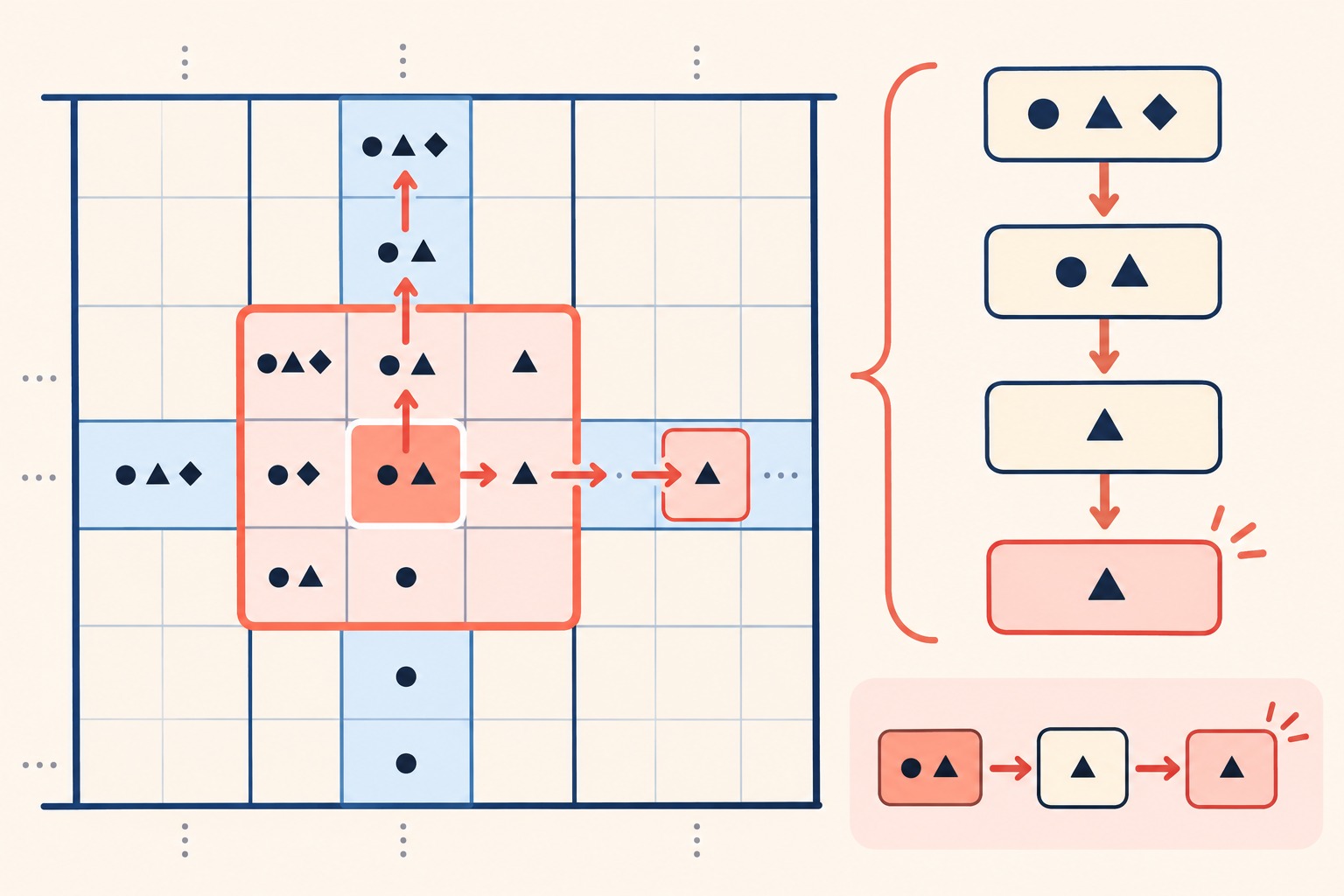
Use a small original example
Imagine the top-right box has four empty cells. The digit 5 appears in the notes of three of them, but all three positions sit in the same row. That does not place the 5 yet, but it tells you that no other cell in that row outside the box can take 5. Remove those outside candidates.
Now one cell elsewhere in the row loses its only 5 option and becomes a single for another digit. You place that digit, then update its column and box. A new candidate may disappear. This is a chain, but every step is still a normal rule:
1. The 5 candidates are confined to one row inside a box.
2. The row loses 5 outside that box.
3. Another cell becomes a single after the removal.
4. The new placement updates its peers.
The chain is not a promise that every puzzle will keep moving. It is a way to notice the next effect of a deduction you have already earned.

Know when the chain has stopped
A chain ends when the latest change creates no new confirmed restriction. That is a normal stopping point. Do not extend it by choosing the candidate you like best.
Stale notes are the main source of false chains. If an earlier placement was not propagated through its row, column, and box, a later pair or single may be based on an impossible digit. Over-erasing causes the opposite problem. If you delete a candidate because it “looks unlikely,” the next step may be built on missing evidence.
Keep a simple rule: every removal should have a source. If the source is a solved peer, name the row, column, or box. If the source is a pattern, name the pattern. If you cannot explain it, do not use it in the chain.
On paper, you can put a small dot beside the most recent active cell. In an app, pause after each placement and let the candidate notes update before scanning again. The [Easy Daily Puzzle Sudoku collection](https://easydailypuzzle.com/?s=sudoku) gives you a simple place to practice this pause without turning the session into a race.
A five-step candidate-chain check
Use this routine when the grid seems close to moving.
1. Choose one confirmed elimination and state its reason.
2. Inspect the affected cell, row, column, and box.
3. Look for a new single or a digit with one remaining position.
4. Apply only the next confirmed change, then update its peers.
5. Stop when no new proof appears and restart from the new grid state.
The fifth step is important. A chain is helpful because it is short enough to remember. When the evidence ends, do not keep the name and lose the discipline. Start a fresh scan from a different house or a different digit.
Small proofs are still progress
Some Sudoku moves feel important because they fill a cell. Others matter because they remove one option from the right place. A Sudoku candidate chain connects those quieter moves. It helps you see that a puzzle can advance before a number is ready to be written large.
Follow the evidence, inspect the smallest affected area, and let the next consequence earn its place. If the chain breaks, that is information too. You know which idea was valid, where it stopped, and where the next scan can begin.
For another practice board, visit the [Easy Daily Puzzle home page](https://easydailypuzzle.com/) and choose a Sudoku where you can work slowly enough to explain every removal.