



Spider solitaire empty columns are tempting because they feel like a gift. One whole column opens up, and suddenly the board has air. You can move a king sequence. You can shift a messy stack. You can rescue a card that has been trapped for ten moves.
Then, almost without thinking, you fill the space with the first legal card you see.
That is the mistake.
An empty column in Spider Solitaire is not just a parking spot. It is a tool. More exactly, it is a temporary workbench. If you spend it too quickly, the board may look cleaner for a moment, but your next repair gets harder.
If you play spider solitaire on Easy Daily Puzzle , this is one of the smallest strategy upgrades that changes the whole feel of the game: do not fill an empty column unless the move reveals, repairs, or builds toward a same-suit run.
Why spider solitaire empty columns matter
Bicycle Cards explains Spider Solitaire as a game of building full suit sequences and removing them from play. That goal sounds tidy. The path is not tidy at all.
The tableau gets crowded. Cards are face down. Mixed suits stack on top of each other. The stock adds pressure. A legal move can still be a bad move if it reduces your options.
Spider solitaire empty columns matter because they give you options back.
With an empty column, you can move a temporary card out of the way. You can turn over a hidden card. You can separate a mixed sequence. You can rebuild a same-suit run without locking every column at once.
That is why the open space is often more valuable than the card you want to place there. Spider solitaire empty columns are not decoration. They are the part of the board that lets you change your mind.
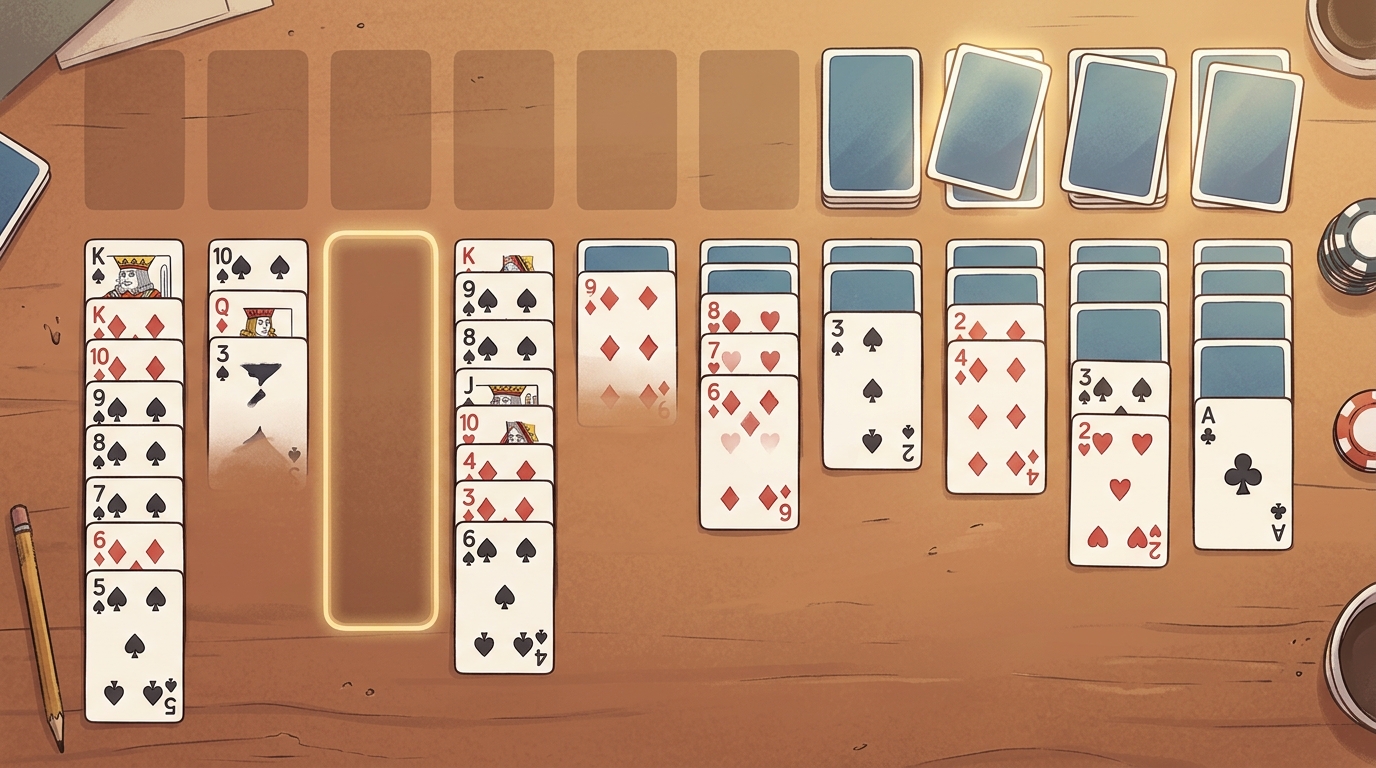
The one-move test before filling space
Before you fill one of your spider solitaire empty columns, ask one question:
What does this move make possible?
If the answer is "it looks neat," wait.
If the answer is "it turns over a hidden card," the move may be worth it.
If the answer is "it lets me move a same-suit sequence together," the move may be worth it.
If the answer is "it fixes a mixed stack so I can free another column," the move may be worth it.
The rule is not that empty columns must stay empty forever. That would be silly. The rule is that empty columns should buy something.
In Spider Solitaire, motion is cheap. Space is expensive.
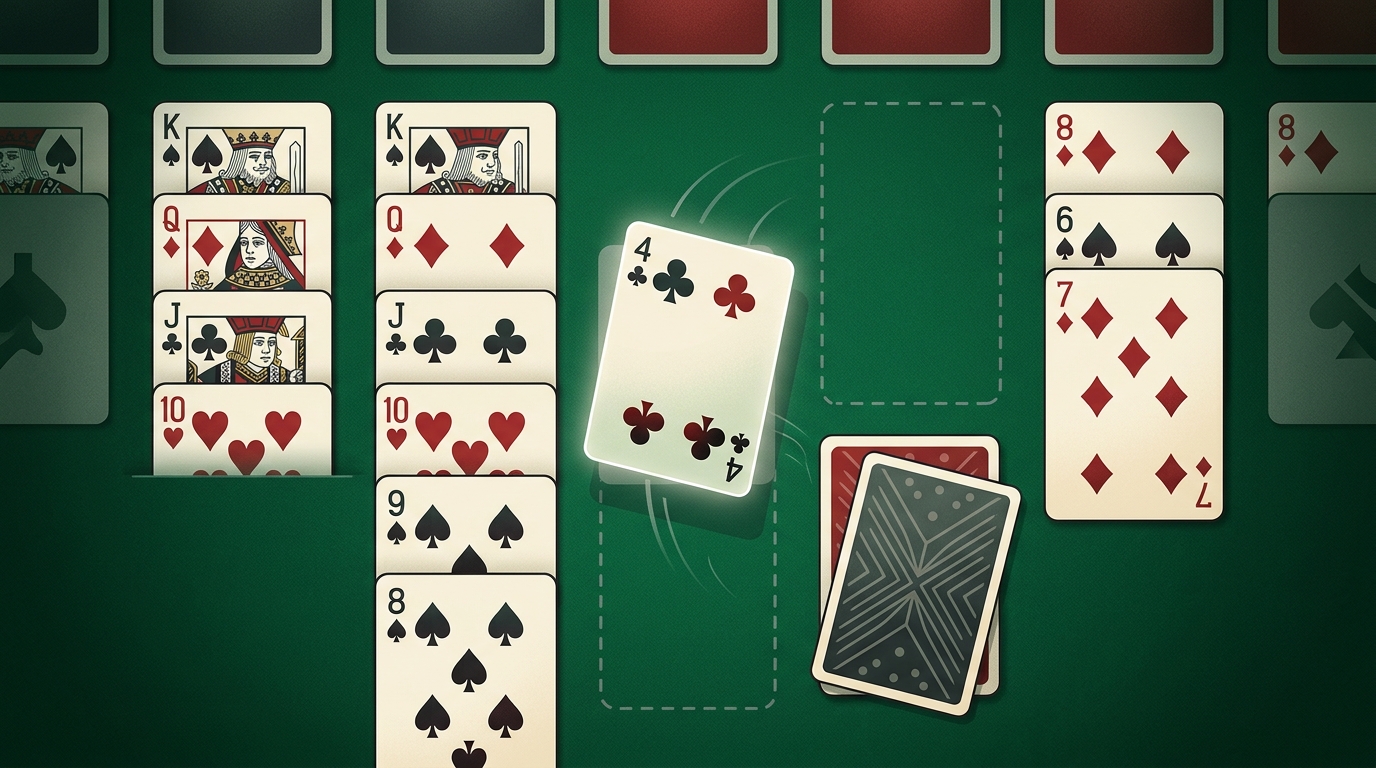
A common empty-column trap
Picture a board with one empty column. You have a black 9 sitting alone and a red 8 underneath another stack. You move the 9 into the empty column because the move is legal and tidy.
Now the empty column is gone.
Next, you notice a mixed sequence that could have been repaired if that space were still open. You also have a face-down card that could have been revealed with one temporary shift. The board did not collapse because the 9 moved. It collapsed because the space disappeared.
This is the trap: a legal move takes a flexible board and makes it stiff.
MobilityWare's beginner guide notes that a single card or group can be placed into an open empty column. That freedom is the point. The more flexible the empty space is, the more carefully you should spend it.
Think of the empty column as a spare hand. You do not want to fill your spare hand with the first object on the table.
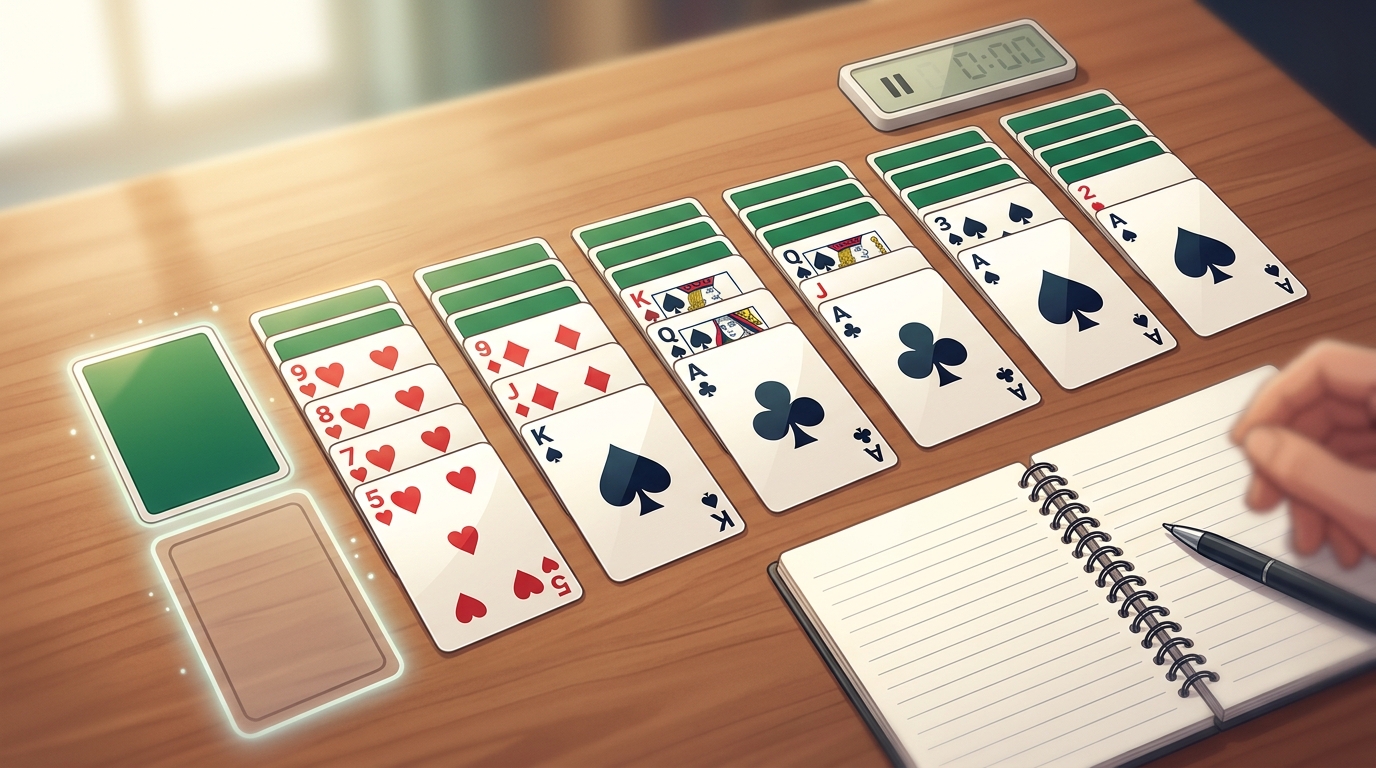
The best uses for an empty column
The best empty-column moves usually do one of three things.
First, they reveal a face-down card. This is often the strongest use because new information creates new moves. A hidden card may give you the missing rank for a run, or it may open another column later.
Second, they repair mixed suits. Mixed suits are sometimes unavoidable, especially in two-suit or four-suit Spider Solitaire. But they should stay temporary. An empty column lets you pull one card or sequence aside long enough to rebuild a cleaner stack.
Third, they protect a same-suit run. Same-suit sequences are powerful because they can move as a block and eventually clear from the board. If an empty column helps keep a run intact, that can be worth spending the space.
Notice what is missing from that list.
"Because I can" is not there.
A quick drill for your next game
Play one game with this restriction:
When you create an empty column, count to three before filling it.
During those three beats, look for hidden cards, mixed stacks, and same-suit repair opportunities. If the first move you saw still looks best after that check, make it. If a better use appears, take the better use.
This little delay is not about playing slowly. It is about preventing automatic moves.
Spider Solitaire punishes autopilot more than many casual card games. The board can look playable for a long time while the real problem is quietly forming: every column is occupied, every stack is mixed, and the stock is waiting to make things worse.
One protected empty column can stop that slide.
When to create an empty column
Opening an empty column is usually good, but it is not always urgent.
If creating the space requires burying a useful same-suit sequence, wait. If it forces you to mix suits in a way that cannot be repaired, wait. If it reveals a hidden card or frees a short column, it may be worth doing immediately.
Short columns are often good targets because they are easier to clear. A column with one or two face-up cards over hidden cards may be a better place to attack than a tall stack that needs too many repairs.
The question is not simply "Can I empty a column?"
The better question is "What will I do with the empty column once I have it?"
If you do not know, pause.
Practice on Easy Daily Puzzle
Open a game from Easy Daily Puzzle and play only for empty-column discipline.
Do not worry about winning the first game. Watch how often you spend space too quickly. Watch how often an empty column could have revealed a hidden card if you had saved it for one more move.
For a second session, browse more spider solitaire games on Easy Daily Puzzle and try the three-beat delay again.
You will start seeing the board differently.
The empty column is not a hole to fill. It is the part of the table where the next good move gets built. Once you start treating spider solitaire empty columns that way, the board becomes easier to read.
That small change makes Spider Solitaire feel less like damage control and more like planning.