



Solitaire tableau bridge card is a useful name for a card that connects options. It may let one descending sequence move onto another, open a blocked tableau pile, or turn a stranded card into a route toward a hidden card. “Bridge card” is not an official Klondike rule. It is a practical way to notice why one visible card matters more than another card of the same rank.
The best bridge card is not always the card closest to a foundation. Sometimes its value comes from the space between two piles. It creates a legal connection, and that connection can expose a face-down card or make a second sequence movable. Before moving it, check what it joins and what the move leaves behind.
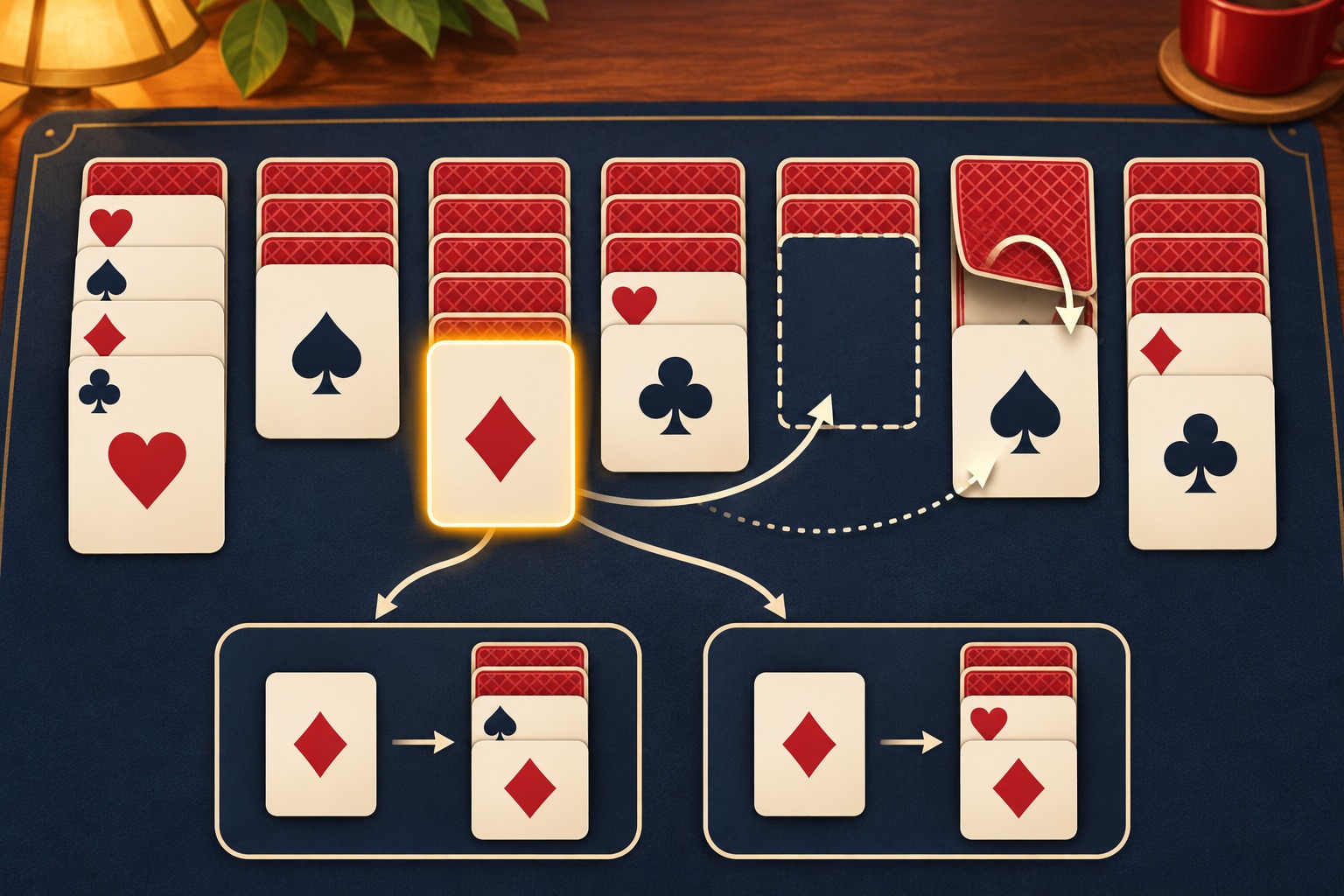
Solitaire tableau bridge card starts with rank and color
Klondike tableau building depends on descending rank and alternating colors. [Bicycle's Klondike rules](https://bicyclecards.com/how-to-play/klondike) state that a movable card can be placed on a card one rank higher if it is the opposite color. That simple rule creates the conditions for a bridge.
Suppose one pile ends with a red 8 and another visible card is a black 7. The black 7 may be a bridge because it can move onto the red 8. The move might also free the card underneath the black 7, or create a new place where a red 6 can be built. The card is useful because it connects the current pile to the next possible move.
Now look at the destination. If the red 8 is supporting a long, flexible sequence, moving the black 7 onto it may be good. If that move blocks a more valuable red 6 or consumes the only open route for a King-led stack, the bridge should wait. Rank and color tell you that a move is legal. They do not tell you that it is timely.
Look for two consequences, not one
A bridge move earns attention when it does more than relocate a card. Ask what it connects and what it releases.
**It connects sequences:** A short face-up stack may become part of a longer descending run.
**It exposes a card:** Moving the bridge card can turn a face-down tableau card face up. The rules make this important because the newly exposed card adds information and another possible route.
**It opens a destination:** A move may leave a tableau card free to accept a different color and rank later.
**It protects flexibility:** A good bridge can join options without using an empty column or sending a useful card to the foundation too early.
The [Solitaire City glossary](https://solitaire.city/glossary) is helpful for reading the layout as a set of tableau piles, foundations, stock, and waste. Thinking in these areas makes the bridge idea concrete. You are not looking for a magical card. You are looking for a card whose movement changes the relationship between two areas.
Compare a bridge with a foundation move
Foundation moves feel final, which can make them seem automatically better. In Klondike, foundations are built upward by suit from Ace to King. That is the goal, but the tableau is where access is created.
Imagine a black 4 that can go to its foundation or onto a red 5. If the red 5 sits above a face-down card, playing the black 4 onto it may help uncover that card later. If the black 4 is the only card needed to complete the next foundation step and the move also frees a blocked waste card, the foundation may be the stronger route.
The comparison is not “tableau good, foundation bad.” It is “which move connects more useful consequences right now?” A foundation move can be a bridge when it frees a card or changes what is playable. A tableau move can be decorative when it only makes a pile longer without opening anything.
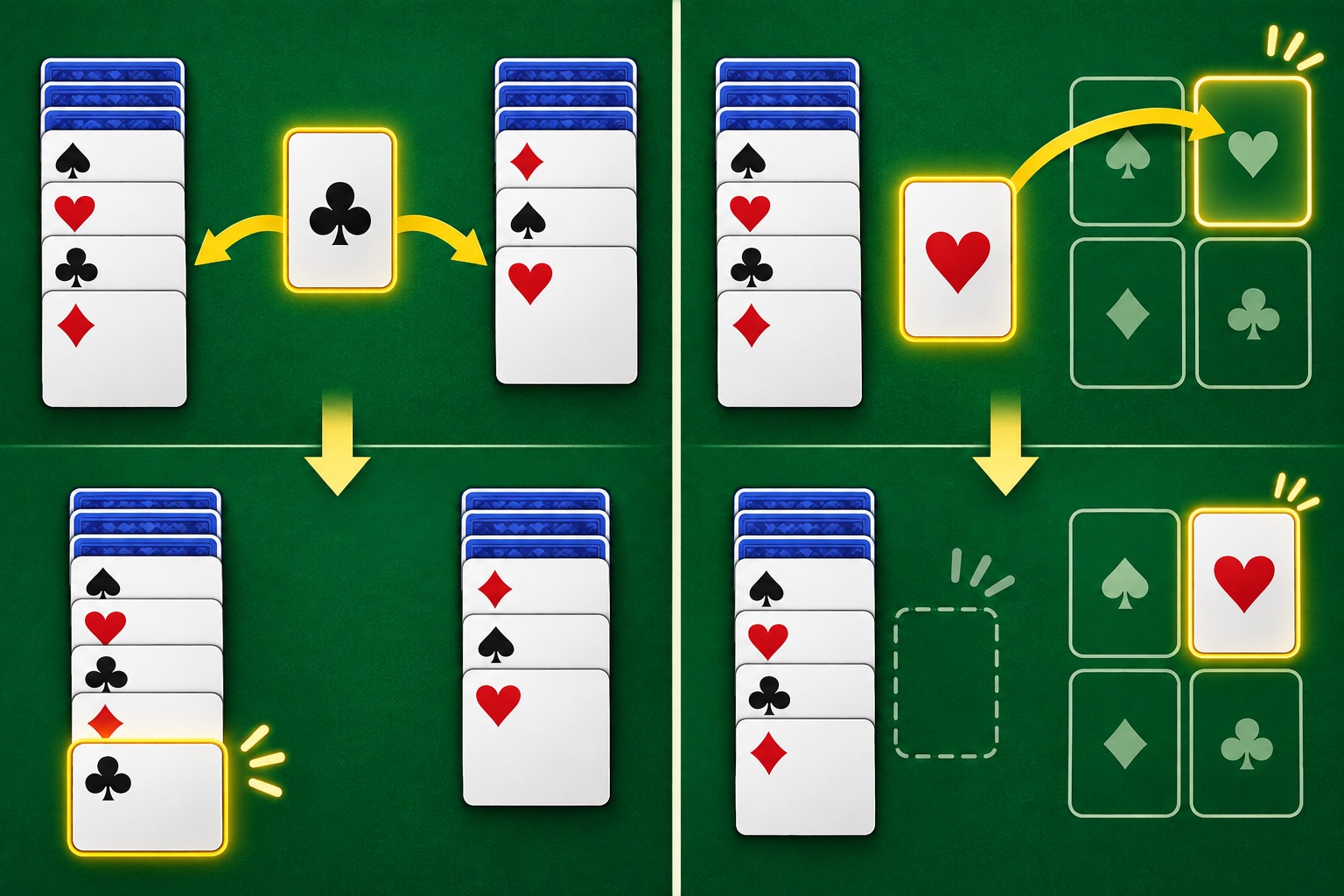
When the bridge card should stay put
Not every connectable card needs to move. A visible 7 may fit on a red 8, but the red 8 could be a temporary landing spot for another black 7 that is harder to access. Moving the first card may make the layout look active while removing a future option.
Wait when the destination is more flexible than the bridge card. Wait when moving the card hides the only route to a useful sequence. Wait when the move consumes an empty tableau column or separates a stack that is already close to revealing a face-down card.
The strongest reason to move is usually concrete: it exposes a hidden card, frees a needed card, or joins a sequence that can travel again. The weakest reason is visual neatness. A long column is not automatically a healthy column.
For practice, use the [Easy Daily Puzzle Solitaire collection](https://easydailypuzzle.com/?s=solitaire). Before moving a candidate bridge card, say the destination, the card it may expose, and the next card that could build on the new connection. If you cannot name a consequence, leave it in place for another scan.
A five-question bridge-card check
Use this routine when two tableau piles appear close to connecting.
1. Does the card fit by descending rank and opposite color?
2. What sequence does it connect, and how many cards travel with it?
3. Does the move expose a face-down card or free a blocked card?
4. Does it consume a flexible destination that another move needs?
5. After the move, do you have more routes, or only a longer-looking pile?
In draw-one play, you may have time to compare several visible options. In draw-three play, the waste order can make a bridge card harder to revisit. The rule does not change, but timing matters because the useful card may not return immediately.

Let the connection decide
Solitaire is full of cards that look ordinary in isolation. A 7 is just a 7 until it links a red 8 to a black 6, exposes a hidden card, or gives a blocked pile somewhere to go. That is the value of the bridge-card idea: it directs attention toward relationships instead of ranks alone.
When a move is legal, ask whether it connects two useful options. If it does, check what it reveals and what flexibility it spends. If the connection creates a new route, take it seriously. If it only makes the tableau look more organized, keep scanning.
For another layout, visit the [Easy Daily Puzzle home page](https://easydailypuzzle.com/) and look for a deal where two visible piles are one opposite-color card away from becoming useful together.