



Solitaire tableau bottleneck is the card or short stack that prevents the rest of the layout from opening up. It may sit on top of a face-down card, occupy the only empty column, or block the sequence you need to build a useful run. Finding that bottleneck is often more important than making the move that looks neatest.
Many games feel stuck because the player keeps asking, "What can I move?" A better question is, "Which card is stopping my next useful move?" That shift changes Solitaire from a hunt for legal motion into a plan for revealing information and preserving options.
You can practice this idea with the [free puzzle games at Easy Daily Puzzle](https://easydailypuzzle.com/), then [browse more Solitaire practice](https://easydailypuzzle.com/?s=solitaire) when you want another layout.
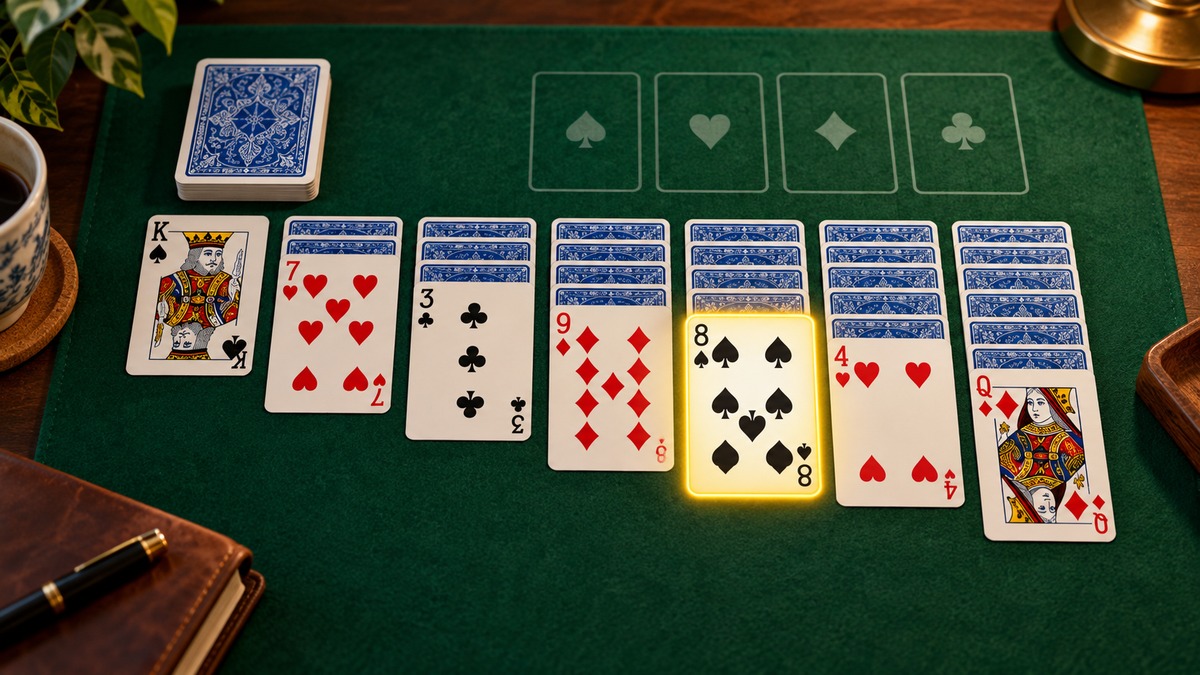
What Solitaire tableau bottleneck means
The tableau is the group of columns where cards are arranged during a standard Klondike-style game. Some cards are face up, while others remain hidden underneath. A legal move changes the layout, but a useful move changes what you can do next.
A bottleneck appears when one exposed card controls access to something more valuable. For example, a black 8 may be sitting on a red 9, and that red 9 may be covering a face-down card. The black 8 is movable in theory, but moving it may not be the real priority. The important question is whether the move exposes a card, creates a flexible sequence, or simply shifts the same problem to another column.
This is why a tidy tableau can be misleading. A move that makes columns look balanced may spend the only destination that could have revealed a hidden card. A slightly messy position may be stronger if it keeps several colors and ranks available.
Find the blocking card before you move
Start with a quick scan of the face-down cards. Which columns still contain hidden cards? Which exposed card sits directly above the next card you want to reveal? That exposed card is a possible bottleneck.
Next, check whether it can move to another column. A legal destination is not automatically a good destination. Ask what the move unlocks. If moving the card reveals a face-down card, the move has information value. If it only places the card on a different stack while keeping the same hidden card covered, the position may not have improved.
Then look at the empty columns. An empty column is valuable because it can hold a king or a sequence beginning with a king, depending on the rules. Filling it with a card that cannot move again may remove your best repair space. Do not treat an empty column as an invitation to place the first legal card you see.
The standard [Bicycle Cards guide to Solitaire](https://bicyclecards.com/how-to-play/solitaire) is a useful rules reference. Strategy begins after the rules are clear: the challenge is choosing which legal move changes the future of the tableau.
Three kinds of bottleneck
This is the card covering a face-down card that you most need to access. It is often the easiest bottleneck to recognize. If one move exposes a hidden card and another move only rearranges face-up cards, the reveal usually deserves priority.
Do not reveal blindly, though. Check whether the new card can be used. A reveal that produces a stranded card may be less valuable than a move that opens a clean sequence or protects an empty column.

The space bottleneck
This appears when the tableau has no spare column for a necessary transfer. You may have the right cards in the wrong order, but no place to park them while you reach the blocking card. In this case, the goal is not immediate foundation progress. It is to create or preserve a flexible space.
A space bottleneck is why moving a low card to the foundation too early can hurt. The card may be safely placed, but it may also be the only card that could have helped you move a sequence in the tableau. Safety and usefulness are not always the same thing.
The color bottleneck
Sometimes the needed rank is available, but the color pattern prevents the move. A red card may be ready to accept a black card, while the required black card is buried under another sequence. The visible cards look close to completion, yet the color alternation has created a wall.
To solve a color bottleneck, find the shortest sequence that can be moved to expose the buried card. Avoid moving a long stack simply because it is legal. A smaller transfer may create the opening while keeping more cards available for later repairs.
Use the bottleneck to choose a move
Once you identify the likely blocker, compare moves by what they reveal. A useful order is:
1. A move that exposes a face-down card and leaves a workable destination.
2. A move that creates an empty column without trapping the space.
3. A move that breaks a blocked color pattern or opens a long sequence.
4. A foundation move that improves the position without removing a needed tableau card.
5. A harmless rearrangement only when it improves future access.
This is not a rigid law. Some layouts require a temporary move that does not reveal anything immediately. The point is to name the reason for the move. If you cannot say what the move is preparing, pause before making it.

Do not confuse motion with progress
Solitaire gives you many legal moves that are strategically empty. You can move a red 6 onto a black 7, move the same 6 back later, and feel busy without changing the information available on the board. That loop is a warning sign.
When you see repeated motion, return to the bottleneck. Which card is still covering the hidden card? Which empty column is still unavailable? Which color pair is still preventing the transfer? The answer may suggest a different move order.
A good move often looks modest. It may expose one face-down card, move a king into an empty column, or clear a single low card from a crowded stack. The value comes from what that small change lets you inspect next.
A practical scan for a new deal
Before your first move, take ten seconds to read the tableau. Count the face-down cards in each column. Note the empty columns, the exposed kings, and the lowest exposed cards. Then mark one likely bottleneck in your head.
After every major move, scan again. The bottleneck can change. A card that mattered at the start may become irrelevant after a reveal, while a new blocked column becomes the urgent problem. This short reset prevents you from following a plan that belonged to the old position.
If the stock is available, do not use it simply to create activity. Check whether the next deal could provide the color or rank needed to remove the bottleneck. If it cannot, use the tableau to improve the position first. Stock timing is part of tableau strategy, not a separate phase of the game.
The habit that makes Solitaire clearer
The next time a layout feels frozen, stop searching for any legal move. Look for the card that is holding the position closed. That is your Solitaire tableau bottleneck.
Try to move it only when the destination serves a purpose: reveal a hidden card, create usable space, repair a color sequence, or open a path toward the foundations. If no move does that yet, keep the options you have and inspect the stock carefully.
Solitaire becomes easier to read when every move has a job. The tableau does not need to look perfect. It needs to keep giving you a way to reach the cards that are still hidden.