



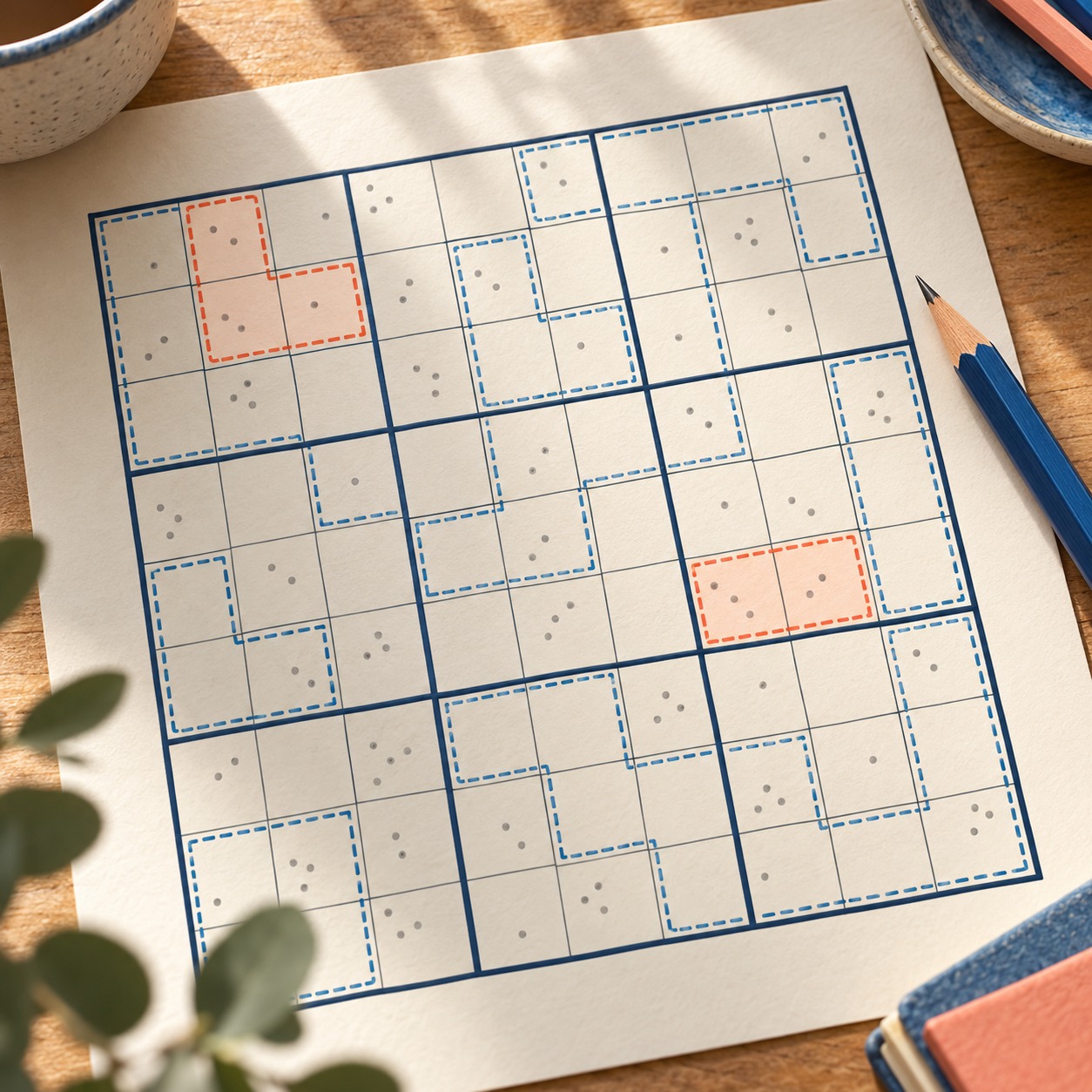
Killer Sudoku cage totals give the familiar Sudoku grid a second language. The rows, columns, and boxes still control where a digit may go. The small outlined cages add arithmetic: the numbers inside must combine to reach the total printed in the corner.
That extra clue can feel intimidating at first. It is actually a useful way to make a vague part of the grid more specific. You do not have to solve every cage immediately. Start with the cages whose size and total leave only a few sensible combinations, then let ordinary Sudoku rules do the rest.
Killer Sudoku cage totals begin with ordinary Sudoku rules
Before doing any arithmetic, remember the base game. Each row, column, and 3 by 3 box must contain the digits 1 through 9 once. A cage does not replace those rules. It adds another restriction to the same cells.
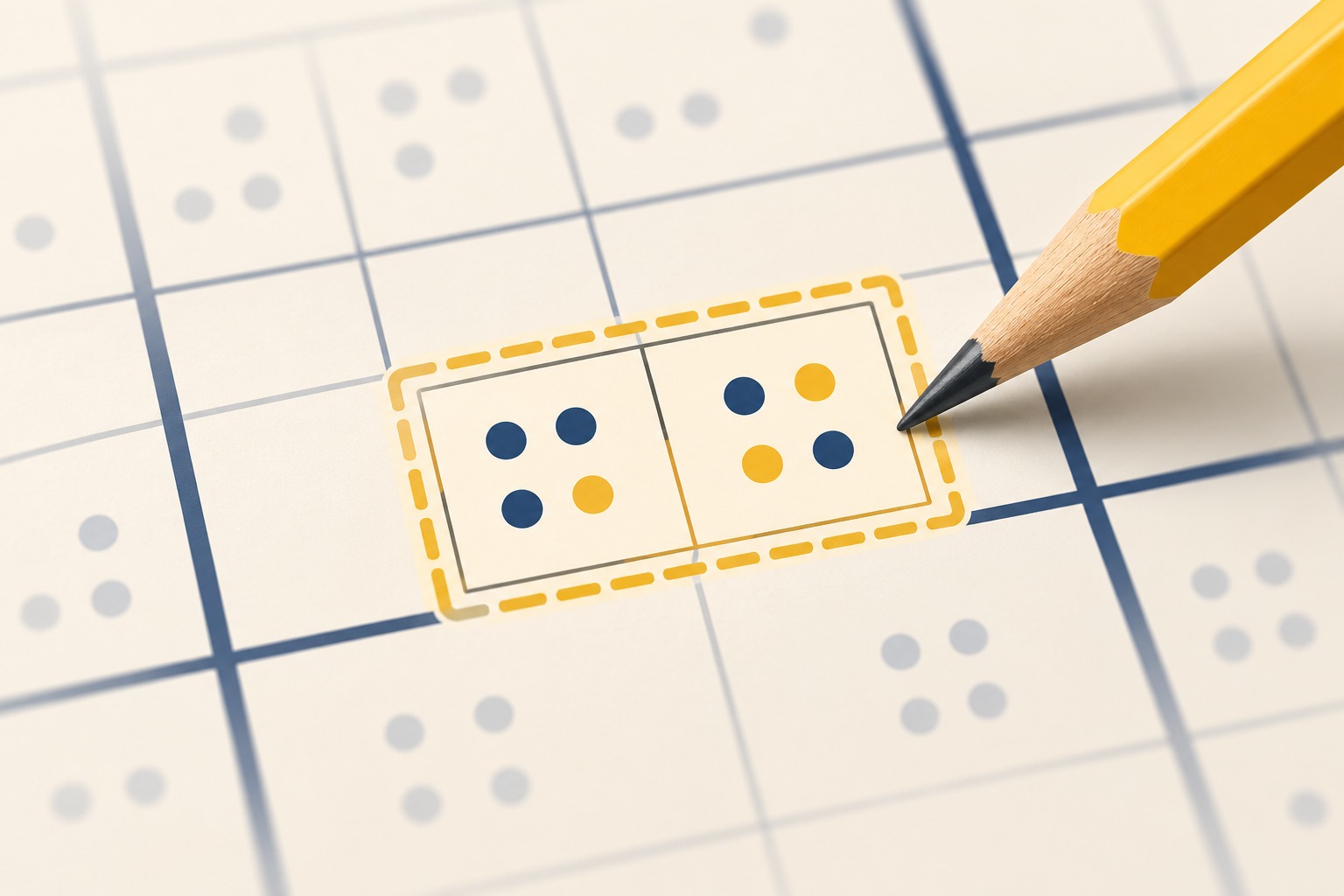
That order matters. If a two-cell cage has a total of 10, several pairs may work: 1 and 9, 2 and 8, 3 and 7, or 4 and 6. The cage total alone does not tell you which cell gets which number. The row, column, and box may remove most of those pairs before you write anything.
The official [Conceptis explanation of Killer Sudoku](https://www.conceptispuzzles.com/index.aspx?uri=puzzle/killer-sudoku) is useful for checking the basic format. It describes the cage totals and the familiar no-repeat rule together, which is the right way to approach the variant. Treat the arithmetic as an extra filter, not as a separate puzzle pasted on top.
How to read a two-cell cage without guessing
The easiest starting point is a small cage with a restrictive total. Consider a two-cell cage that adds to 3. Because a standard Sudoku cannot repeat a digit in the same unit, the only possible pair is 1 and 2. You still may not know the order, but you know the two cells as a set.
Now consider a two-cell cage that adds to 17. The pair must be 8 and 9. Again, the exact order depends on the crossing units. These extreme totals are friendly because the arithmetic does most of the narrowing before the grid rules begin.
Middle totals require more care. A total of 10 has several combinations, but a box restriction may eliminate 1 and 9 if one of those digits already appears in the box. A row restriction may remove 3 and 7 from one cell. Keep the pair as a pair until the board proves the order.
This is the first habit worth keeping: write a combination before writing a placement. A note such as `{4,6}` records useful information without pretending that the cage has already been solved.
Use the cage and the box together
Killer Sudoku becomes much more readable when you stop treating a cage as an isolated island. Look at the cage's box first. Which digits are already used there? Which candidates remain in each cell? If the cage requires a pair and one cell can take only one member of that pair, the order is solved naturally.
Three-cell cages work in the same way. A total of 6 has only one combination of three different Sudoku digits: 1, 2, and 3. A total of 24 has a much smaller group of high-digit combinations than a middle total. The exact list depends on the rule that digits cannot repeat in the relevant unit, so do not copy a combination from memory without checking the cage layout.
The [World Puzzle Federation Sudoku resources](https://www.worldpuzzle.org/) are a useful place to keep the wider puzzle context in view. For a casual solve, you do not need a catalogue of every combination. You need a short list for the cage in front of you and a way to cross out a pair when a row, column, or box makes it impossible.
Three mistakes that make cages look harder
The first mistake is repeating a digit inside a cage without checking the units. If the cage crosses multiple boxes, the no-repeat rule still applies within each row, column, and box. Arithmetic does not grant a special exception.
The second mistake is treating the printed total as an order. A cage total of 10 gives a set of possibilities, not a left-to-right instruction. Let the crossing cells decide which number belongs where.
The third mistake is listing every mathematical combination and keeping them all forever. Candidate notes should shrink. If a row removes one member of a pair, erase that pair and update the cage. A crowded cage is often a sign that the surrounding Sudoku information has not been applied yet.
A short Killer Sudoku cage totals routine
Try this routine on a fresh grid:
1. Mark the smallest cages and the most extreme totals.
2. List legal combinations without assigning an order.
3. Check each cage against its rows, columns, and boxes.
4. Place only a digit that has one legal home or one legal combination member.
5. Recheck every cage touched by the placement.
The last step is where many clean moves appear. A number placed in one box may remove a combination from a nearby cage. A cage that looked open a minute ago can become a forced pair after one ordinary Sudoku deduction.
If you reach a cage with several combinations, leave it alone. Move to another part of the grid and return later. Killer Sudoku rewards delayed certainty. The arithmetic will still be there, but the crossing rows and columns may have changed the question.
Let the total guide your attention
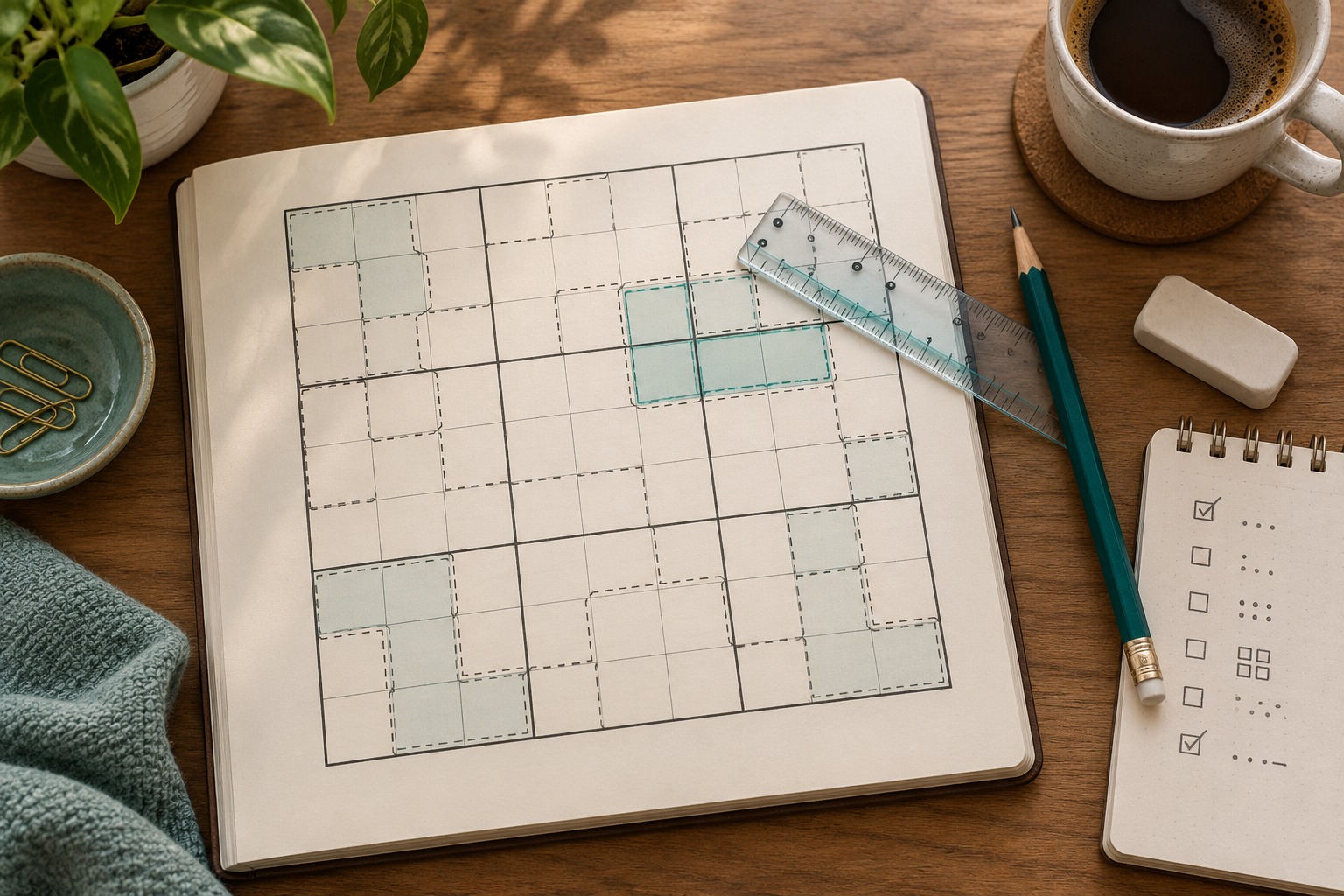
Killer Sudoku cage totals are most useful when they guide the next scan rather than demand an immediate answer. Extreme totals are good entry points. Small cages are good places to store precise combinations. Larger cages are often easier after a few surrounding numbers have been placed.
For a fresh daily challenge, try the [Sudoku section on Easy Daily Puzzle](https://easydailypuzzle.com/?s=sudoku), then return to the [Easy Daily Puzzle game library](https://easydailypuzzle.com/) when you want a different kind of break.
The best Killer Sudoku move may be a number, a pair, or simply a cage that has become easier to read. Keep the arithmetic honest, let the grid confirm the order, and the variant starts to feel less like extra work and more like extra information.