



Jigsaw repeated texture is what turns a simple blue sky into a box of nearly identical pieces. The picture looks calm. The table is not. Every piece seems to have the same pale color, the same soft edge, and no obvious object to claim.
This is the point where many solvers return to the border and start forcing pieces. A better move is to stop calling the area "blue" and look for the texture inside the blue. Some pieces are brighter. Some have a grain. Some carry a faint cloud edge, a shadow, a reflection, or a change in direction.
Start a fresh puzzle on [Easy Daily Puzzle](https://easydailypuzzle.com/), then browse [more jigsaw puzzles and articles](https://easydailypuzzle.com/?s=jigsaw). The aim is not to sort every piece perfectly. It is to turn one large uncertain field into two or three smaller fields that can be tested.
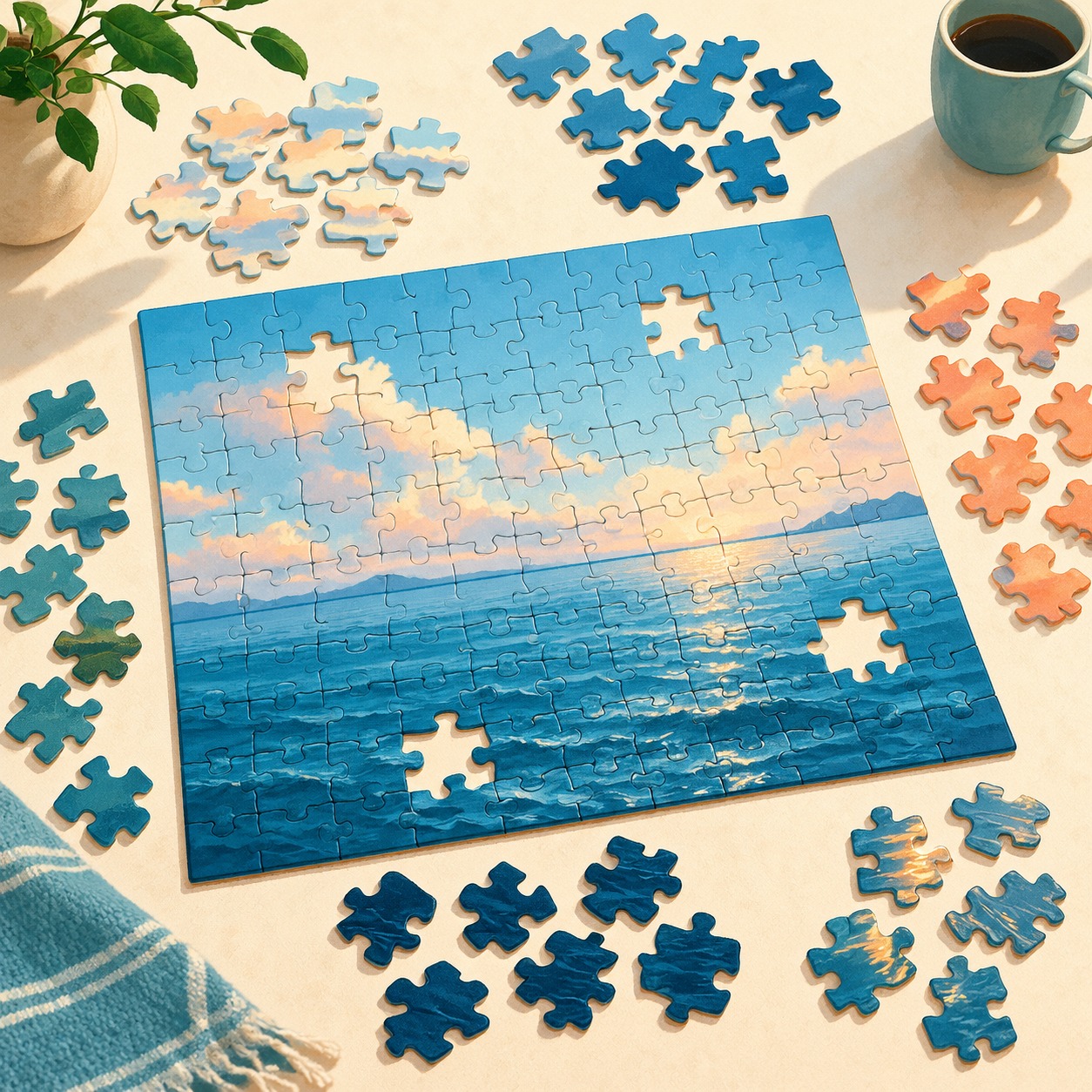
Jigsaw repeated texture is more than a color problem
Color is useful when the image has strong regions: a red roof, a yellow sign, a dark tree line. It becomes weak when the picture contains a large sky, a lake, a wall, sand, or a field of grass.
Repeated texture gives you other evidence. Look at the direction of tiny marks, the distance between lines, the amount of light, and the way a shadow fades. Two pieces may both be blue, but one may be smooth and bright while the other has a darker lower edge. They belong to different neighborhoods even before you know where either piece sits.
This is why a piece sorting tray with a single color group can feel unhelpful. It has collected the right color but the wrong level of detail. Split the group again by what the surface is doing.
The [World Jigsaw Puzzle Championship rules](https://worldjigsawpuzzle.org/wjpc/2026/rules) use an unpublished 500-piece puzzle for the individual event, which makes visual reading important under a fixed time limit. Casual players do not need to race, but the same principle transfers well: when a broad color category is too large, sort by smaller visual signals.
A three-zone method for repeated textures
Take a pile of pale blue pieces. Do not try to place them immediately. Make three temporary groups.
The first group is smooth or open. These pieces have little visible detail and may belong to the center of a sky or a quiet wall.
The second group has a mark. Look for a cloud edge, bird shape, branch, wave line, roof angle, or any small interruption in the repeated surface.
The third group has a light change. Some pieces are warmer, darker, cooler, or more gray. A gradual change in the image often tells you more than the base color.
Then use the preview image. Look for the larger shape each group might build. The marked pieces may follow a horizon. The darker pieces may collect near the lower edge. The smooth pieces may fill the open center. You are not proving a location yet. You are making a reasonable map.
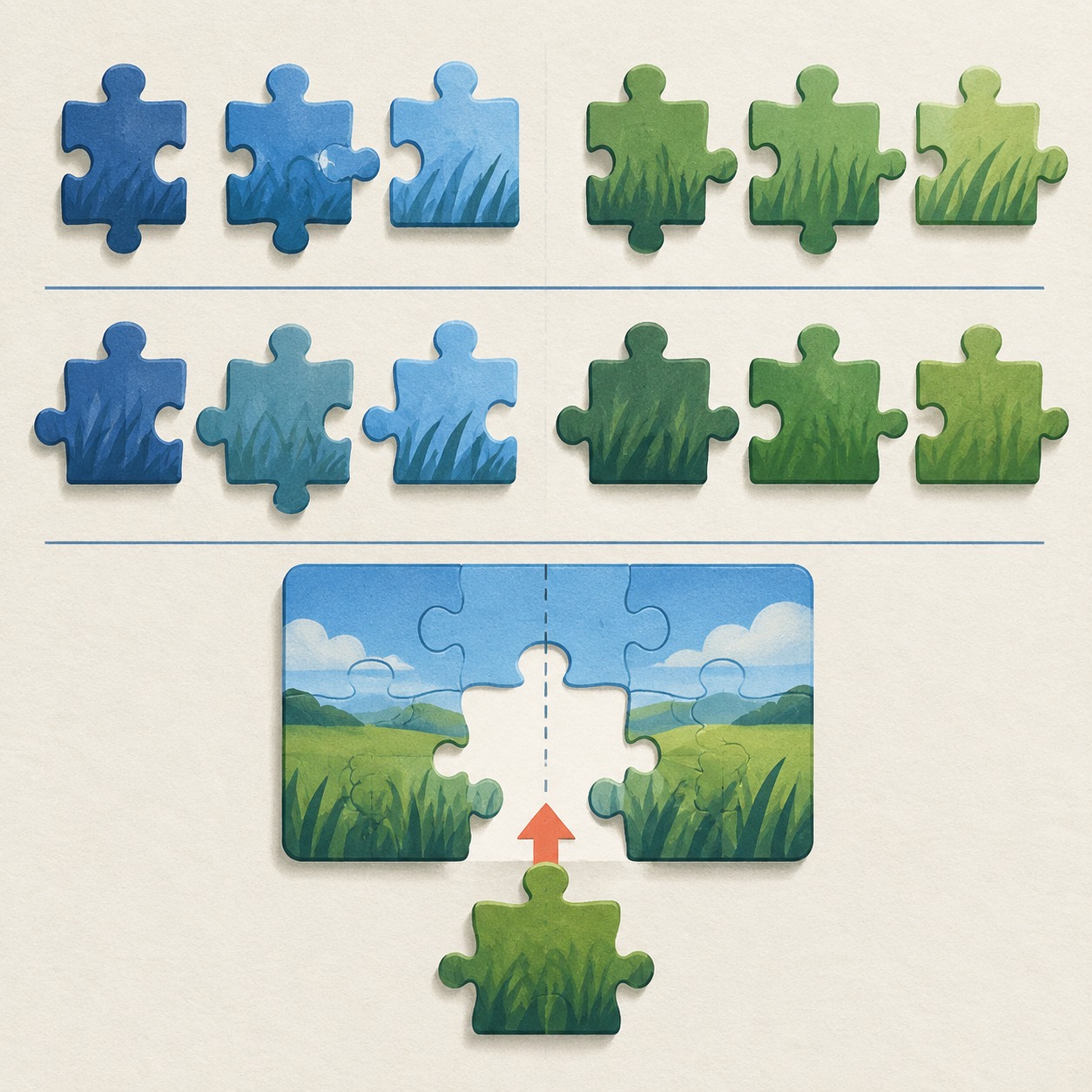
Read the grain before the tab
Piece shape gets most of the attention in a difficult section, but the picture's grain can be just as useful. A water surface may carry horizontal lines. Grass may break upward. Wood may run diagonally. A building facade may repeat vertical marks.
Hold two possible pieces next to the gap without pushing them together. Continue the visible line across the hole. If the line changes direction for no reason, the fit is probably false even if the tabs and blanks look compatible.
This test works especially well for online puzzles, where rotation and snapping can make a nearly correct piece feel more convincing than it should. Let the image direction challenge the shape. A piece has to match both.
Light is another form of grain. In a sky, the upper section may be cooler and lighter while the lower section picks up warm color from a sunset or a landscape. In water, a reflection can repeat the color of an object but not its texture. Separate those surfaces before trying to build one giant blue area.
The missing hole tells you which texture to test
When a piece will not fit, study the gap instead of the piece in your hand. Is the hole narrow on one side? Does it have a flat edge that belongs to a line? Does the missing shape sit beside a darker region or a smooth region?
The hole often gives you a smaller search area. If the gap has a long horizontal shoulder and a soft blue interior, search the smooth horizontal group first. If it has a sharp diagonal corner beside a shadow, check marked or light-change pieces rather than the entire blue pile.
The [Strong National Museum of Play's history of the first jigsaw puzzle](https://www.museumofplay.org/blog/the-first-jigsaw-puzzle/) gives useful background on how early dissected maps turned visual information into separate pieces. Modern images are more complex, but the basic challenge is familiar: rebuild a larger picture from fragments that make more sense when their neighbors are considered.
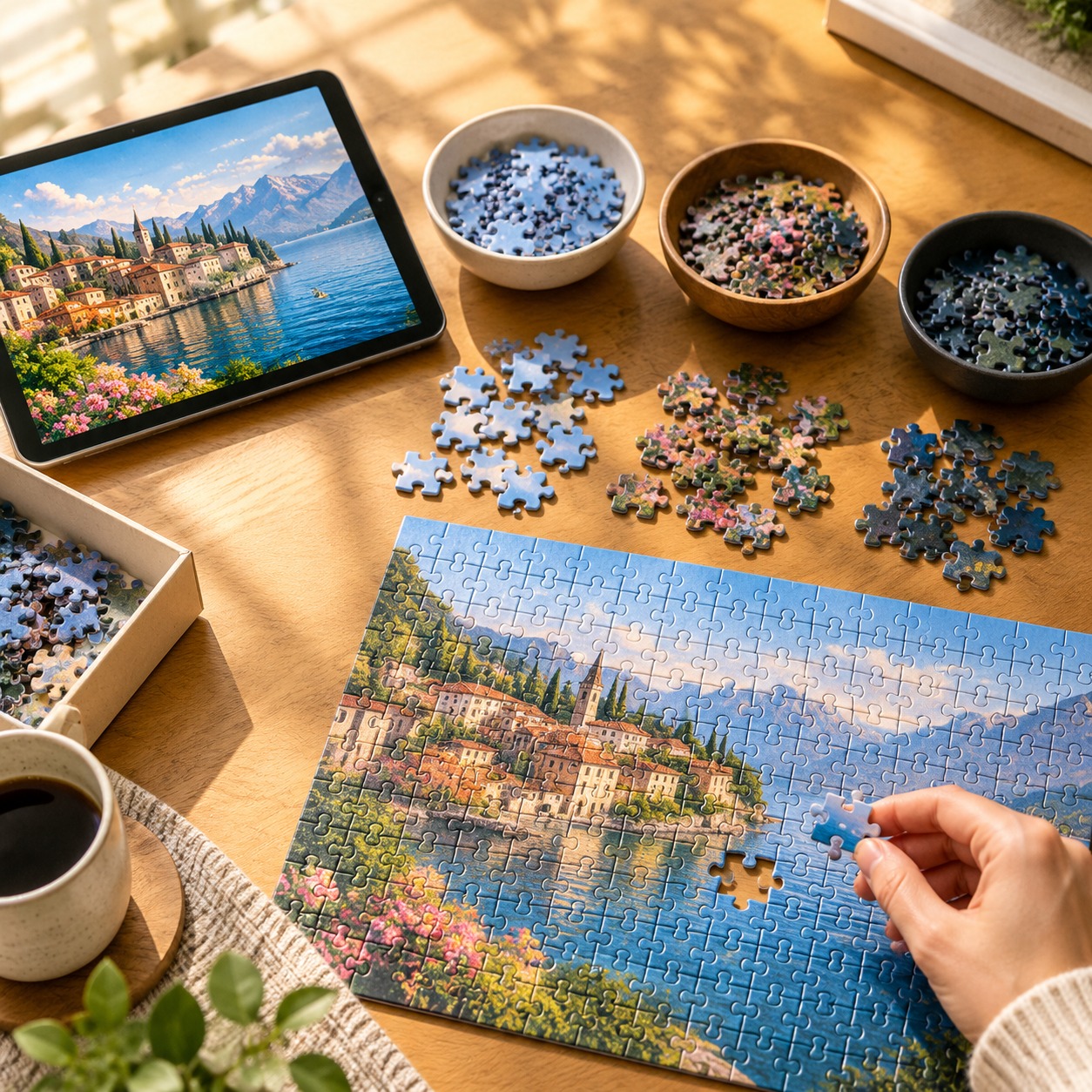
Avoid the repeated-texture false fit
Repeated fields create the most convincing false fits because many pieces share the same color and a similar cut. Before you press a piece into place, check four things:
- Does the line or grain continue?
- Does the light level match the surrounding image?
- Does the piece's texture belong to this local zone?
- Does the neighboring piece still look natural after the fit?
If one answer is no, leave the piece loose. A piece that almost fits can be more expensive than an empty gap because it makes the next comparisons harder. It also creates a new edge that other pieces may appear to follow.
You do not need to reject every uncertain placement. Mark the difference between "probably right" and "confirmed." That small distinction lets you build around a useful guess without treating it as part of the finished picture.
A practical Jigsaw repeated texture routine
Use this routine when a large color field stops giving you clues:
1. Gather the broad color group, but do not leave it as one pile.
2. Split it by marks, light, grain direction, and surface softness.
3. Use the preview to identify likely zones for each group.
4. Study the shape and texture of the open gap.
5. Test one piece without forcing it.
6. Confirm the fit by line continuation and neighboring texture.
For an online puzzle, rotate the piece only after you know which visual zone it belongs to. Rotation can be useful, but it should not replace reading the picture. Start with the evidence that does not change when the piece turns.
Let the difficult blue area become a map
Jigsaw repeated texture feels difficult because the image is repeating information at a large scale. The way out is to read smaller differences. A blue sky is not just blue. It has light, cloud, grain, horizon, and distance. Green grass has direction and shadow. Water has reflection and movement.
On your next puzzle, choose one broad field and make three temporary texture groups before placing anything. You may not solve the whole section at once. You will give your eyes a smaller problem, which is usually enough to make the next correct piece easier to recognize.
Play a new puzzle through [Easy Daily Puzzle's jigsaw library](https://easydailypuzzle.com/?s=jigsaw). When several pieces look alike, do not ask which one feels closest. Ask what the surface is doing and whether the open gap agrees.