



Jigsaw puzzle visual landmarks are the details that give a loose pile somewhere to begin. A face, window, roofline, sign, branch, horizon, or sharp color junction carries more information than a tray full of pieces that are simply “blue” or “green.”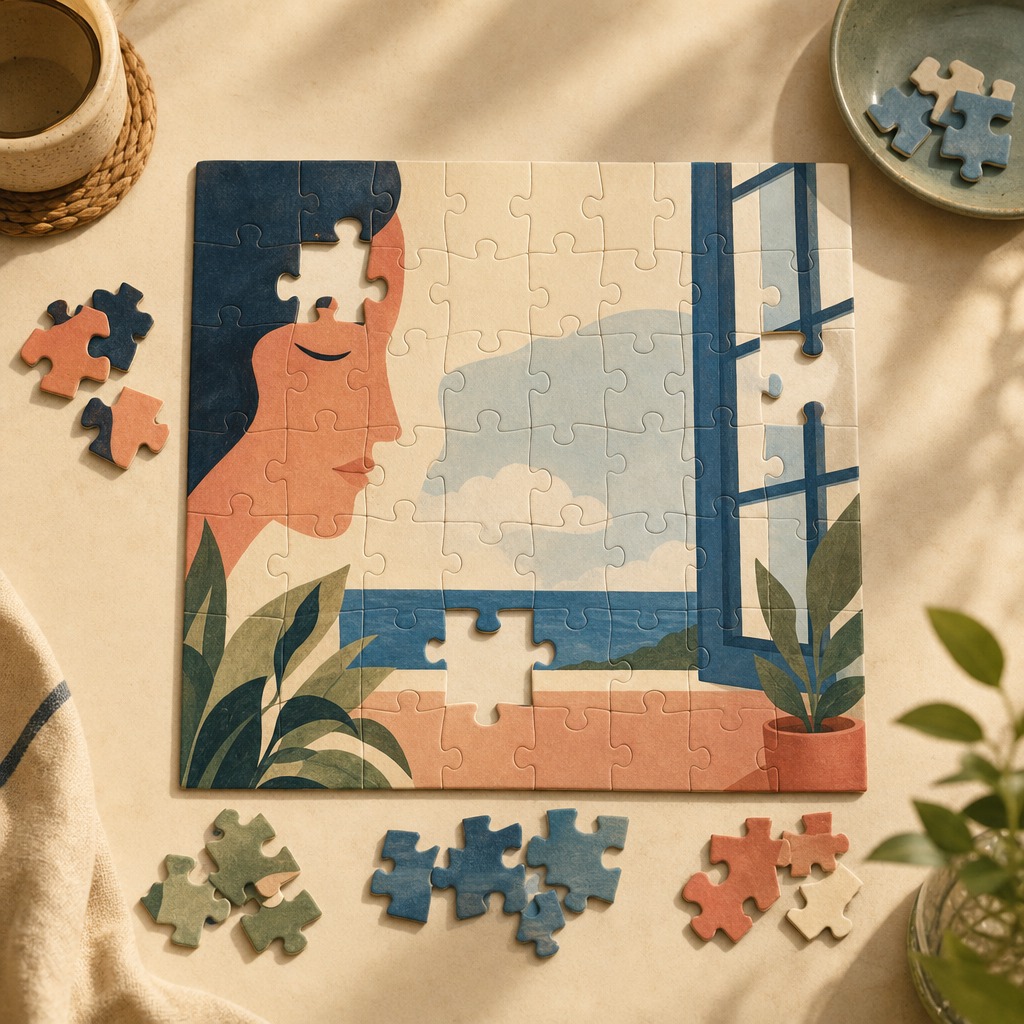
The goal is not to find the first piece and then solve outward in a straight line. The goal is to build a small island that tells you what its neighboring pieces should look like. Once the island has a direction, the larger pile becomes easier to read.
Start a new puzzle on [Easy Daily Puzzle](https://easydailypuzzle.com/), then browse [more jigsaw puzzles and articles](https://easydailypuzzle.com/?s=jigsaw). A landmark works best when it gives you two kinds of evidence: a recognizable image detail and a reliable edge, line, or texture that can continue into nearby pieces.
What counts as a visual landmark?
A visual landmark is any small part of the image that is easier to identify than the background around it. Faces are obvious examples, but they are not the only useful ones. Look for a window frame, a wheel, a printed letter, a fence post, a roof corner, a bright flower, or a sharp change between shadow and light.
Lines are often better than large color areas. A horizon gives you direction. A branch gives you a curve. A roof edge gives you an angle. A stripe on clothing can continue across several pieces even when the base fabric is similar.
The Museum of Play research on puzzlers describes players sorting by color, texture, and depicted objects, then switching to interlocking shapes when the image offers fewer markers. That is a useful description of how a landmark works: it gives the eye a concrete feature before shape becomes the main evidence. You can read the study here: [Understanding jigsaw puzzlers’ techniques and motivations](https://www.museumofplay.org/app/uploads/2022/01/5-3-article-explorers-detectives-matchmakers-and-lion-tamers.pdf).
Choose information, not just something easy to see
The largest object in the picture is not automatically the best starting point. A broad sky may cover half the box and still tell you almost nothing about where each piece belongs. A small red bicycle light may identify only a few pieces and show the direction of a wheel.
Ask three quick questions before you make a pile:
- Does this detail appear on a limited number of pieces?
- Does it contain a line, corner, or color break that can continue?
- Will the finished patch tell me which neighboring zone to search next?
If the answer is yes to two of these, you have a useful landmark. If the detail is only a broad shade with no direction, keep it in a wider color group for now.
This is why a small object can beat a large landscape. The object reduces the search area and gives the growing island a shape. You are solving the picture's structure, not trying to place every matching color at once.
Build the first island in layers
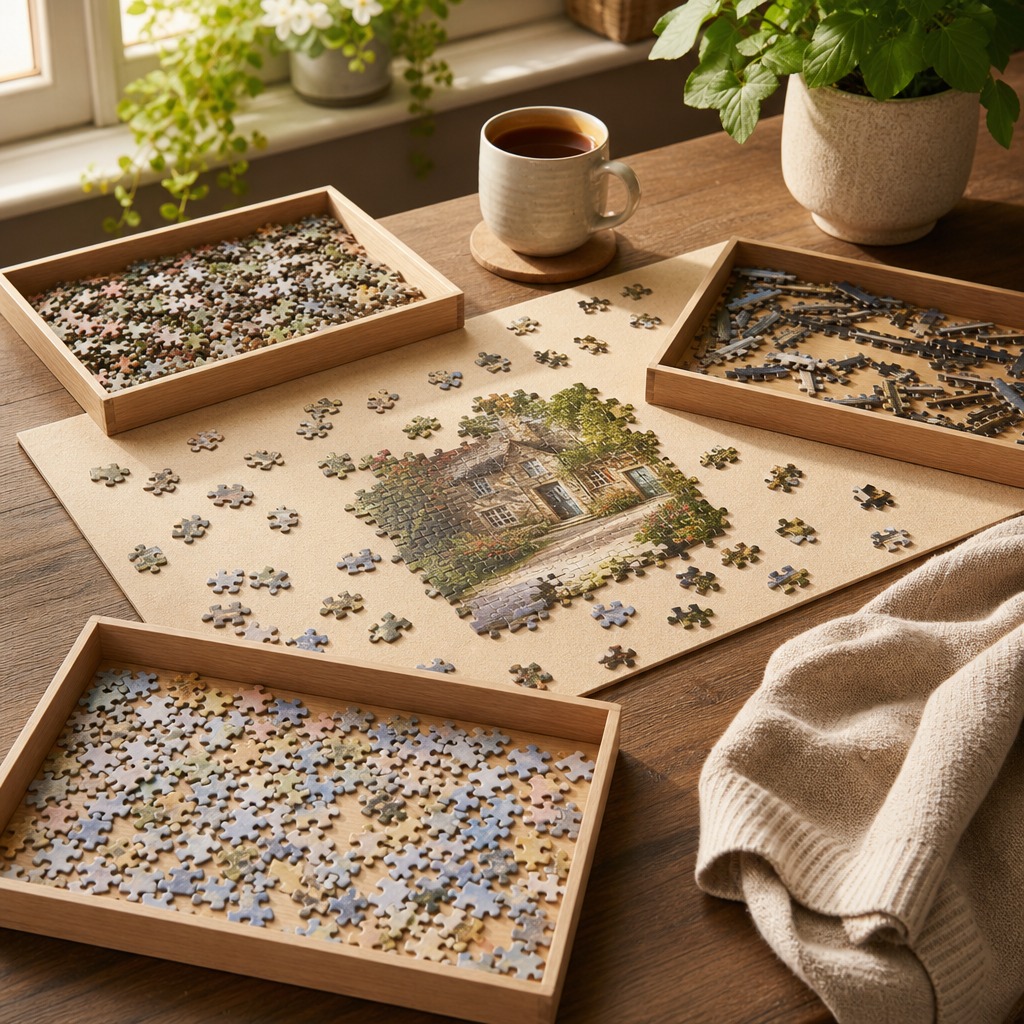
Start with the most certain piece or pair. Do not spread ten guesses around it. Add pieces that continue the same object, line, or edge. A face may lead to hair, a collar, or a background boundary. A window may lead to a sill, a wall shadow, or a curtain line.
Keep the patch loose until two types of evidence agree. A piece that matches the color but breaks the line should wait. A piece with a perfect tab shape but the wrong light level should also wait. The island is useful because it is trustworthy. One forced fit can make every later comparison harder.
As the patch grows, pause after every few pieces and compare it with the full image. Ask what direction the next edge seems to take. If the line bends upward in the preview, search for pieces with that change instead of continuing the original straight path.
The history of jigsaw puzzles helps explain why this works. Early dissected maps turned a larger image into separate pieces that made sense through neighboring geography. Modern pictures replace coastlines and borders with faces, signs, shadows, and textures, but the task remains local reconstruction. Ravensburger’s overview of jigsaw history gives a readable account of that shift from educational dissected maps to leisure puzzles: [The history of the jigsaw puzzle](https://www.ravensburger.us/en-US/blog/the-history-of-the-jigsaw-puzzle).
Use three landmark types when the image is busy
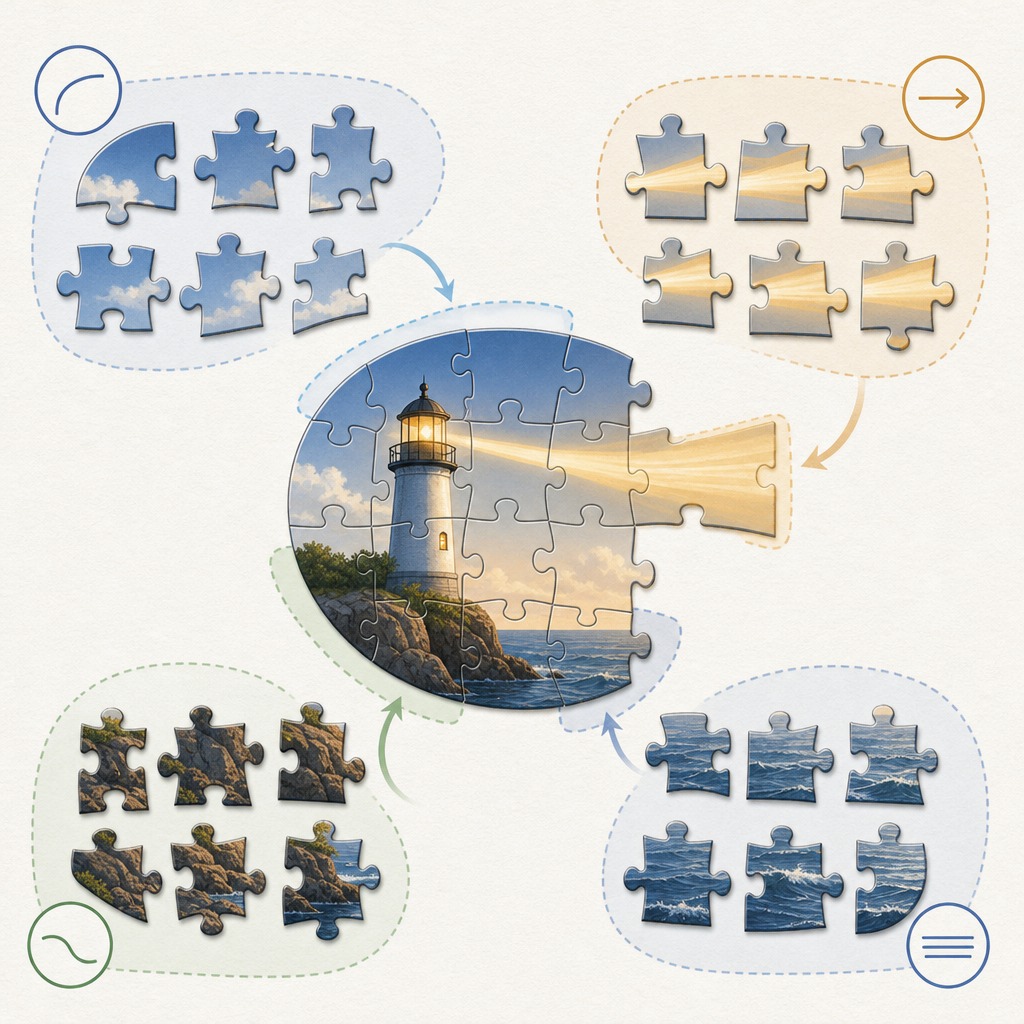
For a detailed picture, sort landmarks into three temporary groups.
The first group contains objects. Faces, doors, wheels, signs, flowers, and animals usually have clear boundaries.
The second group contains lines. Horizons, rails, branches, text edges, rooflines, and shadows can guide the direction of a patch.
The third group contains transitions. Look for places where the image changes from light to dark, warm to cool, smooth to textured, or indoors to outdoors.
These groups should not become permanent piles. They are working neighborhoods. If the object patch reaches a clean border, move the nearby background pieces into a new local group. If a line disappears, return the remaining pieces to their wider color or texture category.
When a landmark turns into a trap
A landmark becomes a trap when the solver keeps feeding it pieces after its evidence has run out. Imagine a face completed except for a few similar skin-tone pieces. The next piece may belong to a wall, hair, or another person. The color is no longer enough.
Stop when the patch loses direction. Compare the open edges with the preview. If you cannot explain the neighboring image, leave the gap and work on another landmark. A second island may reveal the boundary that the first island was missing.
The same rule applies online. A piece that snaps into place may be accepted by the interface because its shape is close, not because the picture is correct. Check the image continuation after every confident click. A visual landmark should confirm the placement, not just decorate it.
A practical visual landmark routine
Use this routine when a puzzle feels too scattered:
1. Scan the preview for a small object, strong line, or sharp transition.
2. Pull out only the pieces that clearly belong to that detail.
3. Group them by object edge, line direction, or light change.
4. Build a loose island and test the neighboring image, not only the tabs.
5. Stop when the patch loses evidence and return the leftovers to the main sort.
You do not need to find the best landmark in the whole puzzle. Find one that gives you a useful next question. Where does the line continue? Which side of the object is darker? Does the neighboring piece belong to the same surface?
Let one clear detail start the conversation
Jigsaw puzzle visual landmarks work because they turn a large picture into a small, answerable problem. A face can tell you about hair and shadow. A horizon can tell you about direction. A window can tell you about repeated frames and reflected light.
On your next puzzle, ignore the biggest color group for a moment. Choose one detail that has a boundary or a line, build a small island, and check what it tells you about the pieces around it. The puzzle does not need to reveal the whole image at once. It only needs to give you one useful place to begin.
Play a fresh puzzle through [Easy Daily Puzzle’s jigsaw library](https://easydailypuzzle.com/?s=jigsaw). When the pile feels anonymous, look for the detail that has a direction. That is usually where the picture starts talking back.