


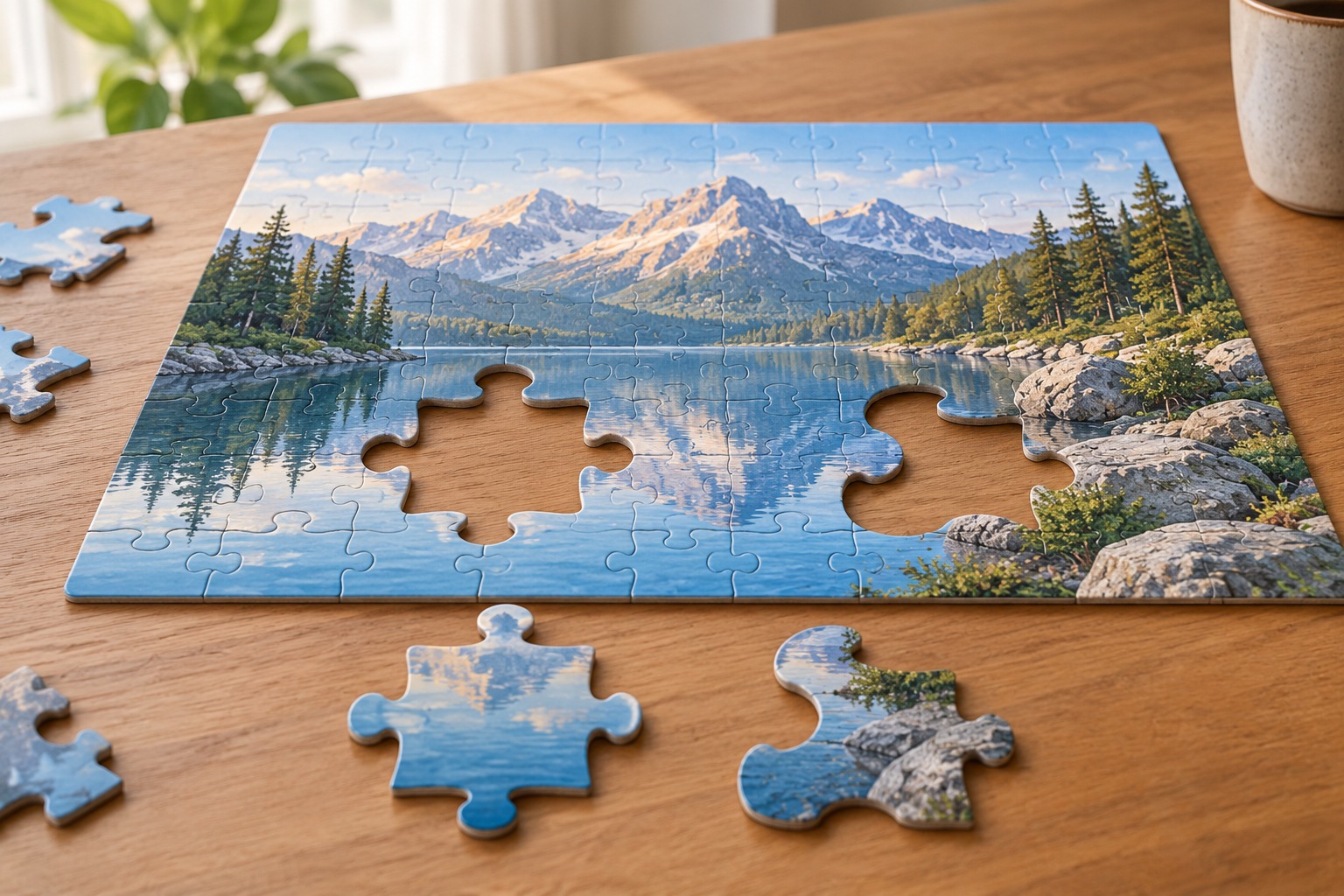
Jigsaw puzzle negative space becomes useful when two pieces seem to belong to the same picture. They may both be blue, gray, or pale yellow. Their printed colors tell you very little. The empty shape around each piece tells you more: one gap may be narrow near the corner, another may open toward a long straight line, and only one may continue the image without a bump or twist.
Most players look at the piece first. Try looking at the space it would leave instead. The gap is not an absence of information. It is a silhouette that records the piece's tabs, blanks, direction, and relationship with the pieces already placed. When color is weak, that silhouette can become the clearest clue on the table.
Jigsaw puzzle negative space is a second outline
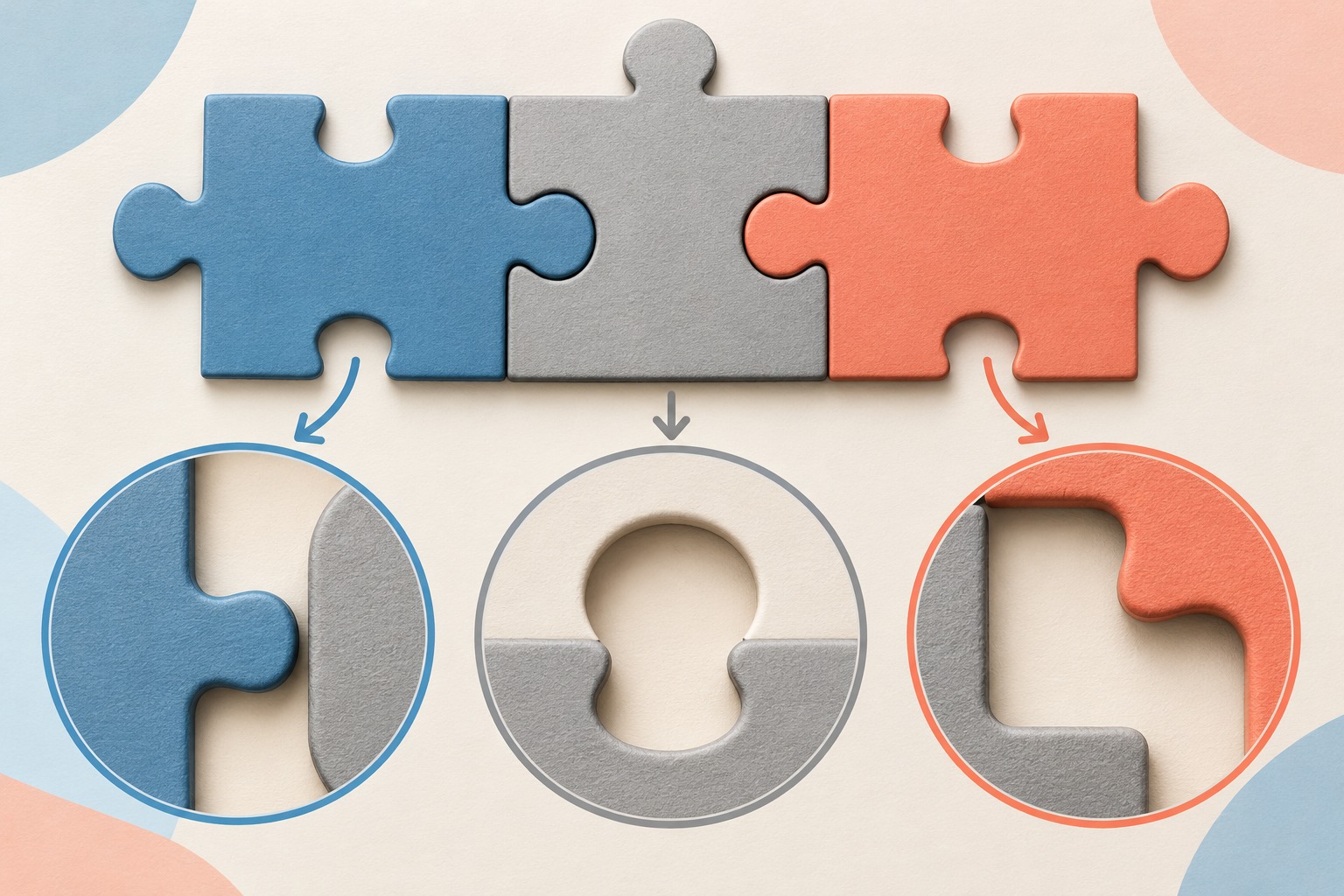
Every piece has a positive shape, made by its tabs and blanks. It also has a negative shape, made by the area around it after it is placed. The two outlines describe the same fit from opposite directions.
This matters because a broad color match can be misleading. A blue piece with a rounded tab may appear promising beside a blue section, but the neighboring gap may require a flat shoulder or a deeper blank. If the surrounding shape is wrong, the printed color is not enough to rescue the placement.
The [Strong National Museum of Play's jigsaw puzzle history](https://www.toyhalloffame.org/toys/jigsaw-puzzle/) is a useful reminder that a jigsaw is built around cutting and reassembling an image. The cut is not decoration. It creates a second problem for the solver: the picture must continue, and the physical boundary must agree with the space around it.
Start with a piece already connected to a small island. Trace the empty area beside it with your eyes. Is the opening shallow or deep? Does it turn toward a corner? Does the next piece need a tab pointing into the island, or a blank that receives one? These questions are faster to answer when you study the gap before you handle a pile of candidates.
Read width, direction, and corners
Negative space is easiest to use when you break it into simple measurements.
**Width:** A narrow opening usually needs a slim tab or blank. A broad opening needs a wider shoulder. Do not compare only the tip. Compare the whole entrance to the gap.
**Direction:** A tab can point upward, downward, left, or right relative to the island. Rotate the candidate mentally, or rotate it on screen, and check whether its shape enters the gap in the same direction.
**Corners:** Corners carry strong evidence. A piece near a corner may need two nearly straight sides. A gap beside a corner often has a short turn that a center piece cannot match.
**Depth:** Some blanks are shallow and rounded. Others reach farther into the piece before turning. Similar-looking tabs can leave very different empty shapes once their shoulders are included.
The [World Jigsaw Puzzle Federation](https://worldjigsawpuzzle.org/) presents jigsaw solving as a timed, organized activity, but you do not need to solve at competition speed to borrow the useful idea. A fast solver is still protecting attention. The gap gives you a compact way to reject candidates before spending time on each printed detail.
Use the gap with image lines, not instead of them
Shape alone can produce a false fit. Two pieces may have matching tabs and blanks while the picture line between them breaks. Use negative space as the first filter, then use the image as confirmation.
Look for a line that should continue across the join. It might be a roof edge, a stripe, a horizon, a fold, or the boundary between light and shadow. If the line changes direction at the gap, check whether that change makes sense in the picture. A correct piece should satisfy both tests: its physical outline should fill the empty shape, and its printed detail should continue the scene.
This is especially helpful in repeated textures. A field of small windows, leaves, or waves may contain many pieces with almost identical colors. The gaps separate them. One candidate may have the right shade but leave the next opening too wide. Another may look less exciting but create a clean silhouette and a continuous line.
Build a small island around the strongest evidence. Do not scatter every similar piece across the table. Keep a short candidate group near the gap, test one at a time, and return the rejected pieces to the same group. This prevents a promising shape from becoming a memory problem.
Jigsaw puzzle negative space for online play
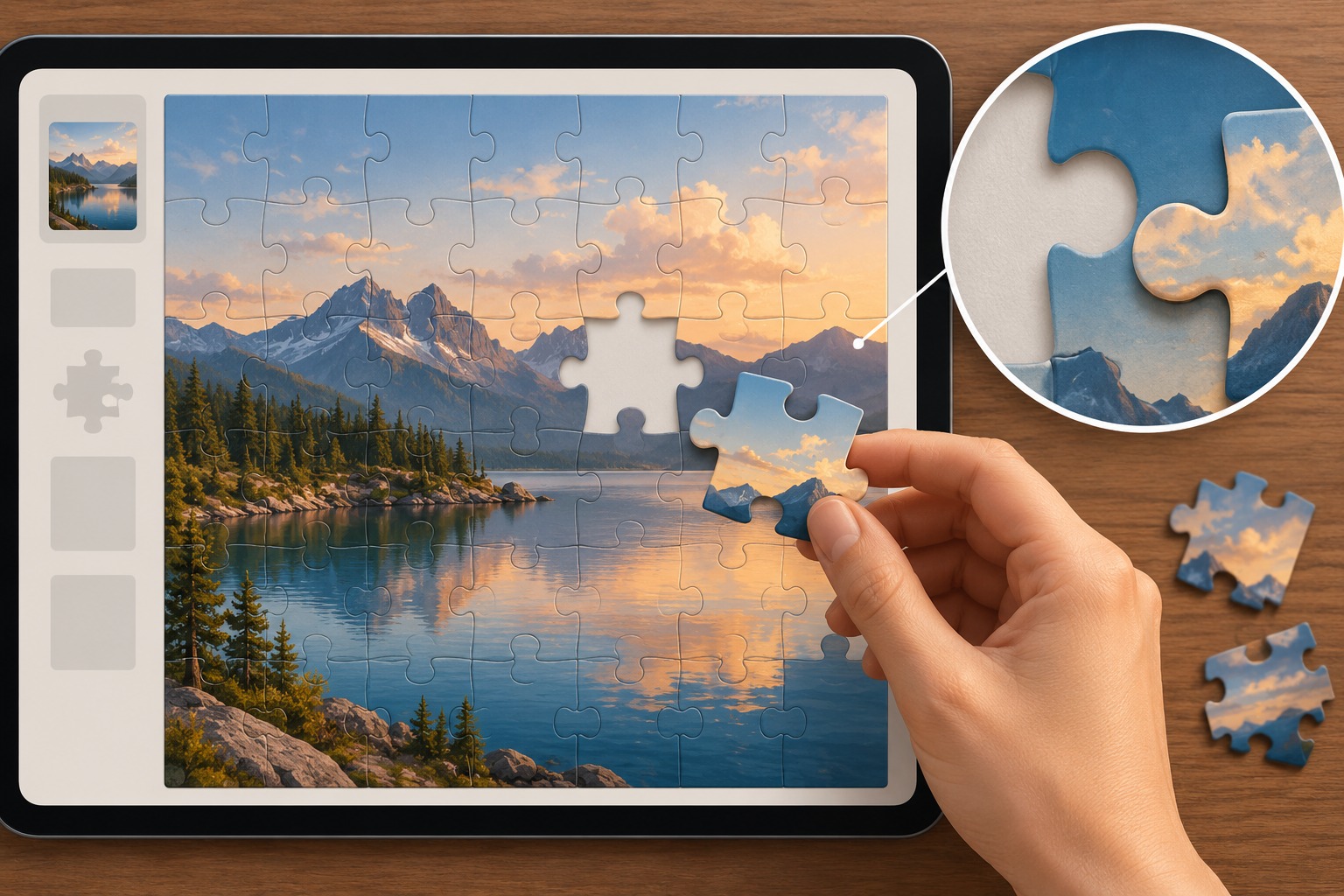
On a screen, the gap can be harder to inspect because pieces may be small or separated by a busy background. Reduce the working area. Zoom in until the tab and blank shoulders are clear, then zoom out briefly to check the image line.
Rotation changes the task. A piece that looks wrong in its current position may fit after a quarter turn, but rotate it for a reason. Match the direction of the gap first, then compare the printed detail. If every candidate is being spun randomly, the shape clue disappears into noise.
Online play also makes false fits easy to miss. A piece may snap into place because the interface accepts a close position, while the picture still feels broken. Pause after each connection and inspect the surrounding negative space. The neighboring gaps should look intentional, not squeezed or stretched.
The [Easy Daily Puzzle jigsaw collection](https://easydailypuzzle.com/?s=jigsaw) is a convenient place to practice this habit. Choose a small area with repeated color, zoom in, and try to identify the next piece from the shape of the opening before searching by image.
A five-step negative-space routine
Use this sequence when a section has too many similar colors.
1. Choose one open gap beside a connected island.
2. Describe its width, direction, corner behavior, and depth in plain words.
3. Pull only a few candidate pieces that could create that silhouette.
4. Rotate each candidate to match the gap, then check the printed line or texture.
5. After a connection, inspect the new gaps before moving to a different area.
The routine keeps shape and image evidence in the right order. Shape removes impossible candidates. Image detail chooses between the survivors. If neither test is clear, leave the gap open and grow another island instead of forcing the most colorful piece into place.
Let the empty shape do some of the work
A jigsaw piece is not defined only by what is printed on it. Its tabs and blanks describe the spaces it can create, and those spaces remain visible even when the picture is low contrast. Once you start reading the gap, a pile of similar pieces becomes a smaller set of physical possibilities.
Use color to suggest a group, use negative space to narrow it, and use image continuity to confirm the decision. The empty area around the next piece is not a delay before the solve. It is part of the evidence that makes the solve move forward. For another short session, browse the [Easy Daily Puzzle home page](https://easydailypuzzle.com/) and choose a jigsaw that gives you room to practice the gap-first habit.