



Jigsaw puzzle light direction becomes useful when color stops being useful.
A blue piece can belong to the sky, a window, water, or a shadow on a nearby object. A gray piece can be a wall, a road, a cloud, or the dark side of a roof. If you sort only by broad color, the pile grows faster than the picture.
Light gives that pile another dimension. Look for the direction from bright to dark. Follow the edge of a shadow. Notice whether a printed area becomes sharper, softer, warmer, or cooler as it moves across the image. These changes can connect pieces that do not share an obvious object yet.
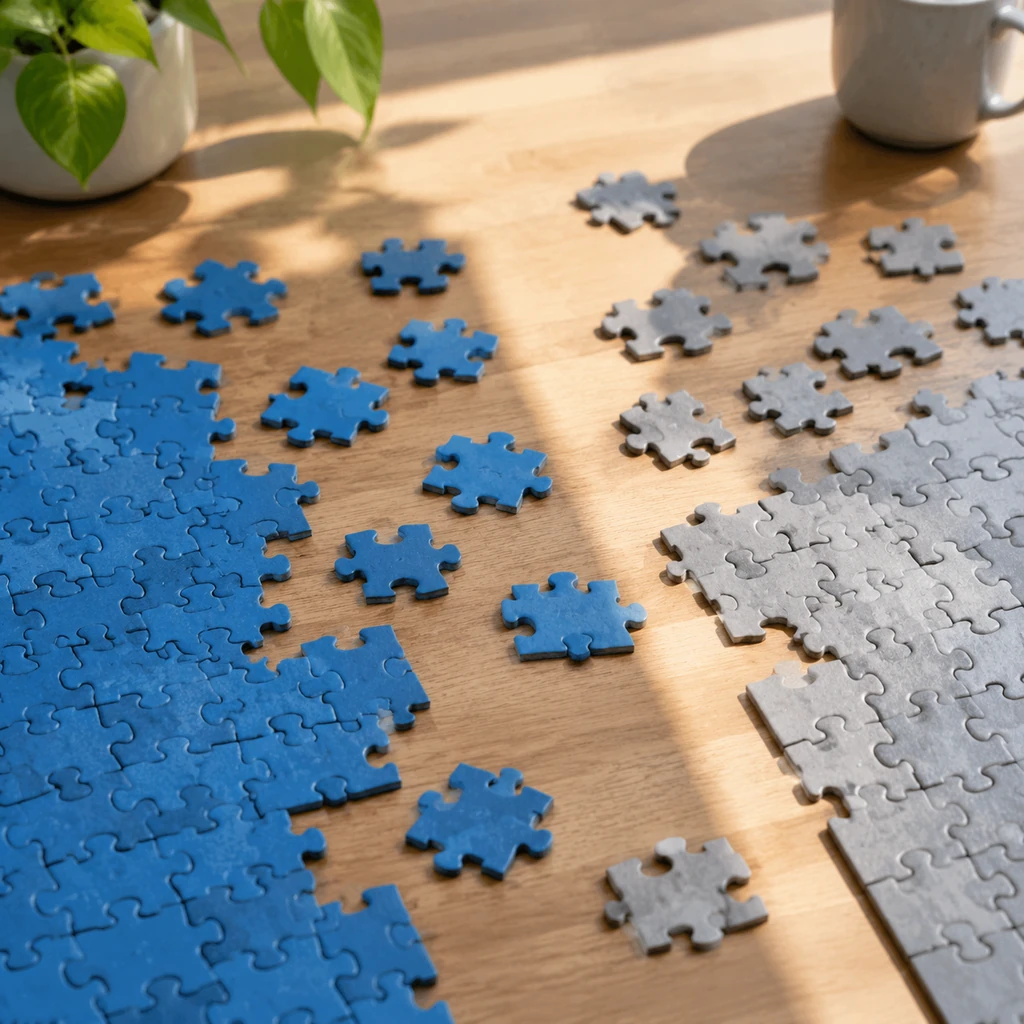
Jigsaw puzzle light direction begins with a short boundary
Do not start by asking what the whole picture means. Find one small transition.
It might be a bright strip beside a darker surface. It might be a soft shadow under a tree, a reflection on water, or a thin highlight along a table. The useful part is not the subject. It is the direction and continuity of the change.
Place the pieces in a line on the table, or in a small group on screen. Separate pieces that seem to continue from left to right from pieces where the brightness changes in the opposite direction. Rotation matters. A piece with a highlight on its right side may look like a match until it is turned and the highlight lands on the wrong side of the neighboring piece.
This is why light can be stronger evidence than color. Color tells you what a piece may belong to. Direction tells you how the printed surface is moving.
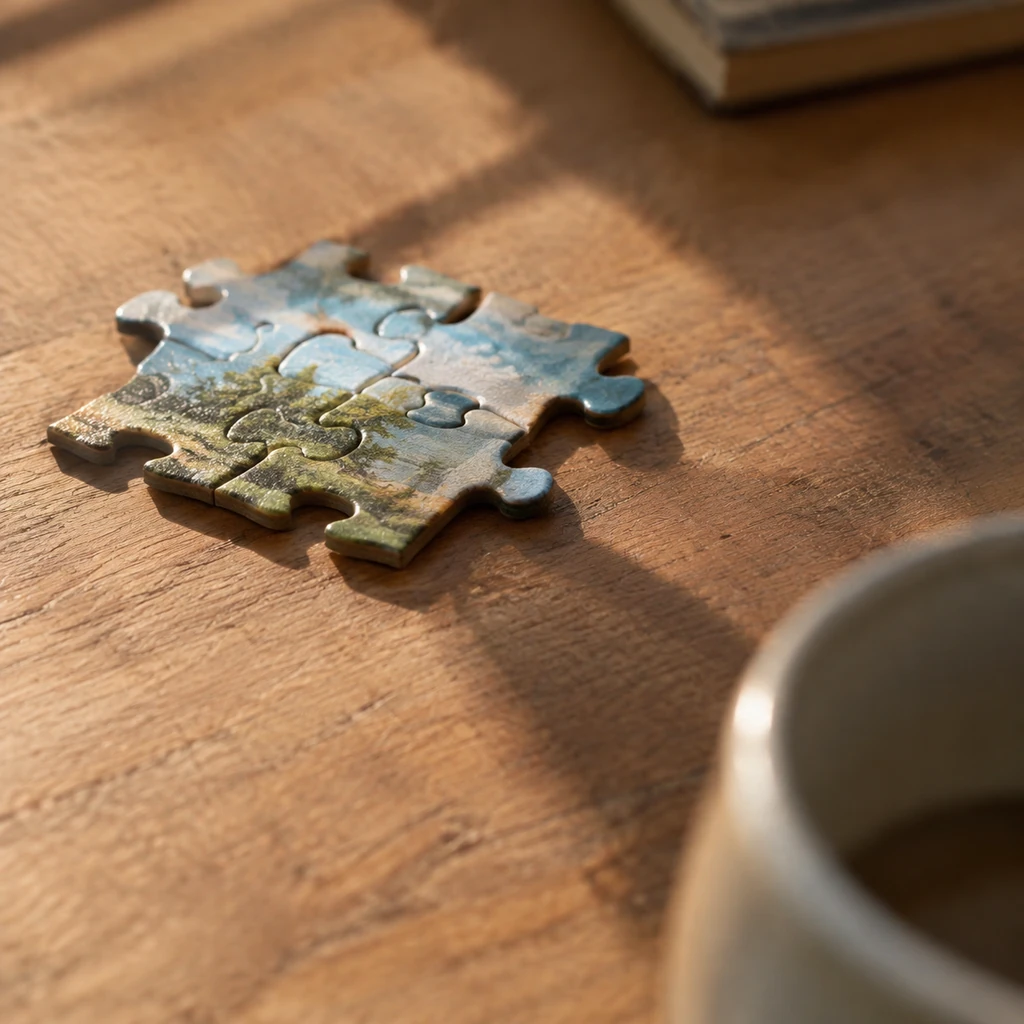
Follow the shadow before chasing the object
A shadow often behaves like a short arrow. It points away from a light source and usually has a direction, even when its edge is soft.
Suppose a group of pieces has the same pale blue background. A few contain a dark, feathered line. Instead of placing all the blue pieces together, pull out the ones whose darker edges run in the same direction. They may belong to a shoreline, the underside of a cloud, or the shadow beside a foreground object.
Build only a small island first. Two or three pieces can tell you more than a large, uncertain patch. Check whether the shadow thickens, fades, or changes temperature in a believable way. If it suddenly becomes a hard line, reverses direction, or ends in an impossible corner, stop and break the group.
The [Jigsaw Puzzle entry from The Strong National Museum of Play](https://www.toyhalloffame.org/toys/jigsaw-puzzle/) is a useful reminder that the picture has always been part of the puzzle's evidence, not just decoration around the pieces.
Brightness changes can split one color pile
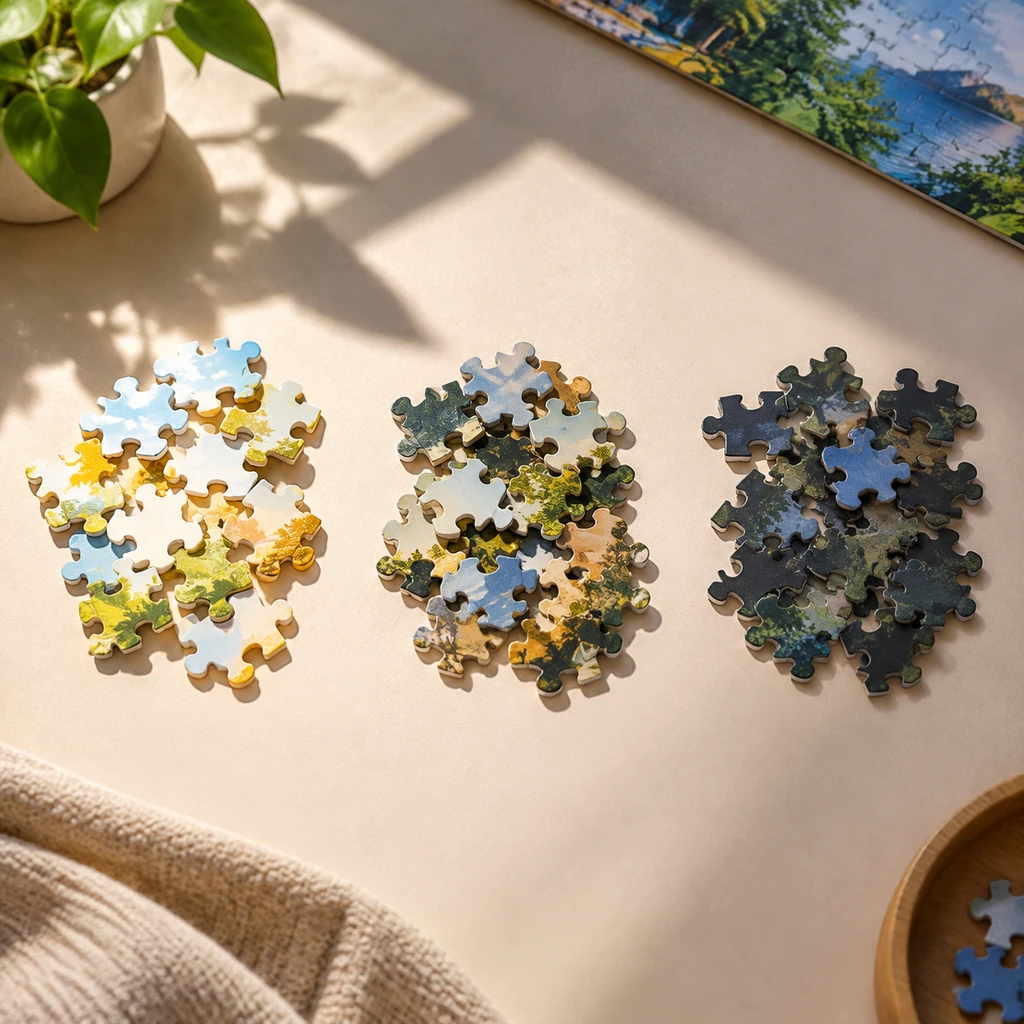
When a scene repeats one color, make three quick groups instead of one large one:
**Bright-facing pieces.** These often carry a highlight, clean edge, or warmer reflected color.
**Middle-light pieces.** These may sit on the main surface and connect the bright and dark areas.
**Shadow-side pieces.** These often have softer detail, cooler color, or a darker band that points toward an object.
The groups do not need to remain separate forever. They are temporary trays for attention. Once a strong landmark appears, combine the pieces that actually touch it and return the rest to the wider sort.
Watch for false fits. A printed streak can look like a shadow but have no consistent direction. A dark edge can belong to a separate object, not the surface you are building. A piece can match the brightness of its neighbor while failing the tab, blank, or image flow.
Jigsaw puzzle light direction on a screen
Online play changes the work area, but not the visual question.
Zoom in until the texture is clear without losing the neighboring pieces. Rotate a candidate before judging its shadow. Keep the active group small enough that you can compare brightness from one piece to the next. If every loose piece is spread across the screen, the eye starts comparing color from memory instead of following the actual line.
The [Easy Daily Puzzle jigsaw collection](https://easydailypuzzle.com/?s=jigsaw) works well for this kind of practice because the goal is not to finish by a clever shortcut. It is to notice one reliable visual relationship and test it carefully.
A five-step light-direction routine
1. Choose one repeated color field, such as blue water or gray sky.
2. Pull out pieces with a visible highlight, shadow, or brightness boundary.
3. Rotate them until the light-to-dark direction is easy to compare.
4. Build a two- to five-piece island and check the shadow's continuity before adding more.
5. If the line breaks, keep the pieces but separate them into bright, middle, and shadow groups again.
You can return to the [full Easy Daily Puzzle library](https://easydailypuzzle.com/) when you want to switch from a visual puzzle to a Sudoku, crossword, or card game. The change of game can be useful after a long session of comparing nearly identical shades.
Let light give the pile a direction
Jigsaw puzzle light direction does not replace edge shape, tabs, blanks, or recognizable landmarks. It gives those clues a better order.
When color creates a pile that feels endless, look for the small movement from highlight to shadow. Follow it for a few pieces. Test the line. Break it when the evidence stops agreeing. A repeated color may still be difficult, but it is no longer featureless. It has a direction, and direction is often enough to start.