



Jigsaw puzzle color anchors are the pieces your eyes keep finding before your hands know what to do. A red umbrella. A yellow window. A blue boat. A strip of white fence that looks nothing like the sky, grass, or shadow around it.
Most players see those pieces and still start with the border.
That is not wrong. The border is satisfying. It gives the puzzle a frame, and a frame feels like progress. But some pictures do not want to begin at the edge. A landscape with four shades of green may have a border that looks almost identical for half the table. A busy city image may hide its corners in brick, glass, and pavement. A flower puzzle may give you fifty edge pieces that all look like leaves.
That is where jigsaw puzzle color anchors help.
Instead of trying to understand the whole puzzle, you pick one color or object that has a clear identity. You build that little island first. Once the island exists, the rest of the picture has something to grow from.
If you want to practice this on a quick digital puzzle, open the jigsaw puzzle collection on Easy Daily Puzzle and choose an image with one obvious color patch. Do not worry about solving the whole thing. Give yourself one job: find the anchor.
Why jigsaw puzzle color anchors work
The first few minutes of a jigsaw puzzle are weirdly noisy.
Every piece is face up. Every color wants attention. The box image or preview tells you what the final picture should become, but the table still looks like confetti.
The Strong National Museum of Play notes that early jigsaw puzzles grew from cut maps and later became a popular home pastime. That history makes sense when you think about how the game feels. A jigsaw puzzle is not just about shape. It is about turning a broken picture back into something your eye can trust.
Jigsaw puzzle color anchors work because they give your eye a trustworthy place to return.
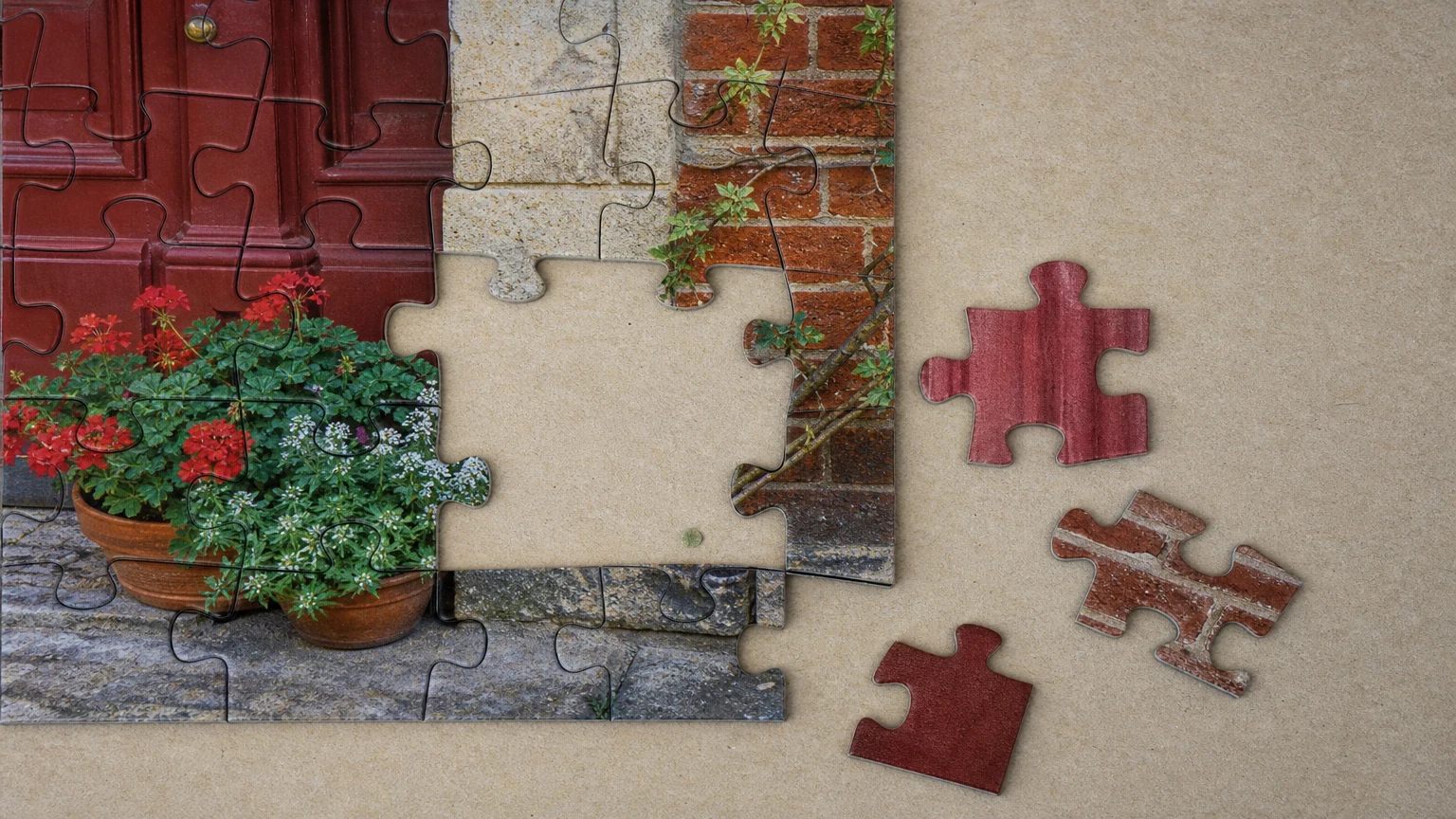
Once you build a red umbrella, all nearby red pieces become more meaningful. A curved red edge may belong to the top. A darker red piece may be shadow. A tiny sliver of red and gray may sit where the umbrella meets a sidewalk.
You are no longer sorting "red pieces." You are reading a small part of the picture.
That shift matters.
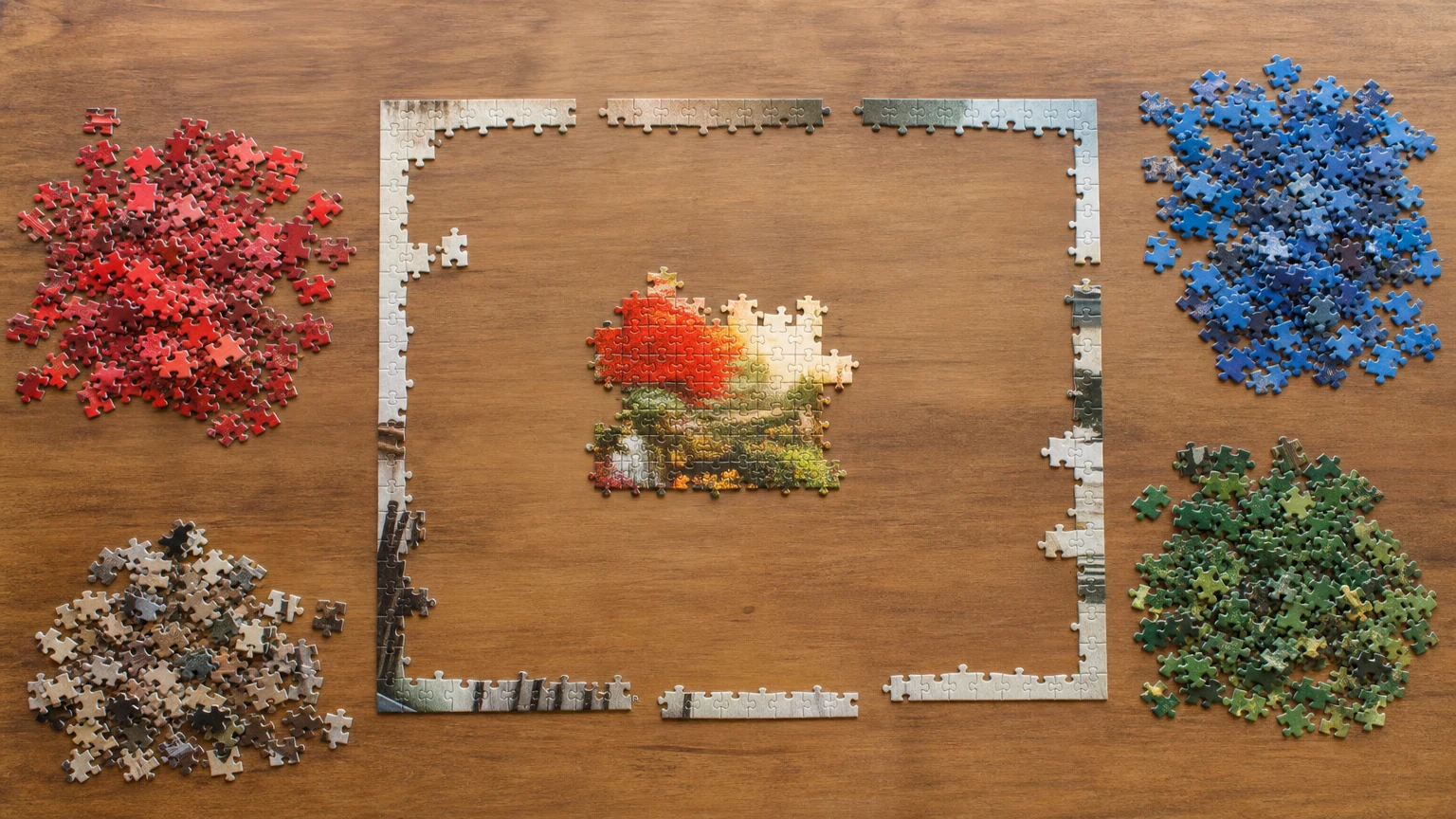
Sorting by color is useful, but it can stay too broad. Color anchors make sorting more specific. They turn a pile into a location.
How to choose a good color anchor
A good anchor is easy to recognize, limited in size, and different from the background.
Do not choose the sky unless the sky has a dramatic sunset, a cloud pattern, or a plane cutting through it. Do not choose grass unless there is a bright path, a fence, or flowers inside it. Large repeated areas are usually better later, once you have more structure.
Start with a thing.
A window.
A sign.
A face.
A sail.
A red mug on a table.
The object does not need to be big. In fact, smaller is often better. A tiny anchor can be finished quickly, and finishing one small area gives you the confidence to start another.
On Easy Daily Puzzle, this is especially useful because online pieces can be moved quickly. That speed is nice, but it also makes random dragging tempting. A color anchor slows you down just enough to make the screen feel organized.
Try this:
- Pick one color that appears in only one or two places.
- Pull every piece with that color into a loose pile.
- Separate pieces with clear object edges from pieces with only tiny color flecks.
- Build the clearest part first.
- Leave uncertain pieces nearby, not inside the build.
The last step is the one people skip. Do not force the almost-matches. Color can lie when two pieces come from different areas of the image. Let the anchor breathe.
The almost-right color trap
Every jigsaw player knows the little thrill of finding a piece that seems perfect.
Same red. Same curve. Same shadow.
Then it refuses to sit.
You rotate it. You test another angle. You press it against the shape in your mind, even though the piece itself is politely saying no.
That is the almost-right color trap.
Color is a clue, not proof. A piece can share the same blue as your anchor and still belong to the sky, a shirt, a door, or a reflection. The more modern and detailed the picture is, the more often this happens.
When color and shape disagree, believe the shape for a moment. Then look for line direction.
Does the stripe continue?
Does the shadow move the same way?
Does a small texture, like wood grain or fabric, line up?
Puzzle Warehouse's sorting advice points to color, pattern, piece shape, and working in sections as separate tools. That is a helpful way to think about anchors too. The anchor begins with color, but it gets confirmed by shape and pattern.
If the fit needs persuasion, it is probably not the fit.
Build islands before the whole coast
The border-first habit is popular because it gives the puzzle a clean outside edge. For many puzzles, that is still a good start. But color anchors are often better when the border is bland.
Think of the picture as a coastline with islands.
The border is the coast. It is useful, but it may be far away from the interesting parts of the image.
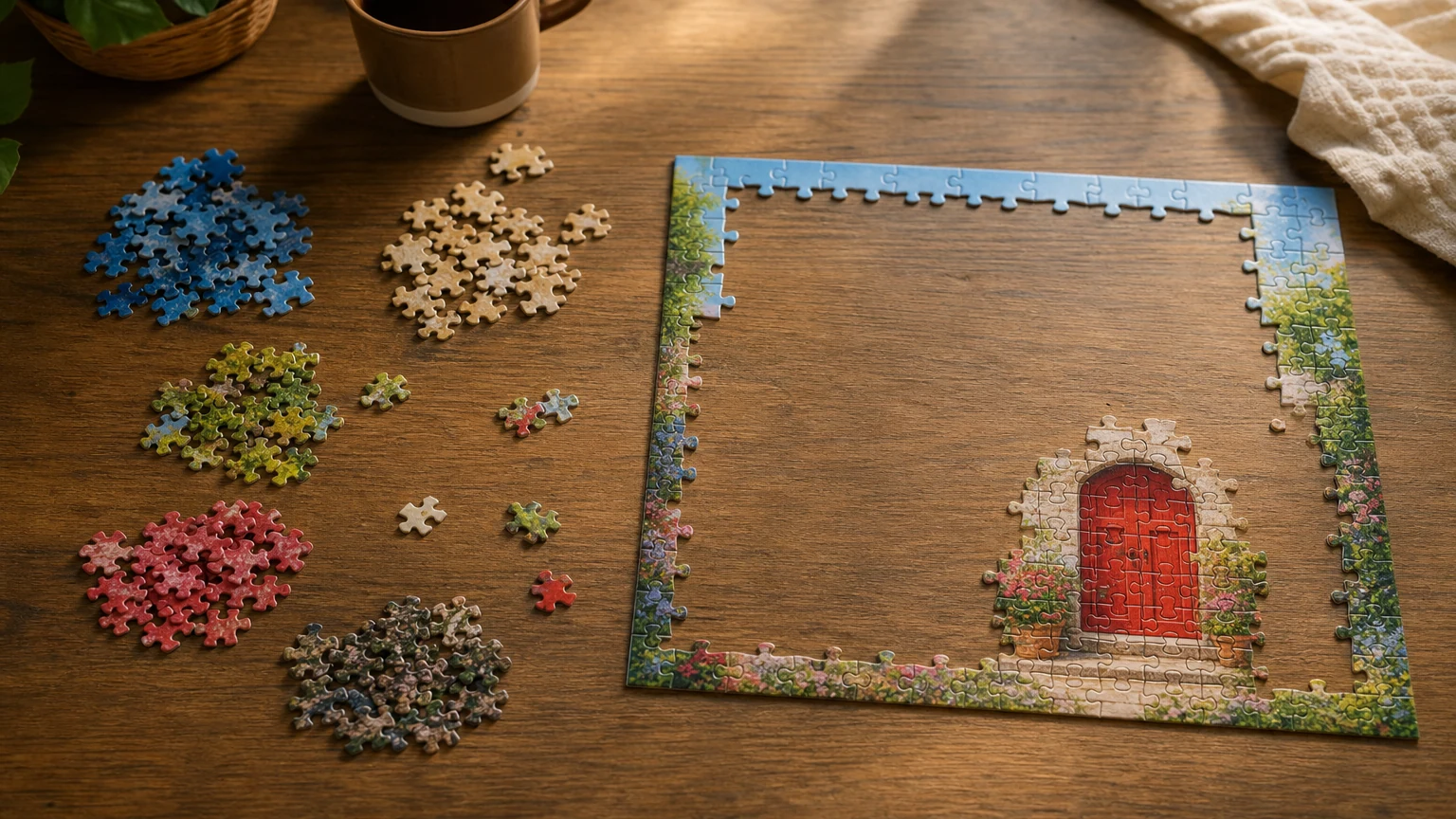
The anchor is an island. Once the island exists, you can expand it. A red umbrella connects to a hand. The hand connects to a sleeve. The sleeve connects to a chair. Suddenly you have a section big enough to attach to another section.
This is why jigsaw puzzle color anchors make a puzzle feel less stuck. You stop waiting for the whole frame to appear before making progress.
Try building three small islands:
- One bright color anchor.
- One texture anchor, such as bricks, leaves, or water.
- One object anchor, such as a face, sign, cup, window, or animal.
Do not connect them immediately. Let each island become strong on its own. When two islands are ready, the connecting pieces usually become easier to spot because you know what both sides should look like.
A 10-minute color anchor drill
Open one puzzle from Easy Daily Puzzle and ignore the finish line for 10 minutes.
Your only goal is to build one anchor.
Minute one: scan the preview and choose the most distinct color or object.
Minutes two to four: pull every possible piece for that anchor into one area.
Minutes five to eight: build only the pieces that clearly belong.
Minutes nine and ten: move the doubtful pieces into a waiting pile and name what you still need.
That last part sounds small, but it teaches you to stop forcing the picture. A waiting pile is not failure. It is restraint.
If you finish the anchor early, do not immediately scatter into the whole puzzle. Ask what touches the anchor. Maybe it is a shadow. Maybe it is a sleeve. Maybe it is a patch of road. The next section should grow from the anchor, not from panic.
When color anchors become automatic
After a few puzzles, jigsaw puzzle color anchors stop feeling like a special method. Your eyes begin to sort the picture by useful little promises.
That corner of yellow can become a window.
That sharp black line can become a bicycle wheel.
That patch of pink can become the flower bed that separates the sidewalk from the house.
The puzzle still has hard parts. It should. But the opening feels less like dumping a box onto the table and hoping for mercy.
Start with one small piece of the picture that knows what it is. Build around it. Let the border wait if the border is boring.
That is the whole trick.
Jigsaw puzzle color anchors do not solve the puzzle for you. They just give the first messy minutes somewhere useful to go.