



Jigsaw negative space starts when the colors stop helping. The blue pieces all look like sky. The grass pieces all look like grass. The border is half done, the table is getting crowded, and one missing patch seems to accept every almost-right piece for half a second before rejecting it.
That empty patch is not empty information.
If you enjoy visual puzzle breaks on Easy Daily Puzzle, learning to read jigsaw negative space can make online jigsaw puzzles feel calmer and less random. You can also browse jigsaw puzzle articles on Easy Daily Puzzle when you want more practical ways to sort, scan, and build a picture without turning the session into a grind.
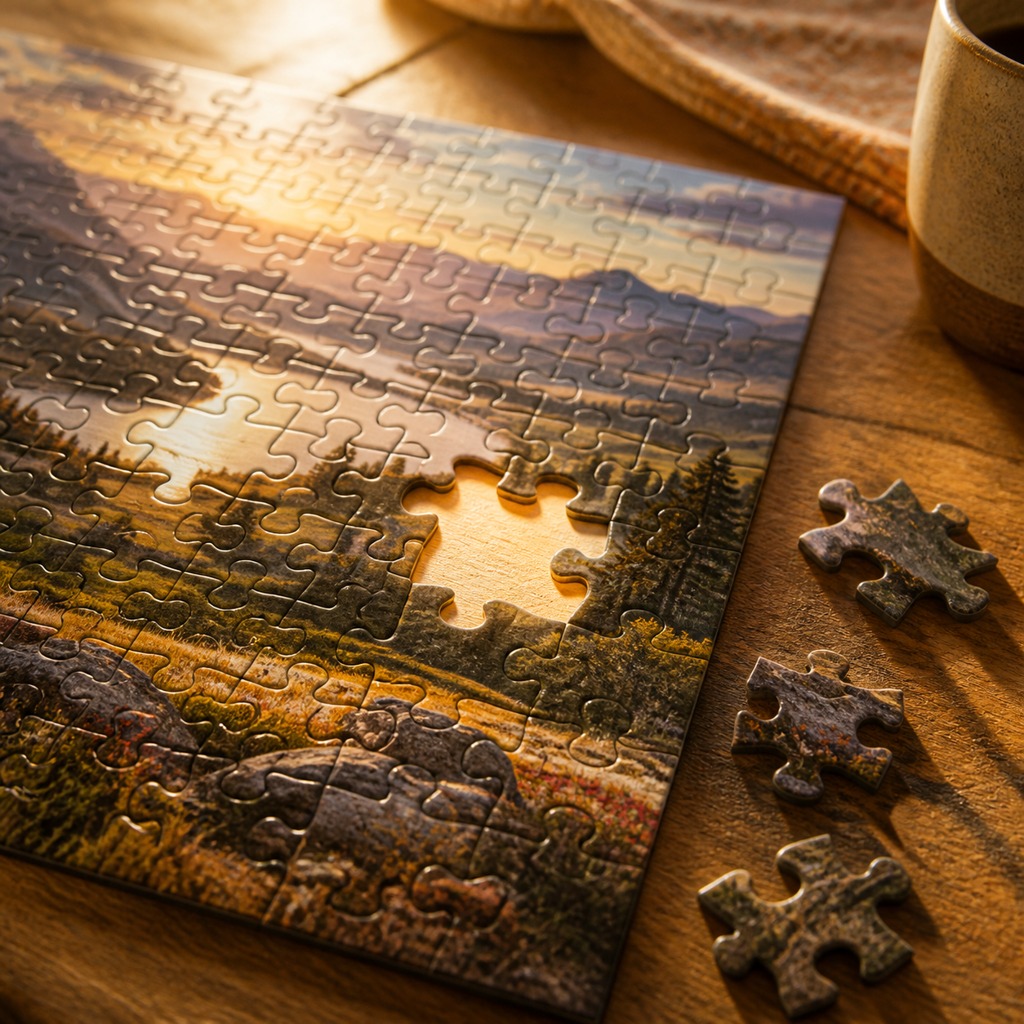
Jigsaw negative space is the shape of the hole
Most beginners search by piece. They pick up a loose piece, look at its color, look at its tabs and blanks, and then hunt for a place it might fit.
That works early. It is especially useful when the picture has strong signals: text, faces, buildings, flowers, horizon lines, or clear border colors. But in repeated texture, the loose-piece method gets noisy. Every piece seems possible until it is not.
Jigsaw negative space flips the question. Instead of asking, "Where does this piece go?" you ask, "What does this hole need?"
The history of jigsaw puzzles supports that way of thinking. The Strong National Museum of Play traces the jigsaw puzzle back to John Spilsbury's cut maps around 1760, where the cuts followed meaningful boundaries and turned geography into a hands-on object. That origin matters because a jigsaw puzzle has never been only about color. It has always been about borders, outlines, and shapes that carry meaning.
Modern speed puzzling makes the same idea visible under pressure. The World Jigsaw Puzzle Championship schedule shows how timed puzzle formats turn sorting and placement into a serious skill. Casual players do not need a competition clock, but the lesson travels well: the faster puzzler is often the one who stops trying random pieces and starts reading the table.
Jigsaw negative space becomes useful when color repeats
Color is the first friendly clue. It is also the first clue to betray you.
A puzzle with a bright red umbrella, a white sailboat, and a dark window gives you easy islands. You can sort those pieces quickly. A puzzle with fog, ocean, forest, snow, carpet, or cloudy sky is different. The same color repeats across too many pieces. The eye gets tired. False fits become tempting.
That is when jigsaw negative space becomes practical.
Look at the hole beside the built section. Does it need one tab and three blanks? Does the left side require a flat-ish shoulder? Does a dark line continue through the gap? Is the missing shape tall and narrow, or wide and squat? Is there a small notch where a piece with a fat tab will never sit?
These questions sound slow, but they save time. They reduce the number of pieces worth trying.
In an online jigsaw, this is even more useful because screen space is limited. You may not have a full table to spread every candidate. Reading the empty gap lets you create a smaller search. You are not dragging twenty blue pieces across the board. You are looking for a blue piece with one blank on the right, a slight diagonal shadow, and a short top edge.
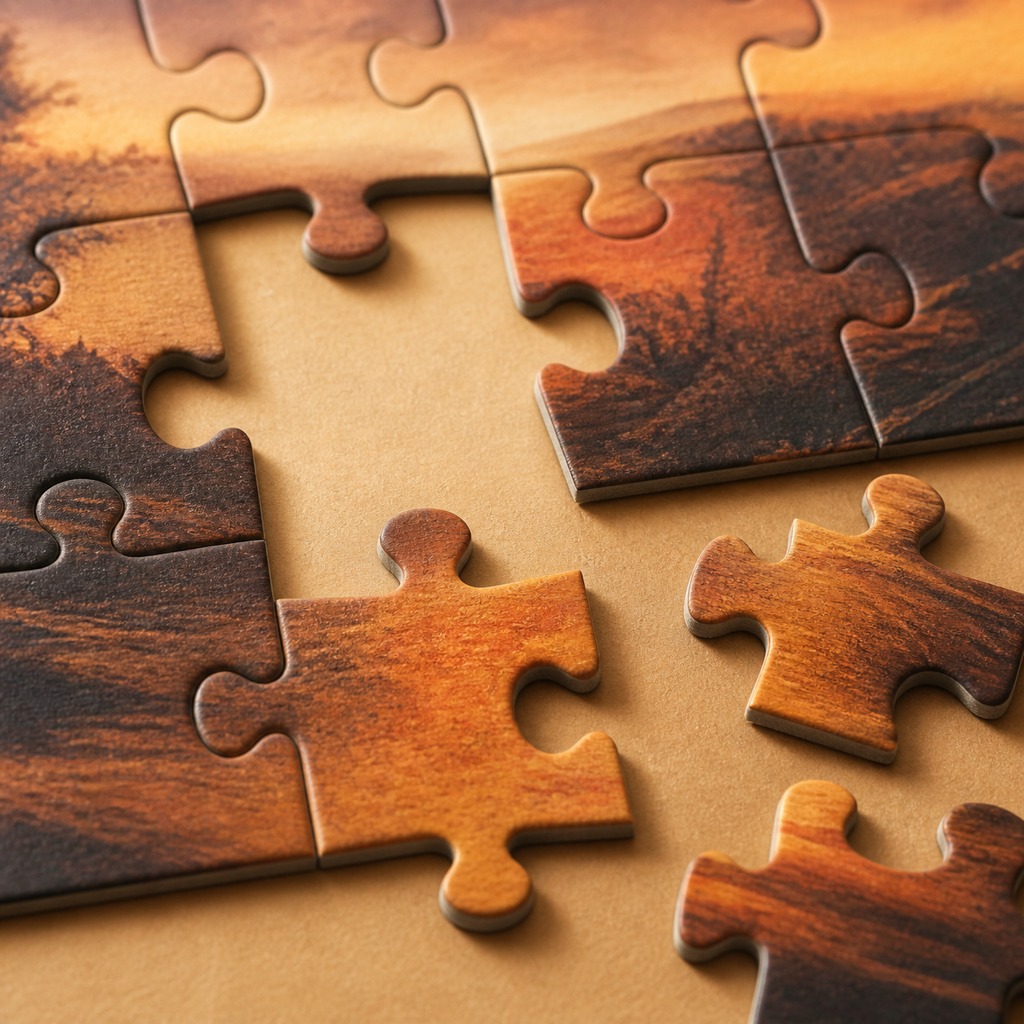
How to practice jigsaw negative space
Start with a nearly built island, not the whole puzzle. Negative space is easiest to learn when a section has enough neighbors to define the missing shape.
Pick one gap with at least two fixed sides. Three sides are better. Four sides are best, but those are usually obvious. The goal is to practice reading partial evidence.
Then make a tiny checklist:
1. Count tabs and blanks around the hole.
2. Notice whether the gap is tall, wide, square, or irregular.
3. Follow any line, shadow, or texture that enters the empty space.
4. Look for color temperature, not only color name.
5. Try only pieces that satisfy shape first and color second.
That last step may feel backwards. It is not. When color is distinctive, color can lead. When color repeats, shape should lead.
Color temperature is especially useful. Two blue pieces may both be "sky," but one leans gray and one leans green. Two brown pieces may both be "wood," but one belongs to a warm sunlit area and the other belongs to shadow. The hole often tells you which family it wants.
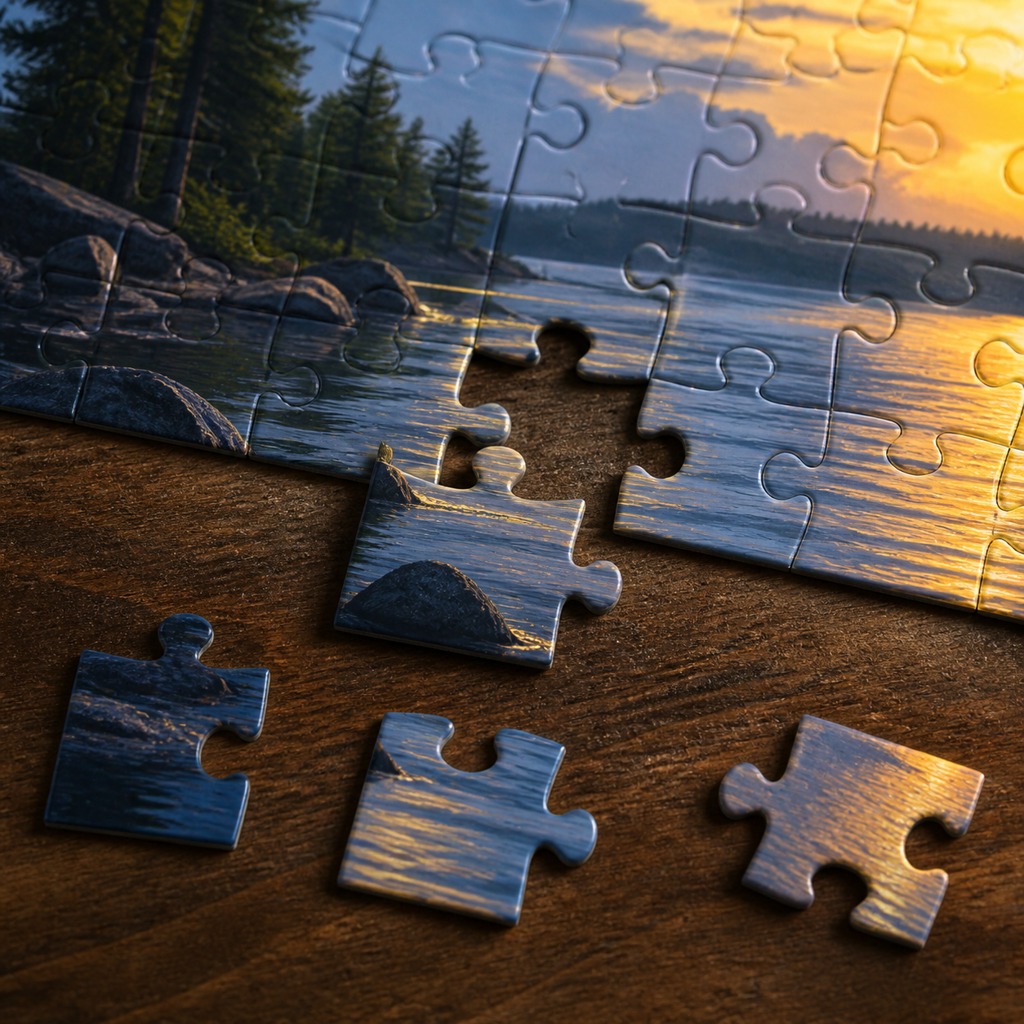
The false fit test
False fits happen when a piece is almost right in shape and close enough in color to fool the hand. Physical puzzles make this especially dangerous because a piece can sit loosely in the wrong place. Online puzzles may prevent impossible placements, but the same mental trap remains: a piece looks right enough that you stop searching carefully.
Use jigsaw negative space as a false fit test.
Before accepting a piece, ask what happens at the edges. Do the lines continue? Does the texture flow? Does the piece create a strange bump that the next gap would have to explain? Does the color shift too suddenly? Does the neighboring piece seem to disagree?
If the answer feels uneasy, leave the piece nearby but do not commit emotionally. That phrase matters. Puzzlers often lose time defending a piece they already wanted to be right.
The best solvers are less dramatic. They keep candidates available. They test, release, and return. A wrong piece is not a failure. It is a note that says, "Not this shape yet."
What jigsaw negative space teaches about the whole picture
Jigsaw negative space is not only a late-game trick. It changes how you build from the start.
When you sort pieces, do not make piles only by color. Add a small pile for distinctive shapes: long necks, deep blanks, sharp tabs, strange corners, and pieces with unusual cut rhythm. These pieces may not reveal their picture location immediately, but they become useful when a matching hole appears.
When you build islands, leave the edges readable. Do not bury uncertain pieces under piles of maybes. A clean edge gives the eye a clear gap to inspect.
When the border is slow, do not treat that as failure. Sometimes the middle gives better negative-space clues than the frame. A face, a window, a flower stem, or a printed letter can create holes with stronger identities than a row of similar edge pieces.
This is why the old border-first habit is useful but not sacred. The point is not to obey a method. The point is to create evidence.
A quieter way to solve the next puzzle
The next time a jigsaw section stalls, do not immediately shuffle the whole pile. Choose one empty space and make it the question.
What shape is missing? What direction does the line want to continue? What kind of tab would break the edge? Which loose pieces can be eliminated before you try anything?
That little pause changes the mood of the puzzle. Instead of feeling surrounded by hundreds of pieces, you are answering one local question. The table gets quieter. The next piece has a job description.
Jigsaw negative space is useful because it reminds you that the puzzle is giving information even where no piece is sitting. The hole has a shape. The shape has preferences. Read those first, and the correct piece feels less like luck when it finally lands.