


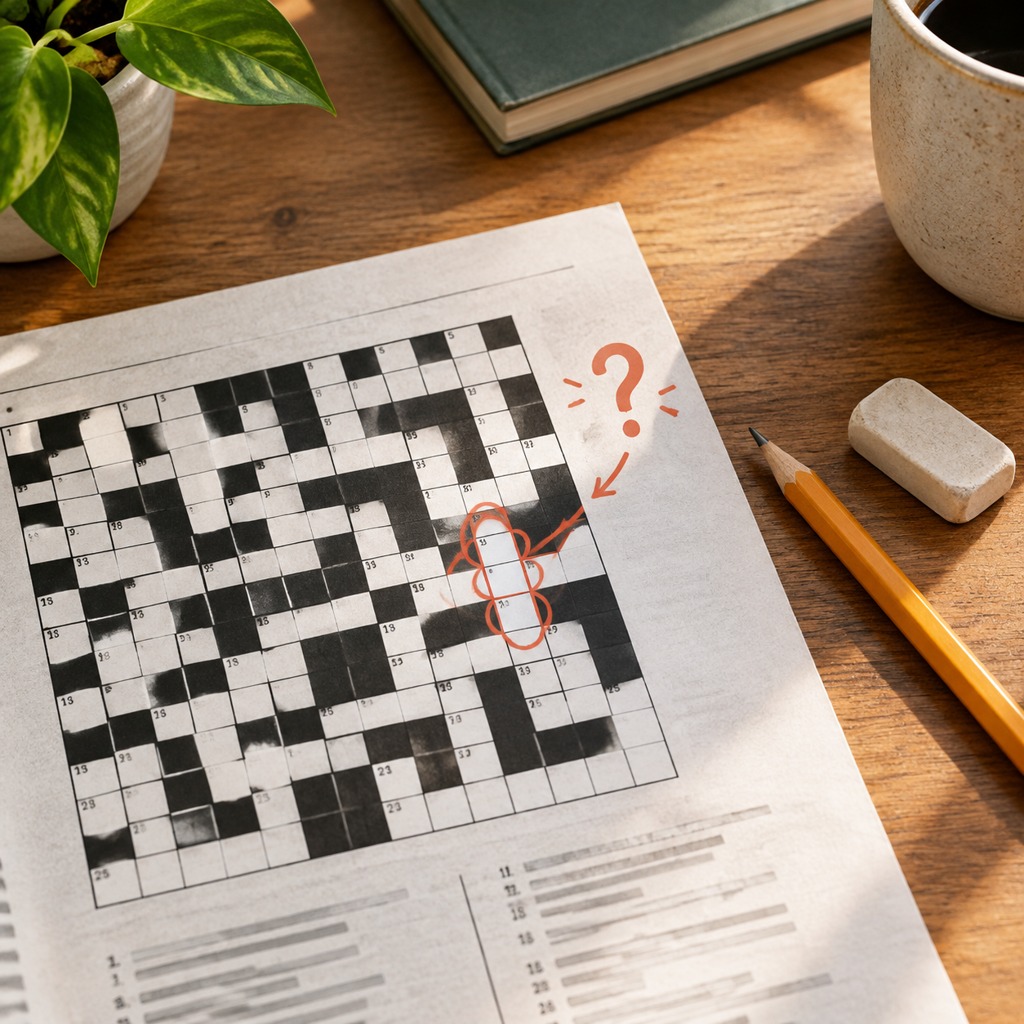
Crossword question mark clues can make a familiar sentence suddenly feel suspicious. The words look ordinary, the answer seems close, and then a small question mark appears at the end. That mark is not asking you to provide a fact. It is telling you that the clue may be using its words in an unexpected way.
The safest response is to stop taking the surface literally.
In a standard crossword, a question mark often signals a pun, double meaning, or playful definition. [The crossword overview on Wikipedia](https://en.wikipedia.org/wiki/Crossword) describes the convention with a simple example: the mark can warn that the clue and answer are connected through wordplay rather than a straight definition.
That does not mean every question-mark clue is impossible. It means the clue has changed the rules of conversation. You can practise the habit on [Easy Daily Puzzle](https://easydailypuzzle.com/) and then browse [more crossword puzzles and clue articles](https://easydailypuzzle.com/?s=crossword) for another grid.
The most useful thing about Crossword question mark clues is that they tell you when to change reading modes before you waste a corner on a clever-looking guess.
Crossword question mark clues are a change of tone
Most clues give you a job in a fairly direct voice. They ask for a synonym, a name, a short phrase, or a familiar fact. A clue with a question mark can still do one of those things, but it adds a wink.
Imagine a clue that sounds as if it is asking for an object. The answer pattern fits a common noun, yet one crossing letter refuses to cooperate. The question mark gives you permission to revisit the sentence and ask whether one word has a second meaning. Maybe the clue is describing an action instead of a thing. Maybe a phrase has been split in an unusual place. Maybe the answer is a familiar word used in an unfamiliar role.
This is why the mark is useful even before you know the answer. It changes your search space. You are no longer looking only for a clean definition. You are looking for a clean definition with a twist that still fits the grid.
The twist should not be random. Good wordplay creates a moment when the answer feels obvious after you see it. If the clue requires an explanation longer than the answer, keep it provisional and wait for more crossings.
Read Crossword question mark clues once, then turn them over
The first reading of a question-mark clue is still valuable. It gives you the scene or phrase the constructor wants you to imagine. Do not throw that reading away. Use it as the decoy you are meant to notice.
Then try a second pass with three questions.
1. Does one word have a common second meaning?
2. Could the clue be describing a phrase rather than an object?
3. Does the answer pattern support the playful interpretation?
The second pass works best when you keep the clue's grammar intact. A joke does not excuse the wrong part of speech. If the clue reads like a plural, the answer should usually account for that. If the clue sounds like a verb, do not force a noun simply because the pun feels clever.
The question mark opens the door to wordplay. It does not remove the lock on answer length, grammar, or crossings. That balance keeps Crossword question mark clues playful without making them arbitrary.
Let the crossing letters keep the joke honest
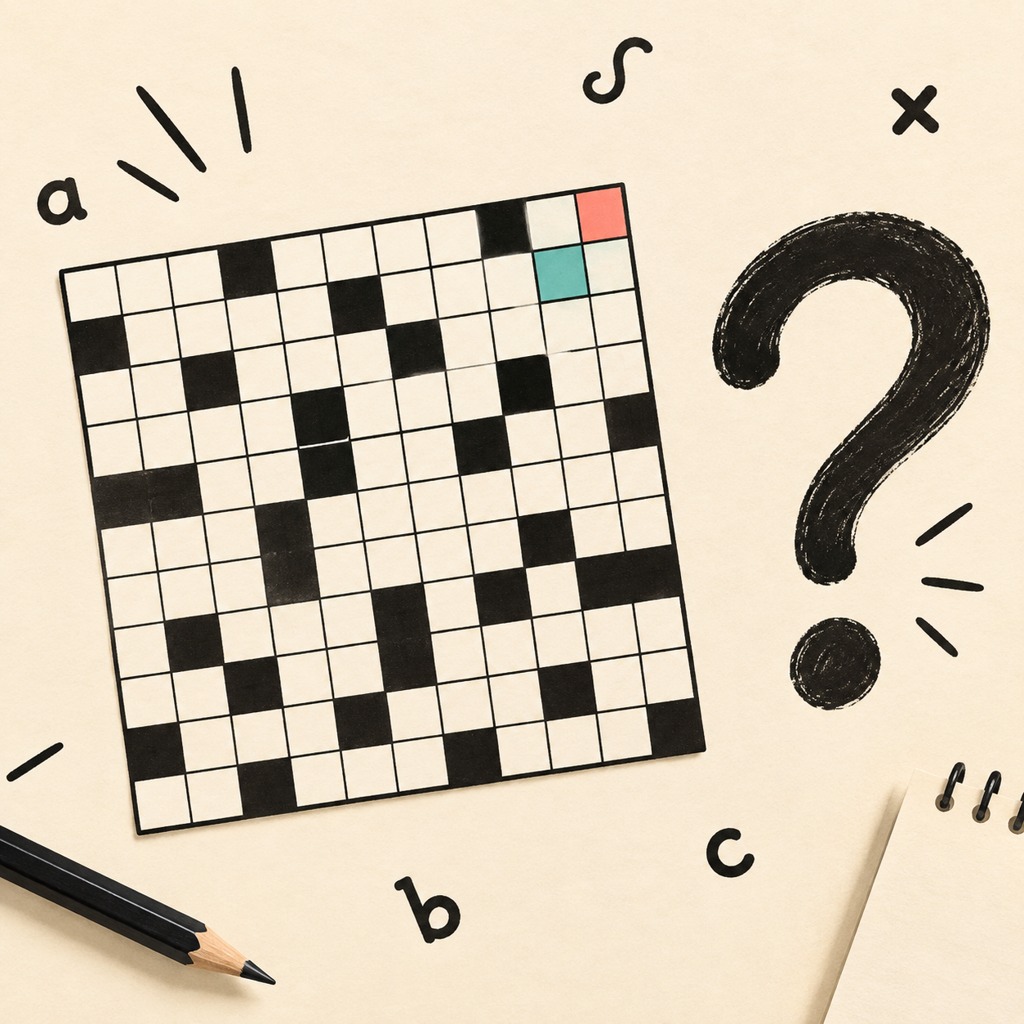
Wordplay feels slippery when it is considered by itself. Crossings make it accountable.
Suppose a question-mark clue suggests two possible answers with the same general joke. The first crossing can remove one. A second crossing may reveal that the answer needs a different tense or a shorter phrase. If the answer only works when you ignore its letters, it is not a good answer yet.
This is the same discipline that makes a crossword more than a collection of clever guesses. The [American Crossword Puzzle Tournament](https://www.crosswordtournament.com/) scores solvers on accuracy as well as speed, and the tournament's published material repeatedly treats incorrect letters as costly. A daily solver does not need a competition clock to borrow the principle: let the grid check the joke.
One confirmed letter is helpful. Two independent crossings are safer. Three may make the wordplay suddenly visible.
When a question-mark answer conflicts with a strong crossing, do not immediately blame the crossing. Re-read the clue. Check whether the playful sense is still plausible, whether the answer length is exact, and whether another clue in the corner is the weaker guess.
Five signals that the question mark is doing real work
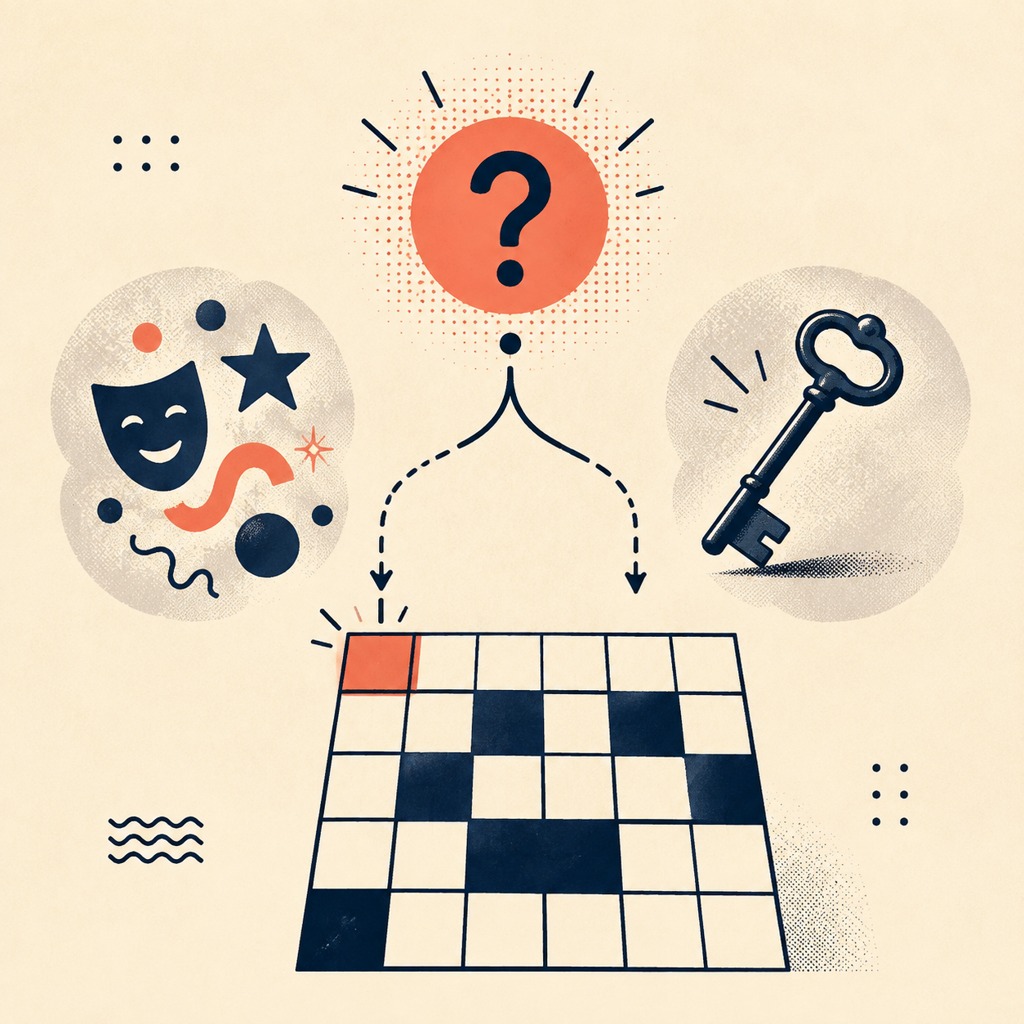
The first signal is an oddly vivid image. If the clue paints a scene that seems too specific for a short answer, look for a phrase hidden inside the image.
The second is a word with two everyday meanings. A clue may move between a physical action and a social expression, or between a literal object and a metaphor.
The third is an answer that sounds like a phrase when spoken aloud. Crosswords can use sound, spacing, and familiar sayings as part of the joke. The crossings still need to support every letter.
The fourth is an answer that feels almost too obvious. A question mark may be telling you that the plain answer is the setup, not the finish. Keep it in pencil until the grid confirms it.
The fifth is a clue whose grammar seems slightly theatrical. That tone can be intentional. Read the sentence as something a person might say, not only as a dictionary definition.
None of these signals guarantees a pun. They simply tell you where to spend another ten seconds before committing.
Do not add a question mark that is not there
Experienced solvers sometimes see wordplay everywhere. That can be just as unhelpful as reading every clue literally.
A clue without a question mark can still be playful, especially in a themed puzzle. A clue with a question mark can still be a straightforward definition with a light joke in the phrasing. The mark is a strong hint, not a mathematical guarantee.
Use it to change your attitude, not to override evidence. Start with the surface meaning, test the likely answer, then check the crossings. If the straight answer fits every part of the grid and the wording, do not invent a second layer simply because you enjoy looking for tricks.
The best solve is the one that explains the clue cleanly. Sometimes that explanation is a pun. Sometimes it is simply the answer you should have written first.
A one-minute routine for Crossword question mark clues
When you reach a clue ending in a question mark, try this sequence.
First, read the clue literally and note the answer shape.
Second, circle the word that might carry a second meaning.
Third, write one light candidate, not three competing answers.
Fourth, check a crossing from an answer you trust.
Fifth, reread the clue with the candidate in place. Does the joke land, or are you defending a near miss?
If the answer works, continue. If it does not, leave the space open and solve around it. A question-mark clue is often easier after the nearby entries provide two or three letters.
That is the quiet advantage of treating punctuation as information. You do not need to become a pun expert. You only need to notice when the clue is asking you to tilt your reading.
Crossword question mark clues are small signals, but they change the mood of a corner. Read the setup, look for the second meaning, and let the crossings decide whether the joke belongs in the grid. Once the signal becomes familiar, the clue feels less like a trap and more like a small invitation to look twice.
Supporting image idea: a clean crossword clue list with one question mark highlighted, next to a grid corner where two crossing letters confirm a playful answer; no readable clue text in the image.