



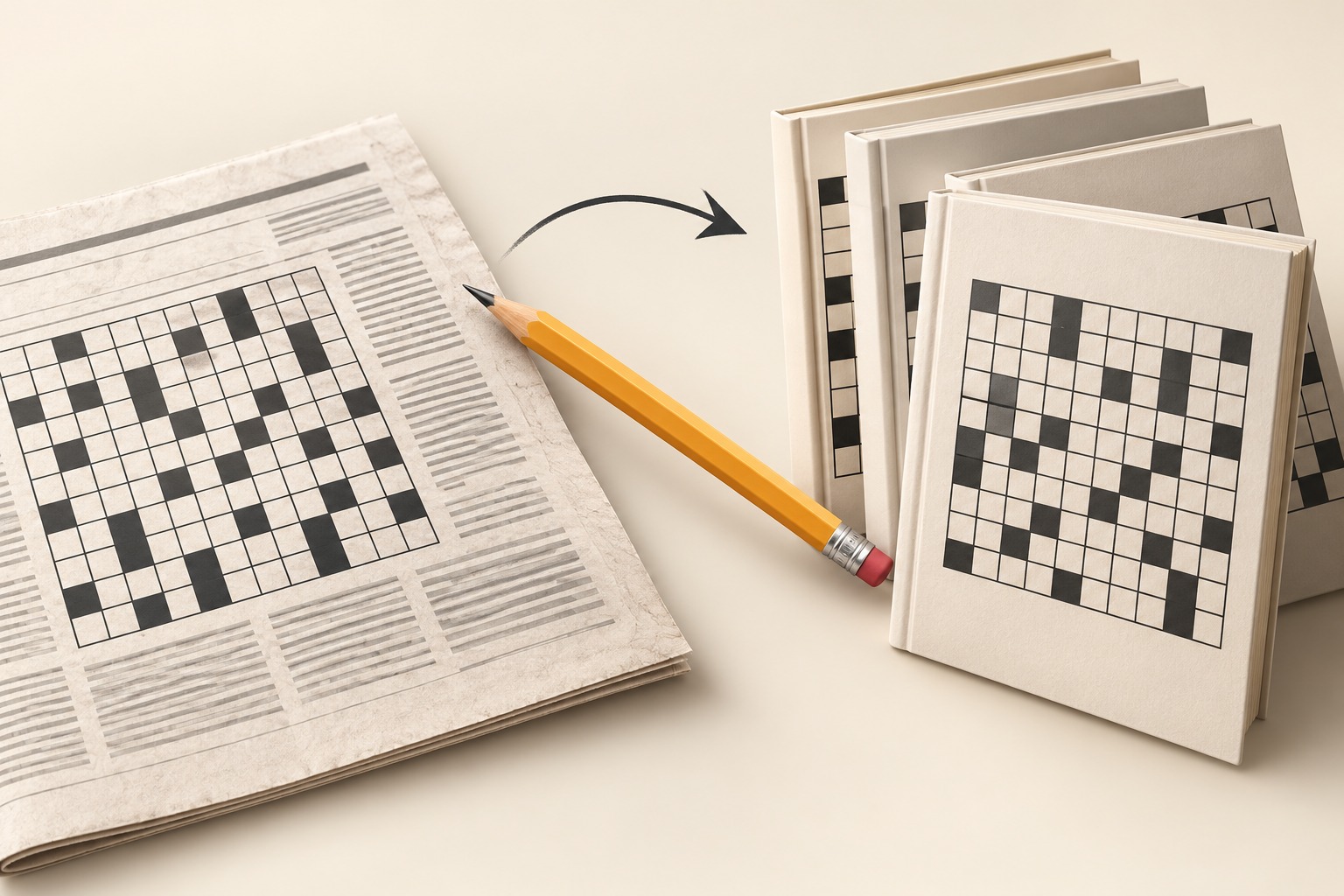
Crossword puzzle books changed the life of a puzzle in a simple way: they made a daily page worth keeping. A newspaper crossword arrives with a date and disappears into yesterday's paper. A book gathers many grids into one object that can travel, wait on a shelf, and be opened whenever the solver has the right kind of attention.
That change is more than a packaging trick. A book alters the rhythm of solving. The reader can move forward, return to an unfinished grid, compare difficulty, or choose a theme before picking up a pencil. The puzzle becomes a small collection rather than a single appointment.
Crossword puzzle books turn a page into a route
The crossword itself began as a newspaper feature. The [Smithsonian history of the crossword](https://www.smithsonianmag.com/arts-culture/crossword-became-american-pastime-180973558/) credits Arthur Wynne with creating the familiar early form for the New York World in 1913. At first, the puzzle belonged to a specific issue and a specific moment. Readers solved it, checked what they could, and moved on with the rest of the paper.
Books changed the unit of time. Instead of asking whether a solver wanted today's puzzle, a book asked how much of a journey the solver wanted to take. One grid could be a warm-up. Ten could become a weekend project. A themed collection could create a mood before the first clue was read.
The earliest books also showed that readers wanted more than a puzzle that happened to be printed. Smithsonian's account of the first crossword book describes an experimental format that initially looked unusual to publishers, then found a large audience. That is the moment when the crossword became a product in its own right, not only a feature attached to a newspaper.
You can still feel that difference in the [crossword collection on Easy Daily Puzzle](https://easydailypuzzle.com/?s=crossword). A browser gives immediate access, while a book gives a physical sequence. Both depend on the same pleasure: a clue that looks closed until one crossing opens it.
Crossword puzzle books change the solving habit
A single newspaper crossword encourages a short, date-based session. A book supports several different habits.
First, it allows comparison. A solver can notice that one puzzle feels open and conversational while another is dense with abbreviations, names, or wordplay. Difficulty becomes something to observe rather than a verdict on one day's performance.
Second, it supports return visits. A book can stay beside a chair with a difficult corner waiting inside. That waiting changes the emotional pressure. The solver does not have to finish before the paper is recycled or the page is lost.
Third, it makes progress visible. A reader can fill several pages, place a bookmark in the middle, and see a record of effort. Digital puzzles can track streaks and completion times, but paper collections show the route through marks, crossed-out guesses, and finished grids.
Finally, a book can group puzzles by voice. A collection may use a particular editor, theme, regional style, or difficulty progression. The reader is choosing not only a puzzle but also the kind of thinking the session will require.
The best order is not always easiest first
Many crossword books are arranged from easier to harder, but a good collection does not have to be read like a school exercise. The right starting point depends on the kind of session you want.
Choose an easier grid when you want momentum. Use it to warm up clue grammar, short answers, and common crossings. Choose a middle puzzle when you want a focused break with a reasonable chance of finishing. Save the most difficult or most unusual grid for a longer stretch when you will not resent leaving a corner incomplete.
This is one reason books remain useful to experienced solvers. They offer choice without requiring a new search. The next puzzle is already there, but the solver controls the timing.
If you are working digitally, copy the same idea. Browse [more crossword puzzles on Easy Daily Puzzle](https://easydailypuzzle.com/?s=crossword), choose one by mood rather than by pressure, and stop while the grid still feels interesting. A collection is valuable partly because it makes stopping and returning feel normal.
Paper, screens, and the value of a clean restart
Crossword puzzle books are physical, but their most useful feature is not nostalgia. It is the clean restart. A book lets a solver close the cover without losing the location of a clue. The next session begins with the same grid, the same partial answers, and a little distance from the last mistake.
Screens offer different advantages. A digital grid can resize, accept typed answers, and make a new puzzle available immediately. It can also make mistakes feel more final because an incorrect entry may trigger a red square or a hint prompt. Paper leaves more room for uncertainty. A light answer can remain provisional until a crossing confirms it.
The two formats can borrow from each other. On screen, solve as though the grid has a margin: keep a doubtful answer mentally soft, revisit clue grammar, and do not let a convenient guess control a whole corner. On paper, use a timer only when it adds interest. The book does not need to become a race to be useful.
Why crossword books still make sense
The newspaper made the crossword a routine. Crossword puzzle books made that routine portable and repeatable. They offered a larger supply, a visible path through difficulty, and a place for puzzles to be collected rather than discarded.
That publishing history explains why the crossword adapts so well. Its core object is small, but its surrounding format can change the reader's relationship with time. A daily page asks for today's attention. A book offers a shelf of possible sessions. A browser offers instant access. The clue remains the same kind of invitation in each setting: start with what you know, let the crossings narrow the field, and return when the answer is ready.