



Crossword misdirection clues are the little traps that make a solver smile after being fooled. A clue sounds like it is asking about weather, but the answer is about mood. It looks like a person, but it wants a verb. It names a familiar object, then quietly asks for the sound, the abbreviation, or the phrase around it.
The clue did not lie. It just let you walk through the wrong door first.
If you play word puzzles on Easy Daily Puzzle, learning to slow down around crossword misdirection clues can make a daily grid feel less random and more playful. You can also browse more word-game pieces through Easy Daily Puzzle crossword articles when you want another clue-reading habit before opening a fresh puzzle.
Crossword misdirection clues start with surface meaning
Every clue has a surface. That is the sentence your brain reads first.
"Leaves in the fall" sounds botanical. You picture trees, wind, and a yard that needs raking. In a crossword, though, the answer might be GOES. The clue can be read as a verb phrase: someone leaves in the fall. The surface pointed at autumn leaves. The answer came from a different reading.
That is the basic pleasure of crossword misdirection clues. They use normal language against your first instinct.
This has deep roots in crossword culture. The American Crossword Puzzle Tournament history page credits Arthur Wynne with the first known published crossword puzzle in the New York World on December 21, 1913. That early puzzle looks different from modern grids, but it already shows the central idea: words can be placed so they check one another. Clues are not isolated trivia cards. They live inside a structure.
That structure is what saves you from misdirection. A clever clue can fool your first reading, but the crossings can still tell the truth.
Crossword misdirection clues should be tested, not feared
The beginner mistake is treating a misleading clue like unfairness. It usually is not. A good misdirection clue is fair after you see it. It gives you a path, but it does not force you to take the obvious one.
The problem is speed. A solver reads the surface, gets a plausible answer, and writes it in because it feels right. The answer may even fit the letter count. That is the dangerous part. A wrong answer with the right length can poison a corner for ten minutes.
Tournament solving makes that cost visible. The 2026 American Crossword Puzzle Tournament lists event results, divisions, pairs, virtual solving, and accuracy details. Casual players do not need tournament pressure, but the lesson is useful: speed only helps when the answer is actually right.
So treat a suspicious clue as a candidate, not a verdict.
Ask four questions before you lock it in:
1. What is the plain surface story?
2. What other part of speech could the clue be using?
3. Does the answer length support the obvious reading?
4. Can at least one crossing prove the first or last letter?
That small pause is often enough to keep a cute trap from becoming a full-grid repair job.
How to spot crossword misdirection clues in the wild
Some clues announce their trick. A question mark at the end often says, "Read me sideways." A short clue with a very ordinary word can also be suspicious because the constructor may be using a familiar word in an unfamiliar role.
Other clues are quieter. They misdirect through grammar.
A clue that looks like a noun may be asking for a verb. A clue that looks singular may want a plural phrase. A clue that sounds like a proper name may be using the name as a common word. A clue that seems emotional may be literal, and a clue that seems literal may be emotional.
Here are a few patterns worth noticing:
1. Common words with multiple meanings.
2. Words that can be nouns or verbs.
3. Clues that sound like tiny headlines.
4. Clues ending in a question mark.
5. Clues that feel too easy for their place in the grid.
That last one is underrated. If a clue in a difficult corner feels strangely obvious, it may still be obvious. But it deserves a crossing check before you trust it.
The best defense is a soft answer
A soft answer is an answer you allow yourself to erase.
That sounds simple, but it changes the mood of solving. Many players become attached to the first clever answer they find. Once it is in the grid, every crossing gets bent around it. The solver stops asking whether the answer is right and starts asking how to make it survive.
Crossword misdirection clues punish that attachment.
A better habit is to write mentally in pencil even if you are solving on a screen. Fill the answer if it helps you move. But keep it soft until two things happen: the clue still makes sense after a second reading, and at least one crossing supports it.
If the answer is long, ask for more proof. Long wrong answers are expensive. They create many false crossings and make unrelated clues look harder than they are.
This is where answer length helps. A three-letter answer can be a quick guess. A seven-letter answer with a tricky clue should earn more evidence. A fifteen-letter themed answer should be treated like furniture. Do not drag it across the room unless you know where it belongs.
What crossings reveal that the clue hides
Crossings are the crossword's built-in honesty system.
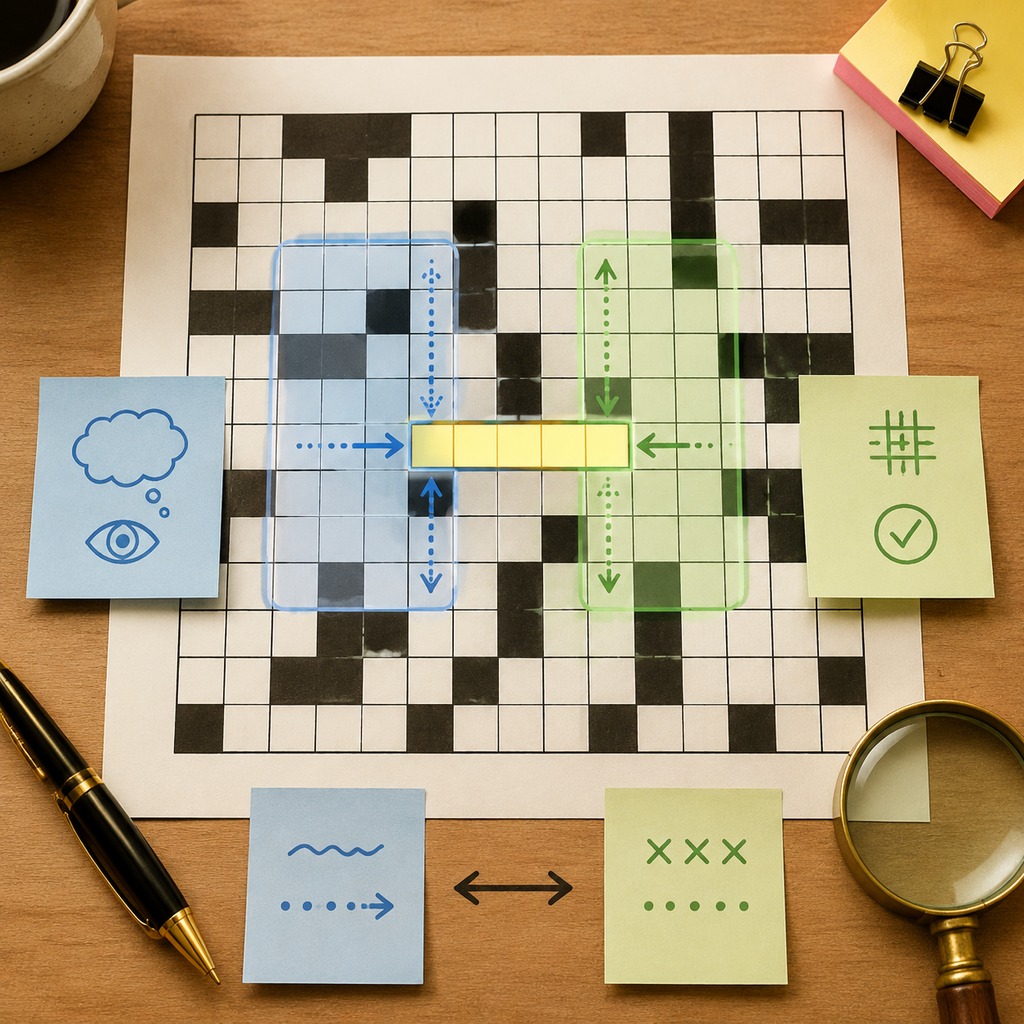
When a clue misleads you, it usually does so through meaning. Crossings do not care about the surface story. They care about letters. That makes them blunt and useful.
Suppose a clue seems to want STORM, but the second crossing gives you an A. The wrong answer starts to wobble. You can either fight the grid or reopen the clue. The better solver reopens the clue.
Try this routine:
1. Fill the answer lightly if it seems plausible.
2. Check the easiest crossing, not the hardest one.
3. If one crossing disagrees, do not immediately change the crossing.
4. Re-read the original clue for another part of speech.
5. Keep the answer only after a second crossing supports it.
This routine works because it gives the clue a fair trial. You are not rejecting the first idea just because it might be wrong. You are asking the grid to confirm it.
Why misdirection makes crosswords more readable
It may sound strange, but misdirection can make a puzzle friendlier.
A grid made only of dictionary definitions becomes flat. The solver knows the routine: read clue, retrieve fact, fill answer. That can be pleasant, but it can also feel mechanical.
Crossword misdirection clues create a small moment of interpretation. They make the solver notice language itself. Is this word acting as a noun or a verb? Is this phrase literal or playful? Is the clue pointing at the thing, the sound, the abbreviation, or the context?
That is why good misdirection does not feel like a cheap trick. It rewards attention. It makes a simple clue more alive.
For casual players, the goal is not to become suspicious of every clue. That would make solving exhausting. The goal is to learn which clues deserve a second glance.
Short, ordinary wording. Strange punctuation. A too-easy answer in a hard corner. A phrase that can change part of speech. Those are the small warning lights.
A better next grid with crossword misdirection clues
The next time a clue feels obvious, enjoy that first answer, but do not marry it immediately.
Look at the clue's grammar. Check the answer length. Ask whether the surface reading is the only possible reading. Then let one crossing speak before you commit.
If the first answer survives, good. You solved it cleanly. If it falls apart, even better. You caught the trap before it spread.
That is the quiet skill behind crossword misdirection clues. They teach you to be curious without becoming paranoid. The clue may be smiling at you, but the grid is still willing to help.