


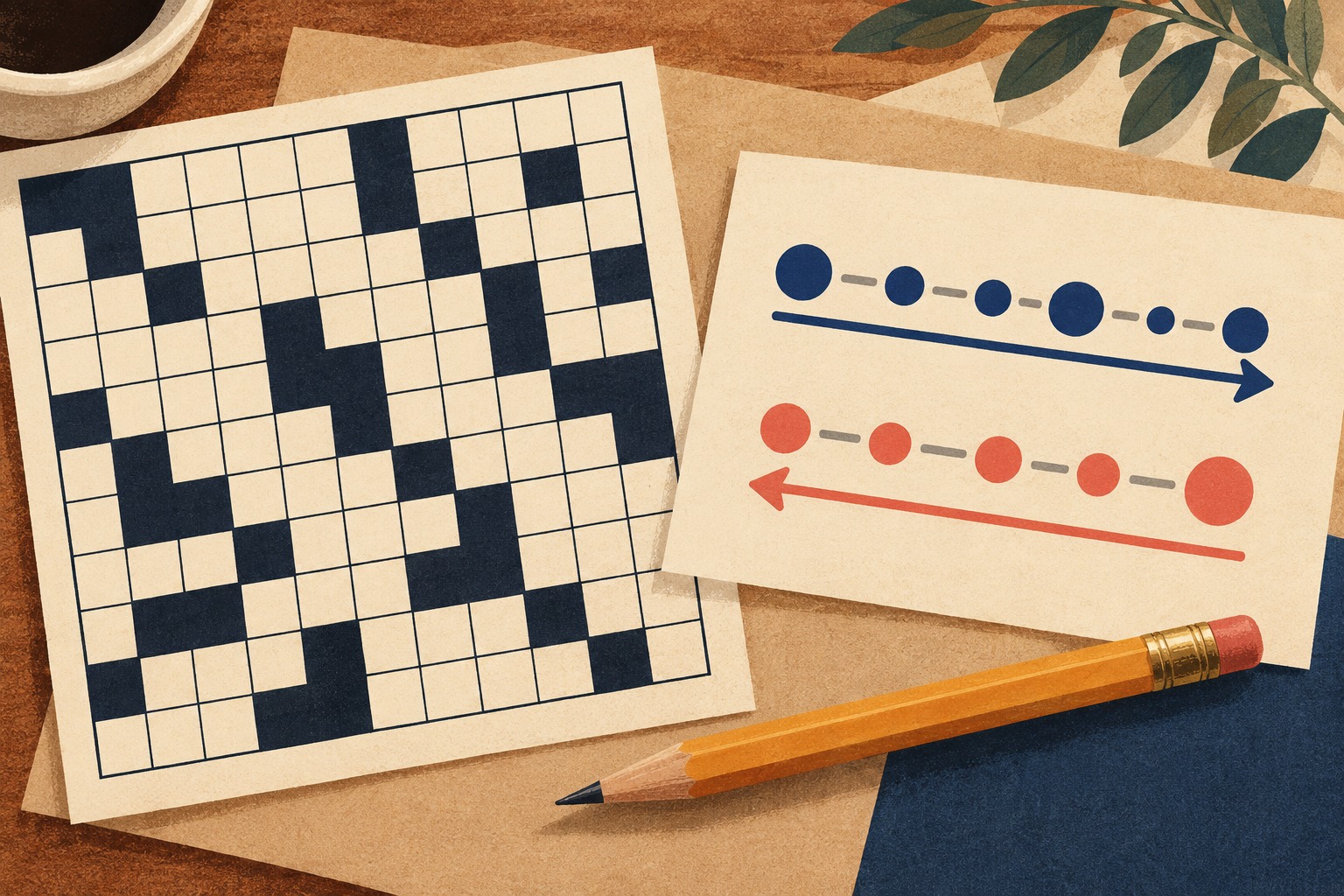
Crossword clue word order is easy to miss because a good clue sounds like a normal sentence. You read from left to right, imagine the situation, and let the first plausible answer settle in your head. Then the crossing letters disagree. The clue was not necessarily unfair. You may have followed the sentence in the order it wanted to sound, not the order it needed to be solved.
That difference matters most in cryptic crosswords, where a clue commonly contains a definition and a separate piece of wordplay. It also helps with quick crosswords, because grammar, answer length, and crossings can tell you which part of a sentence deserves attention first. The goal is not to distrust every clue. It is to learn when to read it once for meaning and once for construction.
Crossword clue word order starts with the surface
The surface is the ordinary sentence you hear on the first pass. It may describe a person, an action, or a small scene. Setters use that surface to make the clue flow naturally, even when the answer is built from a different set of instructions.
The [Guardian beginner guide to cryptic crosswords](https://www.theguardian.com/lifeandstyle/2010/may/03/how-to-solve-cryptic-crosswords) explains the basic division between definition and wordplay. Usually, the definition appears at one end of the clue and the wordplay occupies the rest. The sentence can still sound as if its important information sits in the middle. That is the first trap.
Read the clue once without solving it. Notice the subject, verb, and apparent object. Then read it again as a set of parts. Could the first phrase be a definition? Could the last phrase describe the answer? Is a small word doing more work than it appears to do?
This second pass is not a hunt for hidden meaning in every article or preposition. It is a quick change of angle. A phrase that felt central in the surface may become a connector. A quiet word near the end may become the definition you were looking for.
Find the two ends before chasing the middle
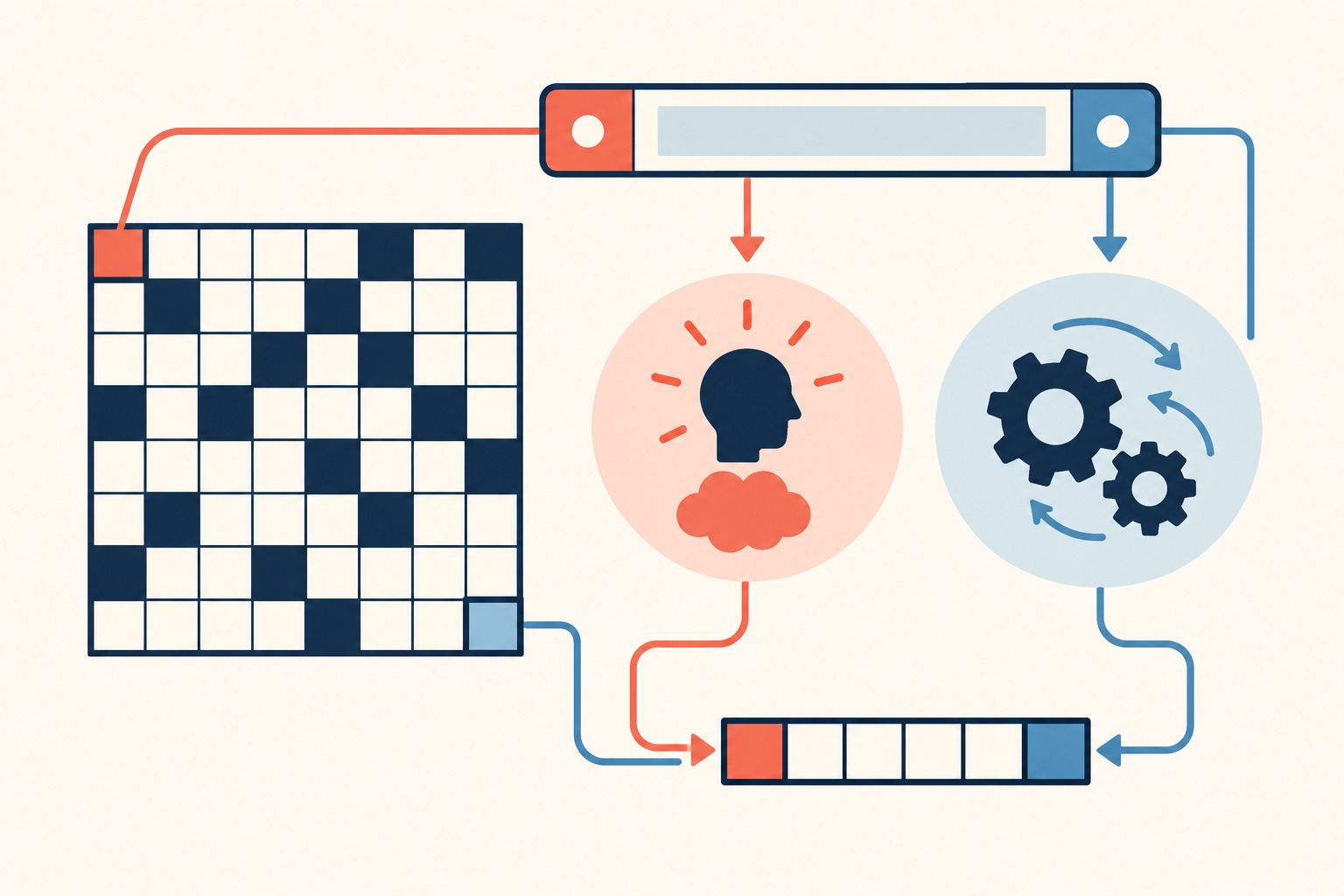
When a clue resists, test the two ends first. In many cryptic clues, one end gives a direct meaning and the other gives the construction. The answer length and the letters already in the grid help you decide which end is more promising.
For example, suppose the answer has six letters and the clue begins with a phrase that could describe a person. Ask whether that phrase can define a six-letter noun or adjective. Then inspect the other end for a possible instruction, such as a reversal, a short form, a container, or an anagram signal. Do not force a complete parse immediately. First decide where the clue might be divided.
This also helps with clues that use a natural verb. A verb can be part of the surface, but it may also tell you to change, remove, or return letters. If the answer fits the definition but the construction has no support, keep it provisional. A nearly correct answer is still a useful question, not a finished solve.
The [Guardian guide to reading clues backwards](https://www.theguardian.com/crosswords/crossword-blog/2012/jul/05/cryptic-crossword-beginners-backwards-clues) makes the same practical point in a different way: once you have a possible answer, work back through the clue and ask whether every important word earns its place. Reading from the answer toward the clue can expose a guess that only matched the surface.
Instruction words can arrive late
Many solvers notice a likely definition and then search for a synonym. That works until the clue asks you to do something with the synonym. A word such as “returned,” “briefly,” “inside,” or “back” may change the route. It can appear after the letters you need, which is another reason not to assume that the sentence's left-to-right order is the solving order.
Use original mini-examples as practice rather than memorizing a published clue. Imagine a clue that asks for a short word meaning “old” and then hints that it should be returned. You would not simply write the first synonym for old. You would check the length, identify the word being reversed, and see whether the crossing letters support it. The example is small, but the habit scales.
Do not turn this into a rigid dictionary. Indicator words vary by setter and puzzle type. The [Guardian's beginner material on cryptic conventions](https://www.theguardian.com/crosswords/crossword-blog/2023/jun/05/cryptic-crosswords-for-beginners-ellipsis-three-dots) is useful because it treats clue reading as a collection of conventions rather than one mechanical formula.
Quick crosswords need a lighter reread
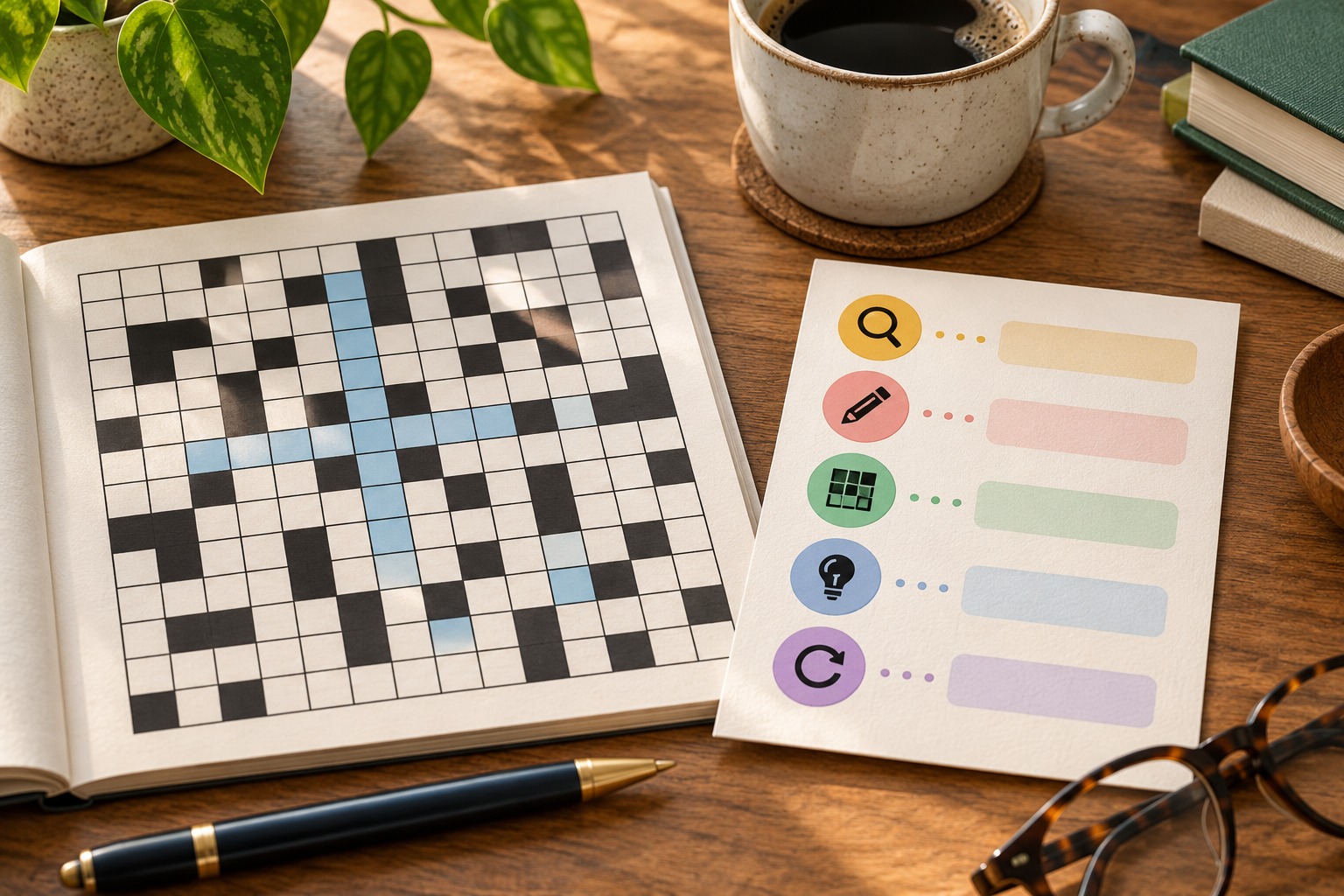
Not every crossword is cryptic. In a quick crossword, the clue may be a direct definition, a short description, a quotation, or a clue with a simple play on words. The same reread still helps, but the questions change.
Check the grammar first. Does the answer need to be a verb, a plural noun, or an adjective? Check the enumeration next. Then use the crossing letters to decide between two ordinary synonyms. If the clue has a question mark, loosen the literal reading for a moment, but do not assume the answer must be a pun.
The key difference is that a quick crossword usually does not require a full cryptic-style explanation for every letter. You are looking for the cleanest answer that fits the clue, length, grammar, and grid. Using a heavy cryptic parse on a direct clue can waste more time than it saves.
For a short daily session, try the [Easy Daily Puzzle crossword collection](https://easydailypuzzle.com/?s=crossword). Leave a doubtful entry in pencil, finish the easier section, and let new crossings change the way you read the old clue.
A five-step word-order reset
Use this routine when an answer seems almost right.
1. Read the whole clue naturally once, without entering an answer.
2. Mark the possible definition at the beginning and the end.
3. Check length, grammar, and confirmed crossings before accepting a synonym.
4. Reread the remaining words as instructions, including late words that suggest reversal, deletion, shortening, or containment.
5. Work backwards from the candidate answer and make sure the clue supports it rather than merely sounding compatible.
This routine protects you from two opposite errors. The first is taking the surface too literally. The second is becoming so suspicious that every small word looks like a code. Good solving stays evidence-led. The answer must fit the clue, not just the story you imagined from it.
Let the grid change the reading order
Crossword clues are written as sentences, but they are solved as relationships. The definition, the construction, the answer length, and the crossing letters all push against one another. When one interpretation fails, changing the reading order can reveal the intended path without requiring a wild guess.
The next time a clue feels polished but unhelpful, pause before searching for a more impressive synonym. Read the ends. Check the length. Look for a quiet instruction near the back. Then let the grid decide whether your clever idea deserves to stay. When you want another short practice round, browse the [Easy Daily Puzzle home page](https://easydailypuzzle.com/) and choose a crossword that matches your available time.