



Crossword clue indicator words are the small signals that tell a cryptic solver what to do with a group of letters. A word such as “broken” may ask for an anagram. “Back” may ask you to reverse something. “Around” may tell you to put one piece inside another.
The clue still needs a definition. The indicator does not give you the answer by itself. It gives you a possible operation, which is useful when the surface sentence sounds ordinary but the letters refuse to behave like a normal definition clue.
You can practice ordinary crosswords through [Easy Daily Puzzle](https://easydailypuzzle.com/), then browse [more crossword puzzles and articles](https://easydailypuzzle.com/?s=crossword). The indicator habit is most important in cryptics, but the larger lesson travels well: pay attention to the words that describe how an answer is built.
What crossword clue indicator words actually do
A cryptic clue usually offers two routes to the same answer. One part is a definition. The other part is wordplay. An indicator sits inside the wordplay and names the operation without announcing it as a set of instructions.
Take this original example: “Friend, broken TEAM (4).” FRIEND is the definition. BROKEN is the indicator. TEAM is the letter material. Mix TEAM and you get MATE, which satisfies both parts of the clue.
The indicator is not always dramatic. “Wild,” “confused,” “out,” and “damaged” can all suggest an anagram, depending on the setter. The useful habit is to mark the likely operation, then check whether the nearby letters can perform it cleanly.
The [National Puzzlers’ League guide to cryptic crosswords](https://www.puzzlers.org/solving-and-constructing/cryptic-crossword/) describes the general split between definition and wordplay. Keep that split in mind before collecting a long list of indicator words. A list is easy to memorize. Seeing which words belong to which job is the part that improves solving.
Four indicator families worth learning first
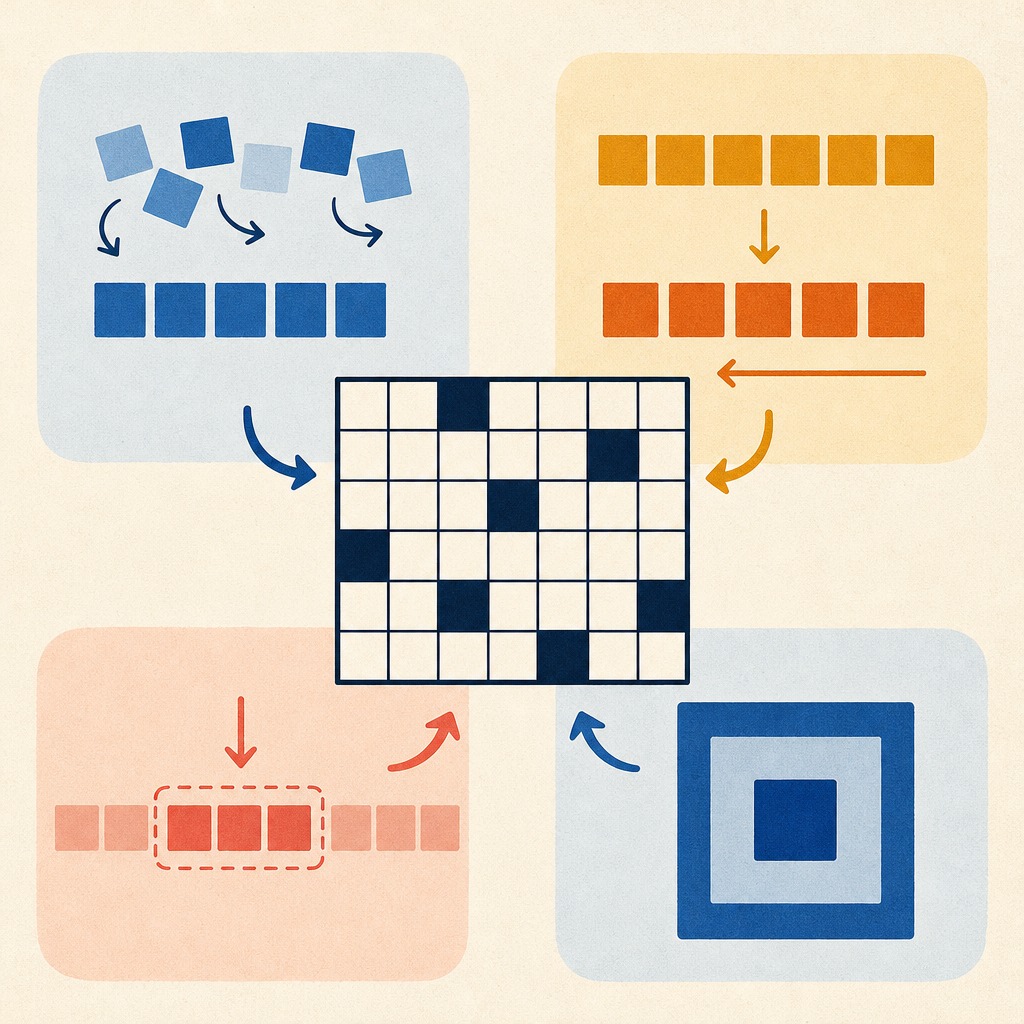
Anagram indicators tell you to rearrange letters. Words such as “broken,” “mixed,” “wild,” or “reworked” often do this job. If the clue contains a short group of letters beside one of these signals, count them and compare the result with the enumeration. An anagram that produces the wrong length is not a clever exception. It is the wrong path.
Reversal indicators tell you to read letters in the opposite direction. “Back,” “returned,” and “reversed” are common examples. The exact direction can depend on the puzzle style. In a down clue, a reversal may be read differently from an across clue. Let the grid direction and the answer length settle the question.
Containment indicators tell you that one piece goes inside another. “Around,” “holding,” “covering,” and “about” can suggest this relationship. Imagine the clue as a small set of brackets. One word or abbreviation supplies the outside letters. Another sits inside.
Hidden-answer indicators tell you to look across a stretch of clue text rather than build the answer from separate pieces. “Some of,” “part of,” “within,” and “in” may point in this direction. Read the letters continuously, including across a word boundary, then check whether the hidden sequence matches the definition and length.
These families are enough to make a cryptic clue feel less like a wall of prose. You do not need a perfect dictionary of signals. You need a small set of operations you can test without bending the clue.
Do not let the indicator swallow the definition
A common mistake is to label every unusual word as an indicator. The clue may contain a natural sentence whose first or last phrase is the definition. If you treat all of it as wordplay, you can find a possible letter operation and still miss the answer.
Look for the definition at one end first. Test a plain synonym that matches the enumeration. Then use the remaining words as the material and instructions. This order keeps the clue grounded.
For example, if the clue ends with “small bird,” that phrase may be the definition. The earlier words might provide an abbreviation, an anagram, or a hidden answer. If your proposed operation uses the words “small bird” as raw letters, ask whether the result still has a clean definition. A neat mechanism is not enough if it explains the wrong half of the clue.
Indicator words can also be ambiguous. “About” might mean approximately in a definition, or it might signal containment. “Back” might describe a body part, or it might tell you to reverse letters. The surrounding grammar and the final answer decide which reading is fair.
A small example without a solver's leap
Consider this original clue: “Hear a bird, reportedly (4).” The definition could be a bird. The phrase “reportedly” suggests a homophone. A bird such as DOVE or TERN might fit the length, but the wordplay still needs to produce the same sound from something in the clue.
That is the useful pause. Do not pick a familiar bird because the definition feels right. Ask what the indicator is asking you to hear, then search for a short source word that sounds like the answer. If the crossing letters later disagree, the clue has not been solved yet.
The [Daily Cryptic indicator directory](https://dailycryptic.org/tools/indicators) is useful as a reference after a solve. It groups indicator words by operation, including anagrams, containers, reversals, deletions, and hidden answers. Use it to confirm a mechanism, not to force an unfamiliar word into a clue that has no supporting letters.
A five-step scan for a difficult clue
When a cryptic clue stalls, use this order:
1. Count the answer length and note any word breaks.
2. Read the first few and last few words as possible definitions.
3. Circle one word that might indicate an operation.
4. Test only the nearby letters that the operation could reasonably use.
5. Require both a clean definition and a clean construction before committing.
If two indicator words appear, do not assume the clue contains two separate operations. One may be part of the surface sentence. Start with the interpretation that explains the most words while leaving the definition intact.
Write the answer lightly until a crossing supports it. A plausible word with a vague mechanism is a candidate, not a finished entry. Cryptics reward proof, and the proof often arrives as a small correction to the letters you first wanted to use.
Why this habit makes cryptics more readable
Crossword clue indicator words turn a long clue into a short instruction. Once you spot “broken,” “back,” “around,” or “within,” you have a reason to test one operation instead of guessing from the whole sentence.
The aim is not to make every clue mechanical. Good cryptics still surprise you. The aim is to notice where the setter has placed the handle. Find the definition, identify the likely indicator, count the letters, and ask whether the wordplay produces the same answer.
Try a fresh crossword through [Easy Daily Puzzle](https://easydailypuzzle.com/?s=crossword). When a clue sounds like a normal sentence, listen for the one word that changes the job of the letters. That word may be the first fair step toward the answer.