



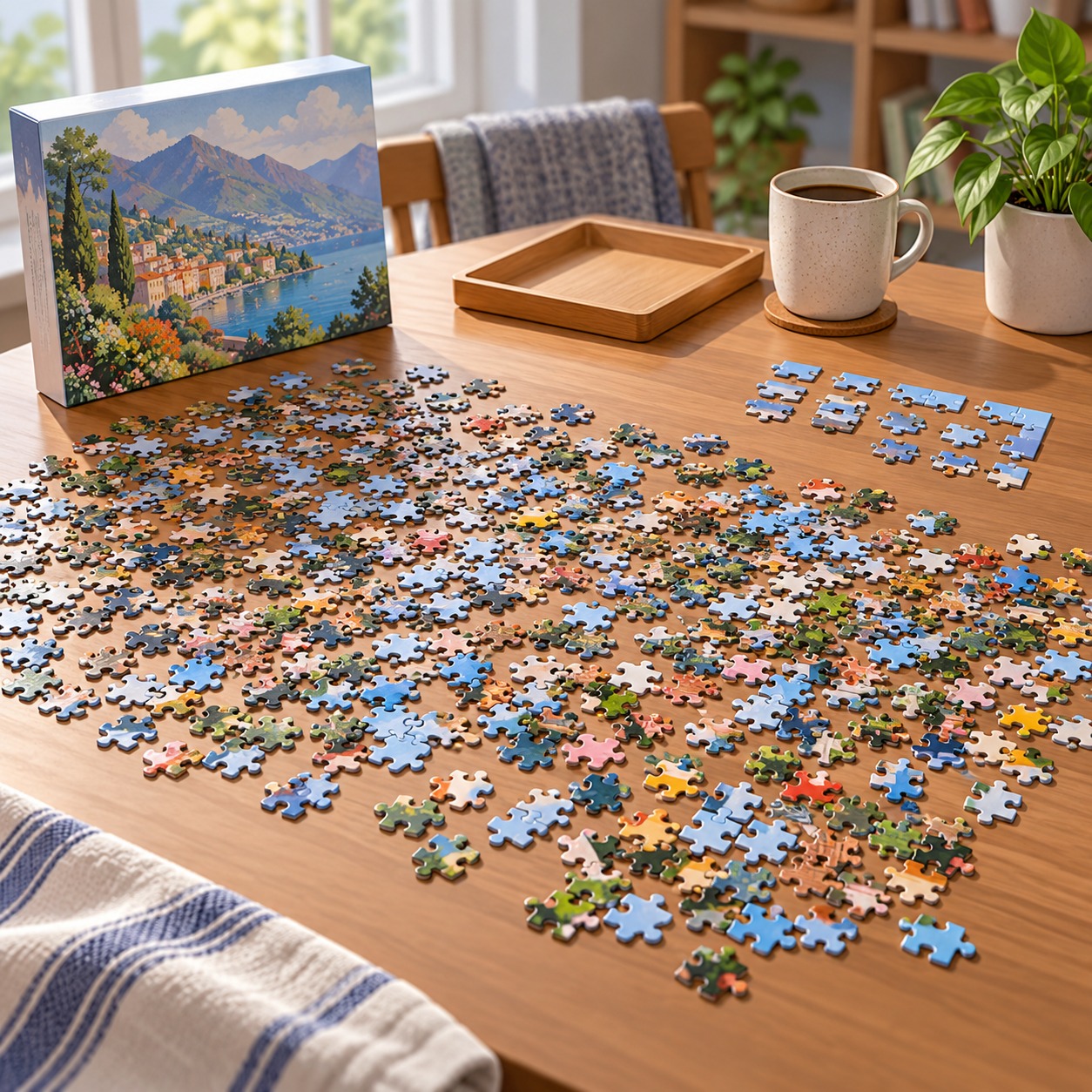
A 500 piece jigsaw speed strategy begins before the first piece clicks into place. The box is open, every piece is face down or upside down, and the table seems to offer too many possible starts. In a speed-puzzling room, that moment is not wasted time. It is the opening phase of the solve.
The useful idea behind a 500 piece jigsaw speed strategy is not to move every piece as quickly as possible. It is to make the table informative early. Every small group should answer a question: where is this color likely to live, which way does this line travel, or which part of the image has enough detail to become a reliable island?
The World Jigsaw Puzzle Championship gives that first phase a clear pressure frame. Its 2026 rules use unpublished 500-piece puzzles in the individual rounds, with a maximum of 90 minutes in the first round and 75 minutes in later individual stages. The official participant page lists 856 individual competitors from 67 countries. You do not need to race at that level to borrow the opening routine.
500 piece jigsaw speed strategy starts with orientation
Before sorting by color, turn the pieces so the picture faces the same way. This sounds ordinary, but it changes the table from a pile into a readable surface. A rotated piece can hide a line, a face, a window edge, or the difference between warm gray and cool gray.
The [World Jigsaw Puzzle Championship rules](https://worldjigsawpuzzle.org/wjpc/2026/rules) allow participants to use trays within stated size limits, but they do not allow digital devices to enlarge the reference image. The practical lesson is simple: make your physical workspace do the reading for you. A clear table and visible pieces are better than a complicated sorting system that you cannot scan.
Do not aim for perfect orientation. Turn pieces until most of the image is readable, then begin making groups. If you spend the whole first phase creating a beautiful array, the array has become the activity instead of the puzzle.
Build information, not just a border
The border is a reliable start, but it is not automatically the fastest start. A long strip of sky, water, or dark shadow may offer fewer clues than a small group around a face, a sign, a roofline, or a strong change in texture.
Use two questions when you choose a first group:
1. How easy will these pieces be to recognize again?
2. How many neighboring pieces might this group reveal?
An edge section can answer both questions, especially when the image has a strong frame. But a high-information landmark can be better when the border is a field of similar pieces. Build the group that gives the table more information, not the group that looks most respectable.
For online play, the same rule applies even when the interface keeps the pieces neatly arranged. Try the [jigsaw puzzles on Easy Daily Puzzle](https://easydailypuzzle.com/?s=jigsaw) and notice whether the image has a natural landmark before committing to an edge-first solve.
The first ten minutes in five small moves
A useful opening routine should be short enough to remember. Try this sequence:
1. Turn the pieces face up and orient the main picture.
2. Pull out obvious corners and a small number of strong edge pieces.
3. Make one group around a high-information object, line, or color transition.
4. Keep uncertain pieces near the group instead of returning every possible match to a distant pile.
5. Pause and look at the reference image again before opening a second large sort.
The fifth move is easy to skip. Solvers become absorbed in the pieces in front of them and stop checking the picture as a whole. A short reference look can show that a line bends, a shadow changes direction, or a color group belongs to a different section of the image.
Do not let sorting become a hiding place
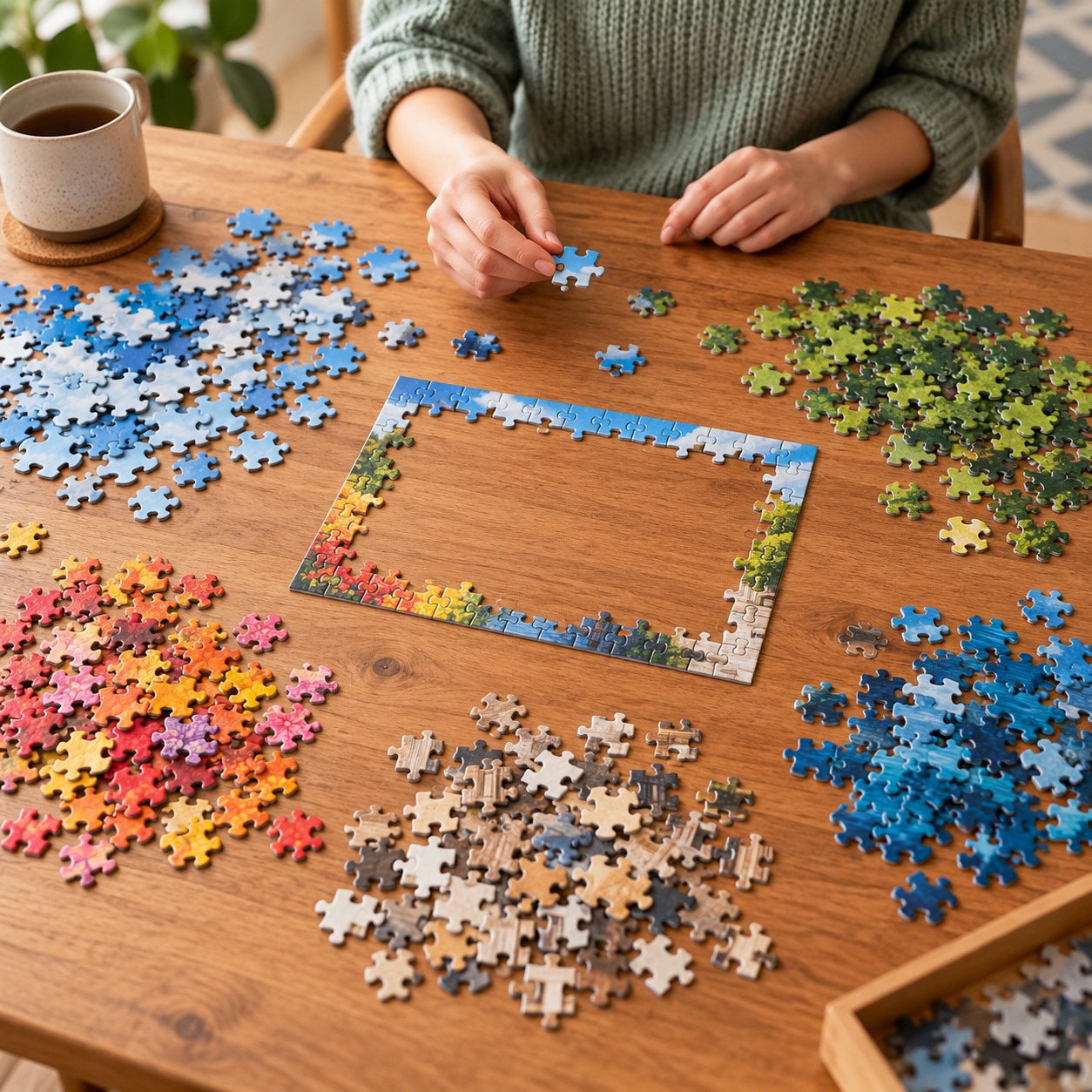
Sorting feels productive because the table becomes tidy. That feeling can be misleading. Ten piles of nearly identical pieces may be less useful than one connected section and a loose tray of unknowns.
Set a limit for each sort. If you cannot name the visual feature that defines a group, stop growing that group. “Blue” is often too broad. “Blue with a thin diagonal white line” is more useful. “Brown” is weak. “Brown with a repeated vertical texture and a flat edge” gives the pieces a possible home.
This is also where the image choice matters. A picture with faces, lettering, buildings, strong shadows, or clear object boundaries supplies more early landmarks than a picture made almost entirely of repeated texture. The [history of jigsaw puzzles from Europeana](https://www.europeana.eu/en/stories/the-history-of-jigsaw-puzzles) offers a useful reminder that puzzles have long depended on images carrying information, whether the picture was a map, a scene, or a decorative design.
What speed puzzlers do after the first section
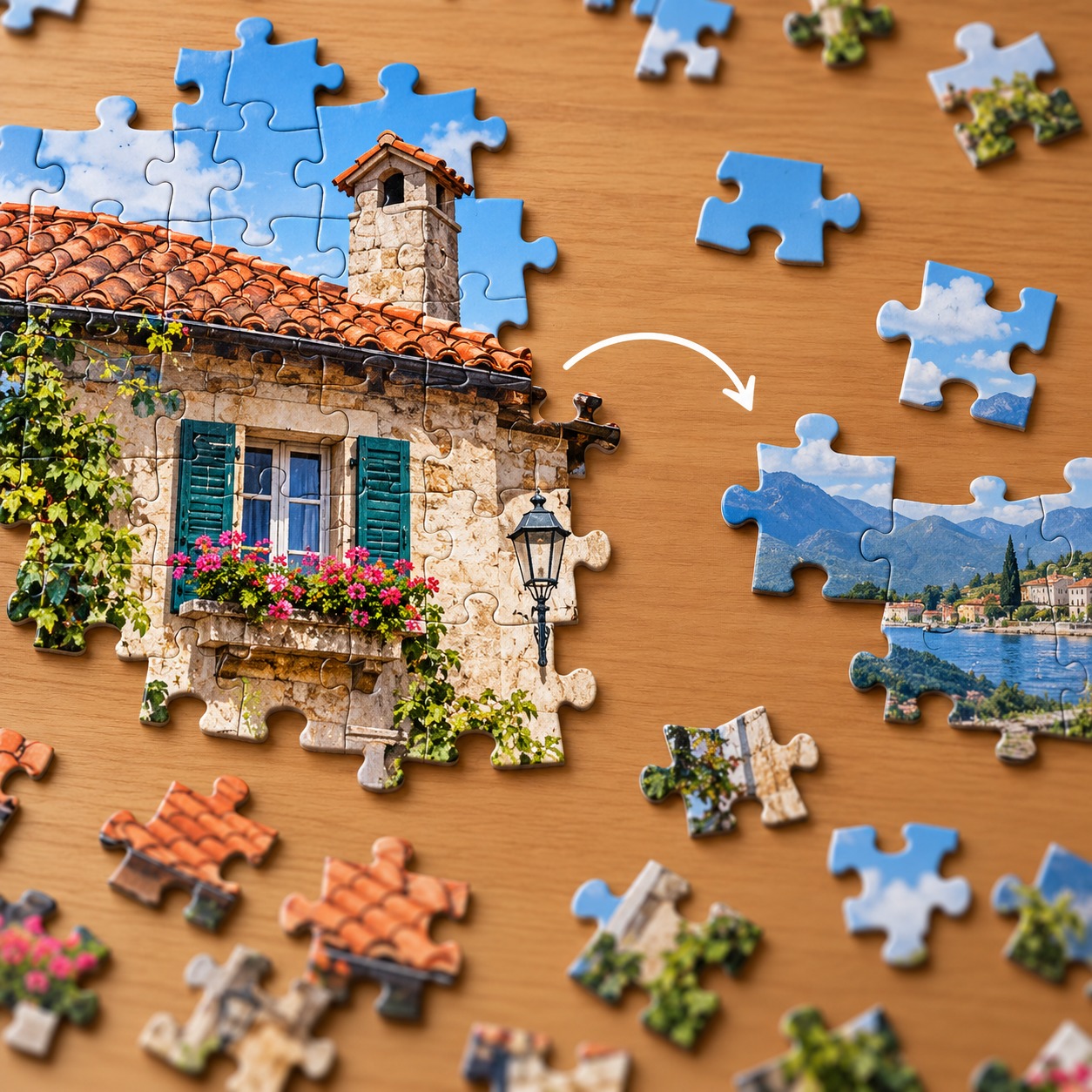
Once one small section is stable, do not immediately scatter it to start another giant pile. Ask what the section has taught you. Does a line continue toward the border? Does a color transition point to a second island? Is there a distinctive piece shape that can help locate a neighbor?
A connected section should create a new search area. Its outside edge gives you shapes to test. Its picture gives you a direction. Its relationship to the reference image tells you whether the next move should expand, connect, or return to the border.
If nothing new appears, leave the section alone and switch to a different high-information feature. Speed is not the same as constant motion. It is the habit of avoiding long stretches of work that produce no new evidence.
A calm 500-piece practice session
You can practise this method without racing the clock. Set a ten-minute timer. At the end, stop and take a quick inventory:
- Did the table become easier to read?
- Did you build one connected section?
- Can you name the next visual feature you want to search for?
- Did your sorting create useful groups or only tidy piles?
If the answer to the last question is uncomfortable, change the next session. Use smaller groups, keep the reference visible, and choose a picture with a clear landmark. The point is not to force a personal record every time. It is to make the opening minutes pay for themselves.
The [Easy Daily Puzzle game library](https://easydailypuzzle.com/) is useful when you want to switch between a jigsaw break and a different puzzle format. A 500-piece jigsaw can be a competition, a quiet evening, or a short visual reset. The first ten minutes decide which one it becomes.