



A 10 minute puzzle break sounds almost too small to matter. Then you notice what usually fills those ten minutes: half a scroll, three notifications, one video you did not mean to watch, and a strange feeling that your brain came back louder than it left.
That is where a puzzle earns its place. It gives your attention a clean job. Not a huge job. Not a self-improvement project. Just one grid, one clue, one card move, one little visual problem that has edges.
If you want a quick reset, start at Easy Daily Puzzle and pick the kind of puzzle that matches your mood instead of forcing the same game every day. A tired brain does not always need the hardest challenge. Sometimes it needs a tidy one.
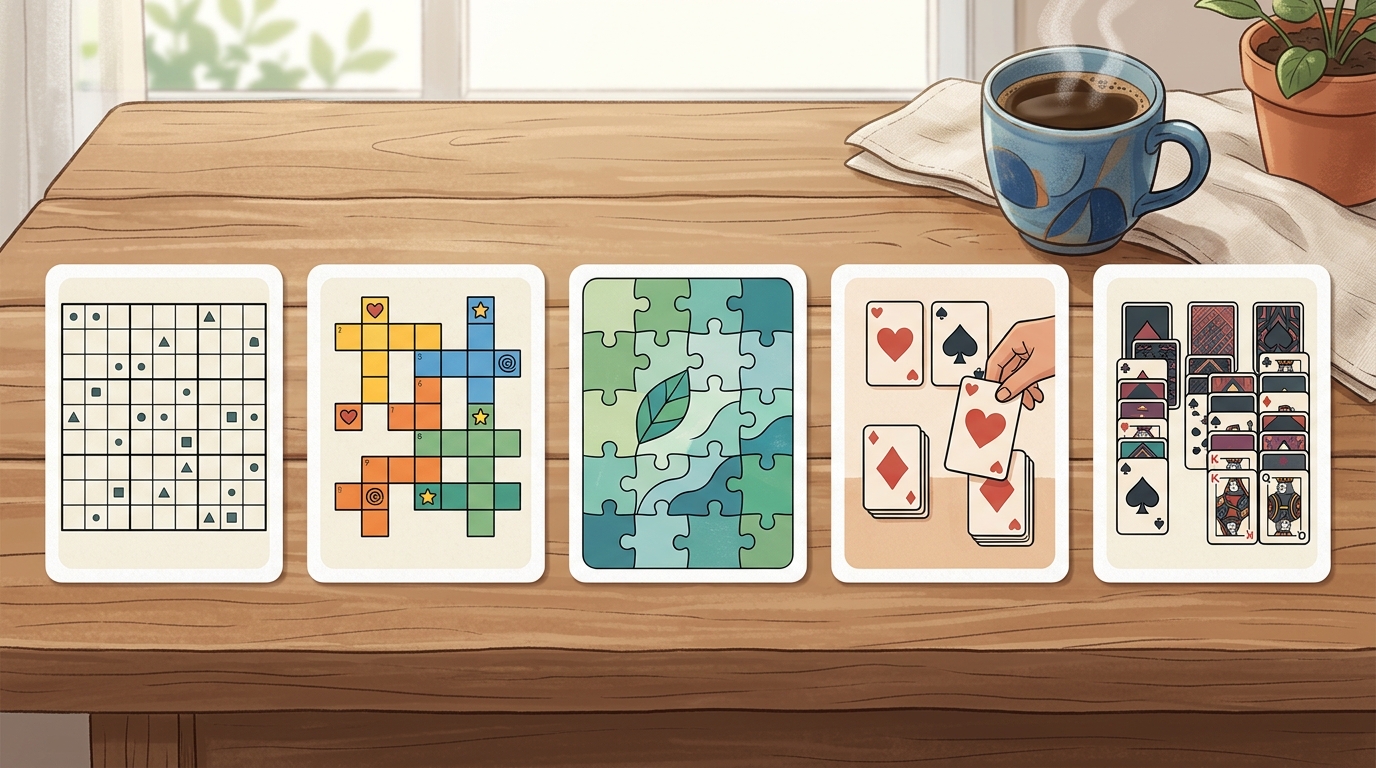
Why a 10 minute puzzle break can feel better than scrolling
Short breaks are not magic, and a puzzle is not medical treatment. Still, there is a real difference between resting your attention and scattering it. A PLOS ONE meta-analysis on micro-breaks found small benefits for vigor and fatigue in the studies it reviewed, although the authors were careful about how far those results should be stretched.
That does not mean every break has to be productive. Please do not turn a puzzle into another task on the list. The point is simpler: a good puzzle gives your mind a single lane for a few minutes.
Scrolling keeps opening new doors. A puzzle closes most of them.
In sudoku, the job is to test one number against a row, column, and box. In a crossword, the job is to ask what the clue really wants. In solitaire, the job is to protect options. In a jigsaw puzzle, the job is to sort color, shape, and texture until the picture stops looking like a spill.
None of those jobs needs your whole day. That is the charm.
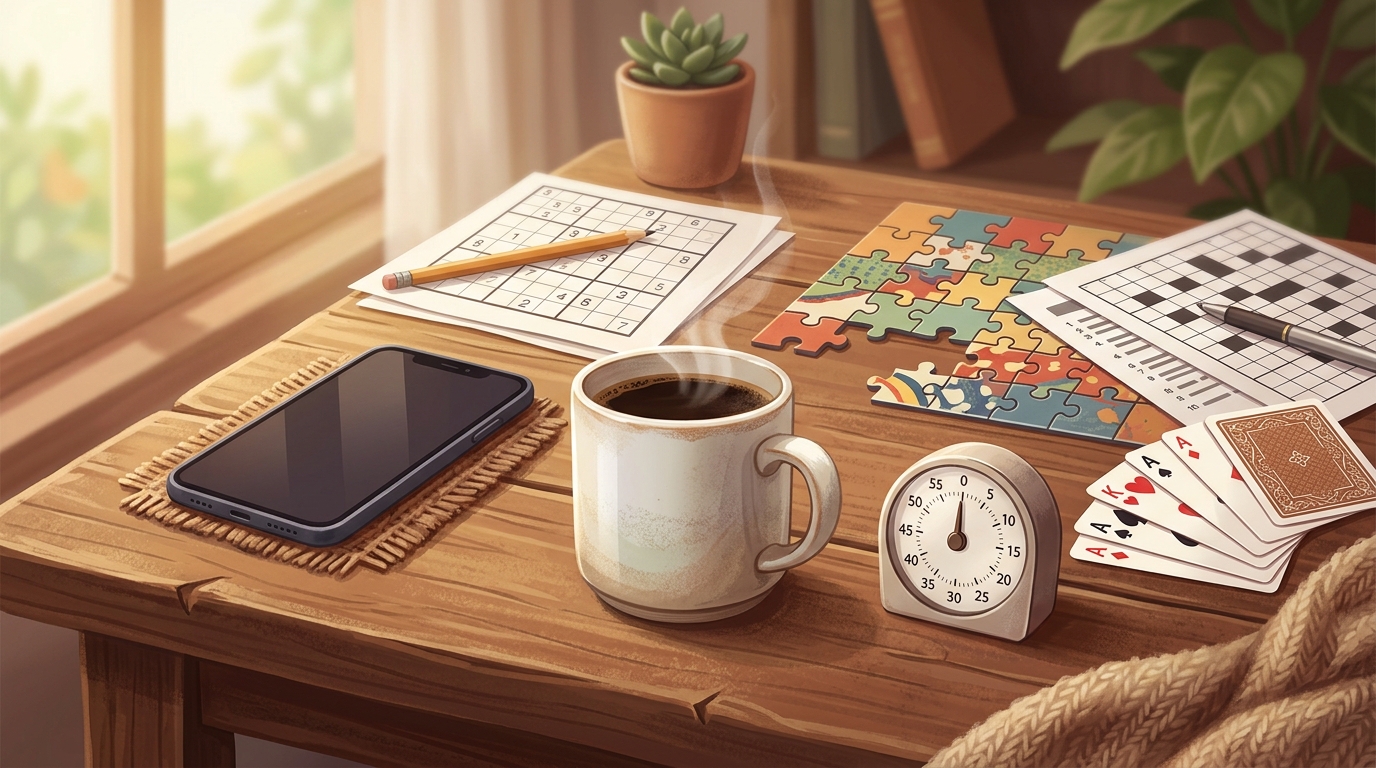
Pick the puzzle by the kind of tired you are
If your brain feels foggy, try sudoku. A clean grid can be oddly comforting because the rules do not move around. You do not need trivia. You do not need speed. You only need to scan, place, check, and repeat. Browse sudoku practice on Easy Daily Puzzle when you want a break that feels orderly.
If your brain feels bored, try a crossword. Crossword clues wake up the language part of the mind. A short clue can be literal, playful, sneaky, or annoyingly simple. That tiny uncertainty keeps the break alive. Browse crossword games and clues on Easy Daily Puzzle when you want words instead of numbers.
If your eyes are tired of text, try a jigsaw puzzle. You can stop reading and start seeing. Sort blue pieces, edge pieces, shadow pieces, corner pieces. The Strong National Museum of Play traces jigsaw puzzles back to cut maps used for learning geography, which makes sense. Even now, the pleasure is still partly about watching a picture become less lost.
If you want a tougher card break, choose spider solitaire. It asks for more patience than classic solitaire because empty columns and suit runs matter so much. That can be a good thing if you want ten minutes that actually catches your attention.
A 10 minute puzzle break should have a stopping point
The problem with many breaks is that they do not end. A puzzle break needs a small exit door.
Try this:
- For sudoku, stop after filling one box or after finding five confirmed numbers.
- For crossword, stop after solving one corner or after getting five across clues.
- For jigsaw, stop after finishing the edge or one color group.
- For solitaire, stop after one deal, win or lose.
- For spider solitaire, stop after one serious attempt, not after five angry restarts.
That last part matters. A puzzle break turns sour when it becomes a little argument with the screen.
If you lose a solitaire deal, fine. If a crossword clue refuses to open, fine. If a sudoku grid stalls, leave it there and come back later. The break has already done its job if your attention had one clean place to land.
Make the break feel like a ritual, not homework
The best 10 minute puzzle break has almost no ceremony. Same chair. Same cup of coffee. One browser tab. Maybe a timer if you are the kind of person who needs one, but do not make the timer the boss.
Start with the puzzle that matches your mood, not the puzzle you think you should play.
On a low-energy day, a jigsaw may be better than sudoku. On a restless day, a mini crossword may be better than solitaire. On a day full of scattered tasks, classic solitaire may be exactly right because it gives you a board that can be cleaned up one card at a time.
There is no prize for choosing the most impressive puzzle.
The better question is: which one gives you back your next ten minutes?
A small test for tomorrow
Tomorrow, before opening social media during a break, try one puzzle first. Do not announce it. Do not track it. Just play.
Pick a sudoku grid if you want order. Pick a crossword if you want a quick language spark. Pick a jigsaw if you want something visual. Pick solitaire if you want a familiar card table. Pick spider solitaire if you want a little more bite.
Then notice how you feel when the ten minutes are over. Not in a grand way. Just honestly. Is your head a little quieter? Did the next task feel easier to enter? Did the break actually end?
That is enough information for one day.
If it worked, keep the habit. If it did not, try a different puzzle tomorrow. The whole point of a 10 minute puzzle break is that it is small enough to experiment with, and useful enough to keep around.